Mid-Engine vs. Front-Engine Sports Car Physics: Weight Distribution, Polar Moment of Inertia & Corner-Entry Dynamics
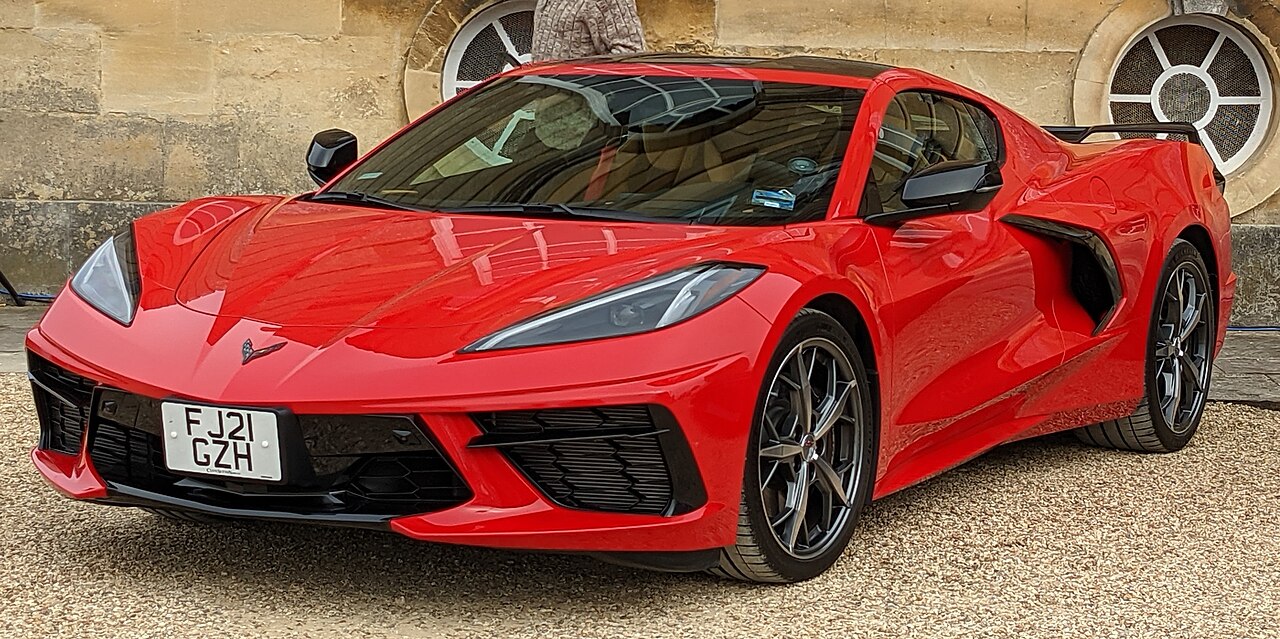
Why Corvette switched to mid-engine: Polar moment of inertia, 40/60 rear-biased weight distribution, braking pitch control, and apex yaw rotation.
Car Data Index Technical Staff
Automotive data desk · Sources: NHTSA · EPA · OEM records
The Physics of Speed: Newtonian Dynamics on the Racetrack
For over sixty years, American performance automotive engineering celebrated the traditional front-engine, rear-wheel-drive sports car formula: a thunderous pushrod V8 mounted ahead of the passenger compartment, a rigid torque tube running down the center tunnel, and a heavy transaxle spinning the rear tires. From the 1953 original through the 755-horsepower 2019 C7 ZR1, the Chevrolet Corvette proved that this layout could dominate endurance racing at the 24 Hours of Le Mans.
Yet by the late 2010s, Corvette chassis development engineers faced an immutable physical wall: the limitations of classic Newtonian vehicle dynamics.
Despite equipping the C7 Z06 with track-compound Michelin Pilot Sport Cup 2 tires measuring a massive 335 millimeters in width, the front-engine chassis could not put 650 horsepower to the ground from a dead stop. Accelerating from 0 to 60 mph took 3.0 seconds, and no amount of horsepower could bridge the gap to European mid-engine supercars like the Ferrari 488, McLaren 720S, or Porsche 911 GT3.
The solution was not more horsepower; it was a fundamental reconfiguration of vehicle physics: the mid-engine revolution of the C8 Corvette.
To understand why this architectural transition completely changed modern sports car engineering, we must analyze the mathematics of polar moment of inertia, longitudinal load transfer, and corner-entry yaw acceleration.
Explore our related technical guides on Track Performance Coupes: Mustang GT vs. GT-R vs. BMW M4 and Drivetrain Layouts: AWD, 4WD, FWD, and RWD Compared.
Technical Specifications: Front-Engine (C7) vs. Mid-Engine (C8) Dynamics
| Engineering Metric | Chevrolet Corvette C7 Stingray (Z51) | Chevrolet Corvette C8 Stingray (Z51) | Ferrari 296 GTB (Benchmark Mid-Engine) |
|---|---|---|---|
| Powertrain Placement | Front-Mid Longitudinal (Ahead of Cabin) | Rear-Mid Longitudinal (Behind Cabin) | Rear-Mid Longitudinal (Behind Cabin) |
| Engine Architecture | 6.2L Naturally Aspirated V8 (LT1) | 6.2L Naturally Aspirated V8 (LT2) | 3.0L Twin-Turbo 120° V6 + E-Motor |
| Horsepower & Torque | 460 hp @ 6,000 / 465 lb-ft @ 4,600 | 495 hp @ 6,450 / 470 lb-ft @ 5,150 | 819 hp @ 8,000 / 546 lb-ft @ 6,250 |
| Transmission Type | 7-Speed Manual / 8-Speed Automatic | 8-Speed Dual-Clutch (Tremec DCT) | 8-Speed Dual-Clutch (F1 DCT) |
| Static Weight Distribution | 50% Front / 50% Rear | 39.9% Front / 60.1% Rear | 40.5% Front / 59.5% Rear |
| Curb Weight | 3,298 lbs (1,496 kg) | 3,366 lbs (1,527 kg) | 3,241 lbs (1,470 kg) |
| Polar Moment of Inertia (Iz) | ~2,350 kg·m² (Moderate) | ~1,880 kg·m² (-20% Lower) | ~1,790 kg·m² |
| 0-60 mph Launch Time | 3.7 seconds | 2.9 seconds (-0.8s Faster!) | 2.4 seconds |
| Quarter-Mile Performance | 12.0 sec @ 119 mph | 11.2 sec @ 121 mph | 9.7 sec @ 150 mph |
| 60-0 mph Braking Distance | 100 feet (30.5 m) | 95 feet (28.9 m) | 93 feet (28.3 m) |
| Max Lateral Skidpad Grip | 1.03 g | 1.04 g | 1.09 g |
| Braking Dynamic Load Split | 75% Front / 25% Rear | 52% Front / 48% Rear (Optimized) | 51% Front / 49% Rear |
1. Polar Moment of Inertia ($I_z$): The Ice Skater Physics
In classical rotational mechanics, an object's resistance to angular acceleration about its vertical (yaw) axis is defined by its polar moment of inertia ($I_z$):
Polar Moment of Inertia Equation:
Iz = ? (mi · ri²)
* Where mi represents component mass and ri represents distance from the vehicle Center of Gravity.
Where $m_i$ represents the mass of individual vehicle components and $r_i$ represents their distance from the vehicle's center of gravity (CG).
Rotational Inertia Analogy: Dumbbell vs. Figure Skater:
* Front-Engine Dumbbell Layout (C7): Heavy engine in front, heavy transaxle in rear. Masses located far from center create high rotational resistance; turn-in is stable but directional yaw transitions require high lateral tire force.
* Mid-Engine Concentrated Layout (C8): Engine, transmission, and fuel tank clustered tightly between the axles near the Center of Gravity. Polar moment drops by ~20%, allowing the chassis to rotate into corners instantaneously.
The Dumbbell vs. The Figure Skater
Imagine holding a 20-pound iron dumbbell in each outstretched hand and attempting to spin around on your heels: the high radius ($r$) creates immense resistance to starting the rotation, and once spinning, immense resistance to stopping. This is the front-engine layout: the heavy internal combustion engine sits over the front axle, while the transmission, differential, and fuel tank sit over the rear axle.
In a mid-engine sports car, the engine block, crankshaft, cylinder heads, dual-clutch transmission, and exhaust manifolds are tightly packaged directly behind the driver's shoulders, inches away from the vehicle's Center of Gravity. Because distance $r$ is minimized, and because $r$ is squared in the inertia formula, reducing the distance cuts rotational resistance exponentially.
When the driver snaps the steering wheel into a 90-degree apex:
- The front-engine car must fight the heavy inertia of the front-mounted engine resisting angular acceleration.
- The mid-engine car rotates around its vertical yaw axis with razor-sharp immediacy, eliminating corner-entry understeer and requiring less steering angle to hit the apex clipping point.
2. Dynamic Weight Transfer: Breaking the 3-Second Launch Barrier
The decisive performance advantage of the mid-engine layout surfaces during full-throttle acceleration:
Dynamic Launch Weight Transfer (Under 1.2G Acceleration):
* Front-Engine C7: 50% static rear weight transfers to ~68% rear load under launch.
* Mid-Engine C8: 60% static rear weight transfers to ~76% rear load (over 2,550 lbs!) directly onto the rear drive tires, breaking the 3.0-second barrier with zero wheelspin.
Under Coulomb friction laws, maximum tractive tire thrust ($F_x$) is governed by:
Tractive Friction Limit Equation:
Fx = ? · FN
*(Where ? is the tire friction coefficient and FN is dynamic normal tire load acting directly on the road patch.)*
Where $mu$ is the friction coefficient of the tire compound, and $F_N$ is the normal downforce pressing the tire contact patch into the asphalt.
When a vehicle launches, longitudinal acceleration transfers weight from the front axle to the rear axle:
Longitudinal Dynamic Weight Transfer Equation:
?W = (m · a · hCG) / L
*(Where m is vehicle mass, a is acceleration, hCG is center of gravity height, and L is wheelbase length.)*
- Because the C7 Corvette started with a 50/50 static distribution, dynamic weight transfer under launch pushed roughly 68% of vehicle mass onto the rear tires. Beyond 460 horsepower, the rear tires broke traction, forcing launch control software to cut engine torque to prevent wheelspin.
- The C8 Corvette starts with a 40% front / 60% rear static distribution. Under launch acceleration, dynamic load transfer shifts nearly 76% of the vehicle's 3,366-pound mass (over 2,550 lbs!) directly onto the rear drive tires.
With 2,550 pounds of normal load pinning the 305-width Michelin tires into the pavement, the C8 Corvette dead-hooks with zero wheelspin, rocketing from 0 to 60 mph in 2.9 seconds using a naturally aspirated 495-hp engine. For a front-engine car to match that 2.9-second launch, it requires all-wheel-drive or drag-radial slicks on a prepped track surface.
3. Threshold Braking & Pitch Control: The 4-Wheel Advantage
Automotive enthusiasts frequently overlook that a mid-engine layout delivers equal or greater performance dividends under threshold braking as it does under acceleration:
Braking Dynamic Load Redistribution Under 1.2G Deceleration:
* Front-Engine C7: Forward pitch pushes ~75% of vehicle load onto front tires. Front brakes do 80% of stopping work; rear tires contribute minimal deceleration.
* Mid-Engine C8: Forward pitch balances the static 40/60 split into a near-perfect 52/48 dynamic balance, allowing all four tires and brakes to work at maximum stopping efficiency.
When a sports car brakes violently from 140 mph down to 40 mph for a hairpin corner, vehicle mass pitches forward onto the front suspension:
- In a front-engine car, forward pitch overloads the front tires. The front brake rotors reach scorching temperatures (exceeding 650°C), while the unweighted rear tires risk locking up or triggering anti-lock braking (ABS) intervention. The front tires are asked to do 80% of the vehicle's total stopping work.
- In a mid-engine car, because 60% of static mass rests over the rear axle, violent forward pitch shifts the load into a near-perfect 52/48 dynamic balance.
The rear tires remain firmly planted on the ground, allowing rear brake calipers and rotors to apply massive clamping force without locking up. Deceleration work is distributed evenly across all four tires, slashing 60-0 mph stopping distances down to 95 feet while preserving front tire grip for corner turn-in.
4. Trail-Braking & Apex Rotation: The Edge of Adhesion
The ultimate discriminator of lap time between professional drivers is trail-braking—the technique of carrying braking pressure past the corner entry point deep toward the apex while simultaneously initiating steering rotation:
- In a Front-Engine Car: Trail-braking is forgiving. If the rear tires step out, the long polar moment acts as a physical damper, slowing the car's yaw rotation and allowing the driver ample time to apply opposite lock. However, aggressive trail-braking easily overwhelms the front tires, creating push understeer that scrubs corner-entry speed.
- In a Mid-Engine Car: The low polar moment allows the driver to trail-brake lightly to pin the front tires, inducing controlled, effortless yaw rotation toward the apex. The car pivots around the driver's hips like a compass needle.
The Hazard: Snap Oversteer
However, this agility comes with a physical consequence: snap oversteer (the pendulum effect). Because the heavy engine rests behind the Center of Gravity, if a driver abruptly lifts off the throttle mid-corner (inducing trailing-throttle oversteer) and exceeds the rear tires' slip-angle limit, the rear mass acts as a pendulum. The chassis rotates violently and suddenly; without immediate, lightning-fast counter-steering, the vehicle will spin 180 degrees.
Modern chassis engineering (such as Chevrolet's eLSD and Performance Traction Management 4.0) utilizes millisecond-fast electronic limited-slip differential torque vectoring and magnetic dampers to tame this behavior, giving amateur drivers supercar lap times without snap-spin penalties.
Summary & Track Verdict
- Choose a Front-Engine Sports Car (e.g., Corvette C7, Ford Mustang Dark Horse, BMW M4) if you value progressive, predictable drift angles, effortless oversteer recovery, front-engine V8 sound resonance, and everyday usability with a cavernous rear hatchback trunk.
- Choose a Mid-Engine Sports Car (e.g., Corvette C8, Porsche Cayman GT4, Ferrari F8) if your primary objective is absolute lap time dominance, sub-3.0-second launch traction, telepathic corner-entry turn-in, and balanced 4-wheel threshold braking.
Explore our related analyses on Carbon Ceramic vs. Floating Steel Brakes and Transmission Types Compared: Dual-Clutch vs. Automatic.
Frequently asked questions
Why did Chevrolet switch the Corvette from front-engine to mid-engine in the C8 generation?
Corvette chief engineers reached the physical traction ceiling of the front-engine layout with the 650-hp C7 Z06 and 755-hp ZR1. Even with sticky 335-width rear tires, front-engine cars cannot transfer enough dynamic load to the rear axle under launch to break the 3.0-second 0-60 mph barrier. Moving the engine behind the driver placed 60% of vehicle mass over the rear drive tires, slashing 0-60 times to 2.9 seconds with just 495 horsepower.
What is polar moment of inertia, and how does it affect sports car handling?
Polar moment of inertia is a measure of an object's resistance to rotational acceleration around a central axis ($I = \Sigma m \cdot r^2$). Think of a figure skater spinning: holding their arms inward concentrates mass near the axis, speeding up rotation. A mid-engine car clusters the heavy engine, transmission, and fuel tank near the vehicle's center, allowing the chassis to change direction instantly at the apex with minimal steering input.
Is a mid-engine car harder to drive fast than a front-engine sports car?
Yes, near the absolute limits of tire adhesion. In a front-engine car, the high polar moment acts as a stabilizing damper, making slides predictable and progressive. In a mid-engine car, once the rear tires lose grip (oversteer), the chassis rotates around its center much faster (snap oversteer), requiring immediate, precise counter-steering reflexes before the car spins.
Why do mid-engine cars brake better than front-engine cars?
Under hard threshold braking, vehicle mass shifts forward. In a front-engine car (which already starts with 52% to 60% front weight), braking pushes over 80% of vehicle weight onto the front tires, overwhelming the front brakes while the rear tires contribute little stopping power. A mid-engine car starts at 40/60, so under hard braking the load balances to roughly 50/50, allowing all four tires and brakes to work at maximum deceleration potential.
What are the everyday practical disadvantages of a mid-engine sports car?
Mid-engine packaging compromises interior ergonomics: passenger cabins sit further forward, restricting legroom and wheel arch clearance; luggage space is split between small front (frunk) and rear trunks; engine maintenance often requires removing body panels or dropping the subframe; and rearward visibility is severely restricted by the high engine cowl and cooling vents.
Cite this page: https://cardataindex.com/blog/mid-engine-vs-front-engine-sports-car-physics
Keep researching
Cross-check the numbers in this guide against live factory data in our specification index or decode a specific car with the free VIN decoder.