CVT vs. DCT vs. DSG vs. Automatic: Every Car Transmission Compared
Torque converter, dual-clutch, CVT or manual, how each gearbox works, how it feels to drive, and which one belongs in your next car.
Car Data Index Editorial
Automotive data desk · Sources: NHTSA · EPA · OEM records
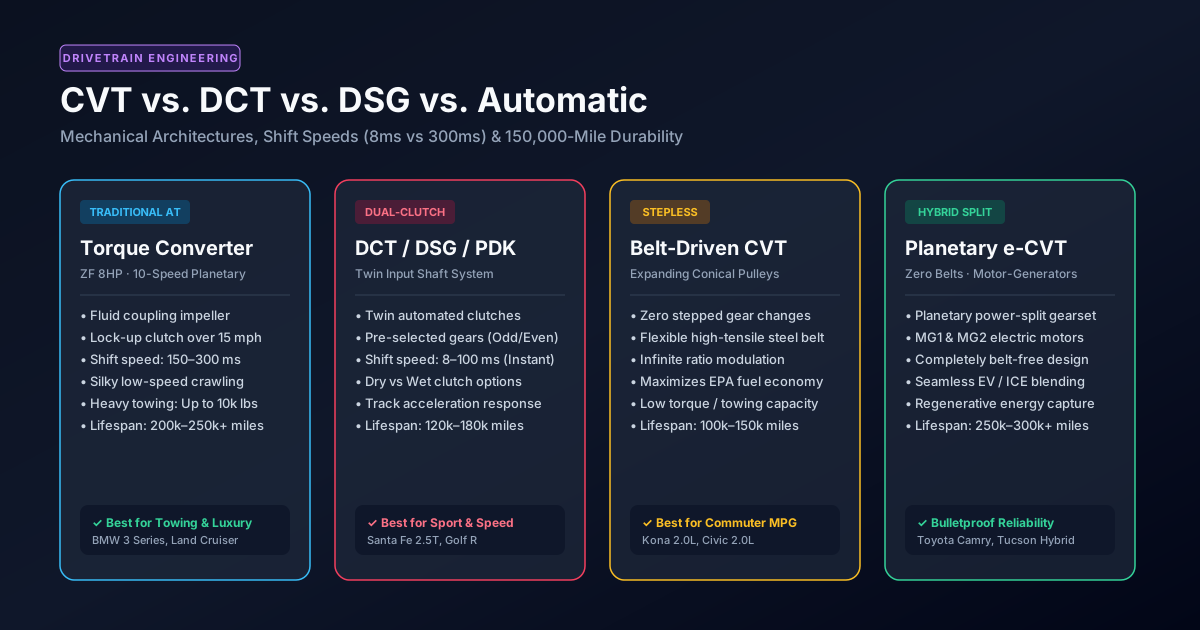
The automotive transmission (gearbox) is the critical mechanical bridge between an engine's crankshaft and the drive wheels. It modulates engine rotational speed and torque through varying gear ratios, allowing a vehicle to launch smoothly from a dead stop and cruise efficiently at 75 mph.
Today's market is dominated by four competing automated gearbox architectures:
- 1.Torque Converter Automatic (AT)
- 2.Dual-Clutch Transmission (DCT / DSG)
- 3.Continuously Variable Transmission (CVT)
- 4.Electronic Hybrid Planetary Gearbox (e-CVT)
Understanding the mechanical distinctions, real-world shift speeds, towing limits, and long-term 150,000-mile reliability risks of each gearbox will help you avoid costly transmission replacement bills.
To check the exact factory transmission code, gear count, and drivetrain on any pre-owned vehicle, enter its 17-digit code into our free NHTSA VIN decoder tool.
1. Transmission Architecture Comparison Matrix
Here is how all four primary automated gearbox technologies compare across mechanical design, performance metrics, and ownership lifespans:
| Engineering Parameter | Torque Converter Automatic | Dual-Clutch (DCT / DSG) | Continuously Variable (CVT) | Hybrid e-CVT (Planetary) |
|---|---|---|---|---|
| Core Mechanism | Hydraulic torque converter + planetary gear sets | Twin input shafts + dual clutch packs (Wet or Dry) | Two expanding conical pulleys + steel push belt | Planetary gear power-split device + dual electric motors |
| Shift Speed | 150 to 300 ms (Fast & cushioned) | 8 to 100 ms (Instantaneous) | Continuous (Zero shift steps) | Seamless variable electrical blend |
| Low-Speed Crawling | Silky smooth (Fluid coupling) | Can shudder / hesitate in stop-and-go | Smooth, but delayed throttle response | Instant, whisper-quiet electric creep |
| Torque & Towing Capacity | Exceptional (Up to 10,000+ lbs) | High on wet clutch (Up to 4,500 lbs) | Very limited (Under 1,500 lbs) | Moderate (Up to 3,500 lbs) |
| Typical Durability | 200,000+ miles | 120,000 – 180,000 miles | 100,000 – 150,000 miles | 250,000+ miles (Virtually bulletproof) |
| Notable Database Models | BMW 3 Series (ZF 8HP), Land Cruiser (10AT) | Hyundai Santa Fe 2.5T (8-Wet DCT), VW Golf | Hyundai Kona 2.0L (IVT), Honda Civic | Toyota Camry Hybrid, Tucson Hybrid |
2. CVT vs. DCT vs. DSG: What Is the Real Mechanical Difference?
Car buyers frequently ask about the distinctions between CVT, DCT, and DSG:
What Is a DSG?
DSG (Direktschaltgetriebe / Direct-Shift Gearbox) is simply the Volkswagen Group's trademarked brand name for its proprietary dual-clutch transmission. While Porsche calls its system PDK, and Hyundai calls its unit Smartstream Wet DCT, they all operate on the exact same core dual-clutch engineering principle.
How a Dual-Clutch (DCT/DSG) Works: Racetrack Shift Speed
A DCT functions like two separate manual gearboxes housed inside a single casing:
- Shaft 1 (Odd Gears): Controls 1st, 3rd, 5th, and 7th gears.
- Shaft 2 (Even Gears): Controls 2nd, 4th, 6th, and Reverse.
While accelerating hard in 2nd gear, the transmission computer has already mechanically engaged 3rd gear on the other shaft. When the shift command arrives, clutch two opens while clutch one closes simultaneously in under 15 milliseconds. Power delivery never drops, delivering exhilarating, uninterrupted acceleration.
How a Belt CVT Works: Stepless Ratio Modulation
A conventional CVT completely abandons toothed gears. It utilizes two pairs of cone-shaped pulleys connected by a high-tensile flexible steel belt:
- By moving the conical halves closer together or further apart hydraulically, the belt is forced to ride higher or lower on each pulley.
- This creates an infinite number of gear ratios between its minimum and maximum bounds.
- Rather than shifting through distinct gears, the CVT continuously adjusts the ratio to keep the engine in its optimal fuel efficiency zone.
To compare how these transmission choices impact real-world fuel economy across driving cycles, review our guide on city, highway, and combined MPG calculations.
3. Torque-Converter Automatics: The Undisputed Durability King
Modern 8-speed, 9-speed, and 10-speed torque converter automatics represent the pinnacle of mechanical refinement:
- The Torque Converter: Rather than a physical friction clutch that wears out over time, it utilizes a doughnut-shaped hydrodynamic fluid coupling. An engine-driven impeller splashes hydraulic fluid against an output turbine, multiplying torque during takeoff.
- Lock-Up Clutch: Once cruising above 15 mph, a mechanical lock-up clutch engages directly, eliminating fluid slip and matching the direct efficiency of a manual gearbox.
- Towing & Shock Absorption: The fluid cushion absorbs driveline shock loads that would shatter a dual-clutch pack or snap a CVT belt, making traditional automatics the only choice for heavy-duty trucks and rugged SUVs like the Toyota Land Cruiser.
- The Gold Standard: The ZF 8HP 8-speed automatic (found in the BMW 3 Series) is widely recognized by automotive engineers as the finest overall transmission ever mass-produced.
4. The Wet-Clutch vs. Dry-Clutch DCT Distinction
If you purchase a vehicle equipped with a dual-clutch transmission, you must verify whether it utilizes a dry clutch or a wet clutch:
- 1.Dry-Clutch DCT: Uses friction plates exposed to air. Found in older economy cars (such as early Ford PowerShift or VW 7-speed DSG units). In heavy stop-and-go city traffic, constant low-speed clutch slipping generates intense heat, leading to notorious shuddering, jerking, and premature clutch burnout.
- 2.Wet-Clutch DCT: Submerges the clutch friction discs in a bath of circulating hydraulic transmission fluid. The oil continuously cools the plates and lubricates the engagement. As demonstrated in our Hyundai SUV lineup comparison, the Hyundai Santa Fe 2.5T employs an 8-speed wet dual-clutch transmission capable of handling 311 lb-ft of torque and up to 4,500 lbs of towing with supreme refinement.
5. Toyota's Planetary e-CVT: Why It Never Breaks
A major point of confusion for hybrid buyers is the label e-CVT on vehicles like the Toyota Camry Hybrid.
Despite sharing the "CVT" moniker, Toyota's e-CVT shares zero parts with a belt-and-pulley CVT:
- It contains no belts, no cones, no friction clutches, and no hydraulic valve bodies.
- Instead, it consists of a single planetary gear set (power-split device) that mechanically links the gasoline engine to two electric motor-generators.
- By electronically varying the rotational speed and direction of the electric motors, the planetary gearset varies the vehicle's output speed seamlessly.
- Because it features virtually no wearing friction elements, Toyota e-CVT gearboxes regularly exceed 300,000 miles in taxi and rideshare fleets worldwide without overhaul.
6. Buyer's Decision Matrix: Which Transmission Fits Your Driving?
To make the right purchase decision, evaluate your driving profile against each transmission's mechanical strengths:
Choose a Torque Converter Automatic If:
- You tow travel trailers, boats, or heavy utility loads exceeding 3,000 lbs.
- You demand a vehicle that will easily surpass 200,000 miles with simple fluid change intervals.
- You commute through hilly terrain or heavy stop-and-go urban gridlock.
Choose a Dual-Clutch (DCT / DSG) If:
- You prioritize razor-sharp throttle response, manual paddle-shift control, and sporty driving dynamics.
- You want the fuel efficiency of a manual gearbox without operating a clutch pedal.
- Tip: Ensure the model utilizes a modern wet-clutch design.
Choose a Belt CVT If:
- You are buying an entry-level commuter car or subcompact crossover (Hyundai Kona).
- You prioritize the absolute lowest sticker acquisition price and maximum city gas mileage.
- You rarely tow and prefer smooth, step-free acceleration.
To explore how engine displacement and turbochargers interact with transmission gearing, read our technical breakdown on engine displacement and what liters mean.
Frequently asked questions
What is the difference between CVT, DCT, and DSG?
A CVT uses two conical pulleys and a steel belt to continuously vary gear ratios with zero step shifts. A DCT (Dual-Clutch Transmission) is an automated manual with two separate clutches for odd and even gears, executing instantaneous shifts (8–100 ms). DSG (Direct-Shift Gearbox) is Volkswagen Group's proprietary trademarked name for its dual-clutch transmission family.
Which is better for daily driving: CVT or Dual-Clutch (DSG)?
For suburban commuters who prioritize maximum fuel economy, smooth low-speed cruising, and zero shift points, a CVT is ideal. For drivers who enjoy spirited acceleration, instantaneous paddle shifts, and sports car responsiveness, a wet-clutch DCT/DSG is dramatically superior.
Do CVTs last as long as traditional automatic transmissions?
Historically, belt-driven CVTs have shorter service lifespans (typically 120,000 to 160,000 miles) and are sensitive to overheating, aggressive acceleration, and heavy towing. Modern torque-converter automatics (like 8-speed or 10-speed units) regularly exceed 200,000 to 250,000 miles with standard fluid maintenance.
What is the difference between a dry-clutch and wet-clutch DCT?
A dry-clutch DCT operates clutch friction plates in ambient air (like a manual gearbox), which can overheat and shudder in stop-and-go city traffic. A wet-clutch DCT (such as Hyundai's 8-speed N-DCT or high-output DSG units) submerges the clutch packs in circulating hydraulic oil, enabling much higher torque capacity, smoother low-speed slip, and superior cooling.
Why do CVTs make a loud droning noise during acceleration?
This characteristic is known as the 'rubber-band effect'. Because a CVT has no fixed gears, its electronic control unit commands the engine to immediately rev to its peak horsepower RPM (often 4,500 to 5,500 RPM) while the pulleys slowly expand to accelerate the car, resulting in a constant engine drone.
Cite this page: https://cardataindex.com/blog/transmission-types-compared-cvt-automatic-dsg
Keep researching
Cross-check the numbers in this guide against live factory data in our specification index or decode a specific car with the free VIN decoder.