Midsize Pickup Trucks: Toyota Tacoma vs. Ford Ranger vs. Chevy Colorado (Towing, Payload & Turbo-4 vs. Hybrid Reliability)
Engineering comparison of 2026 midsize trucks: Toyota Tacoma vs. Ford Ranger vs. Chevy Colorado. Compare towing, payload, turbo powertrains, frames, and durability.
Car Data Index Technical Staff
Automotive data desk · Sources: NHTSA · EPA · OEM records
The Modern Midsize Truck Revolution: Beyond Barebones Workhorses
For decades, the North American midsize pickup truck segment was defined by conservative engineering: naturally aspirated V6 engines, stiff leaf-spring rear suspensions, hydraulic power steering racks, and sparse utility interiors. Pickups were viewed as budget alternatives to full-size haulers like the Ford F-150 and Chevrolet Silverado.
Today, that paradigm has completely inverted. Midsize trucks have evolved into sophisticated, high-performance overland rigs and heavy-duty towing platforms priced from $35,000 to over $65,000. Under the hood, large naturally aspirated six-cylinders have been entirely replaced by high-boost turbocharged four-cylinders and electrified parallel hybrid powertrains.
At the center of this battle stand the three benchmark competitors in the global midsize arena:
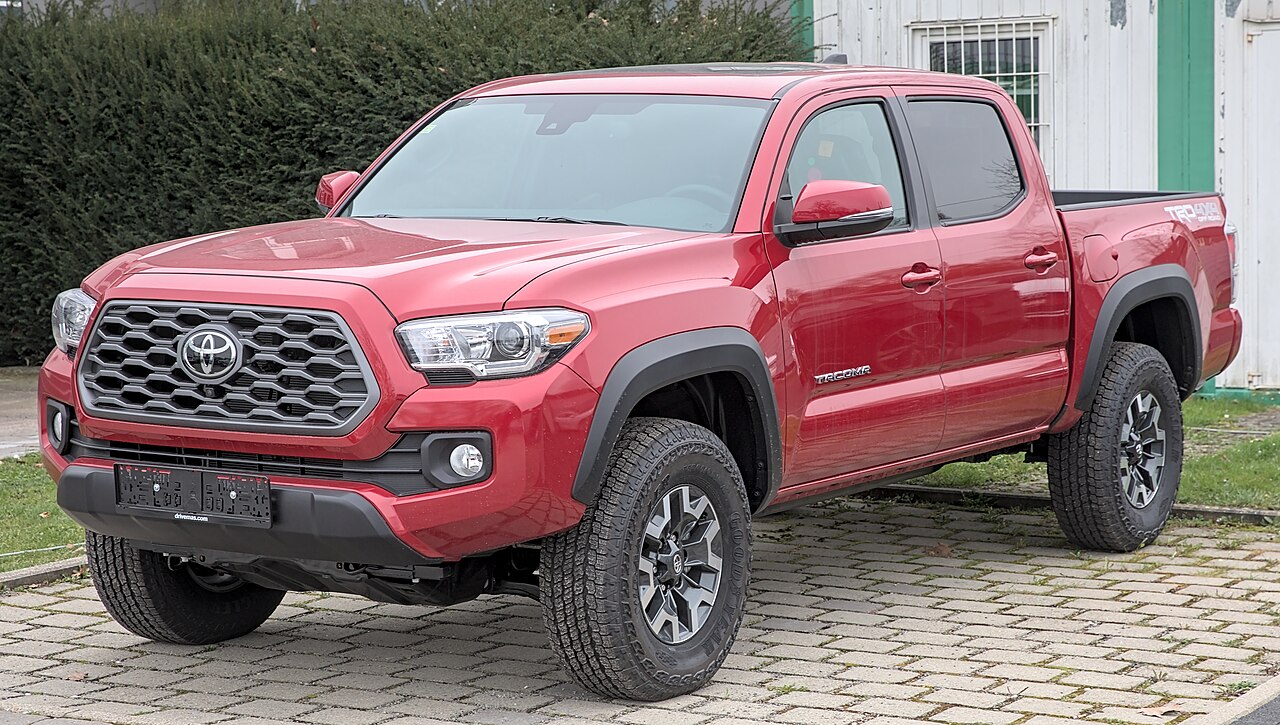
- 1.Toyota Tacoma (4th Gen - N400): Built on the ultra-rigid TNGA-F global truck platform, featuring an optional multi-link rear coil suspension, composite bed, and the benchmark 326-hp i-FORCE MAX hybrid.
- 2.Ford Ranger (5th Gen - T6.2): Engineered on Ford's global T6.2 architecture with widened track widths, outboard-mounted shocks, robust 10-speed automatic, and proven EcoBoost power.
- 3.Chevrolet Colorado (3rd Gen): A ground-up redesign utilizing GM's heavy-duty 2.7L TurboMax commercial engine, achieving class-leading 7,700-pound towing ratings.
Deciding between these three trucks requires analyzing frame torsional rigidity, powertrain thermal endurance under prolonged towing, suspension geometry over severe terrain, and real-world payload capacity.
Explore our technical guides on Full-Size Pickup Trucks Compared: F-150 vs. Silverado vs. Ram 1500 and Truck Bed Materials: Steel vs. Aluminum vs. SMC Composite.
Technical Specifications & Capability Matrix
| Engineering Metric | Toyota Tacoma TRD Off-Road (N400) | Ford Ranger XLT / Lariat (T6.2) | Chevrolet Colorado Z71 (3rd Gen) |
|---|---|---|---|
| Chassis Platform | Modular TNGA-F Boxed Steel Frame | Global T6.2 Boxed Steel Ladder Frame | GMT31XX-2 Fully Boxed Steel Frame |
| Standard Engine | 2.4L i-FORCE Turbo I4 (T24A-FTS) | 2.3L EcoBoost Turbocharged I4 | 2.7L TurboMax Turbocharged I4 (L3B) |
| Optional Powertrain | 2.4L i-FORCE MAX Parallel Hybrid | 2.7L Nano Twin-Turbo V6 | None (Standard across entire lineup) |
| Horsepower | 278 hp @ 6,000 RPM (Hybrid: 326 hp) | 270 hp @ 5,500 RPM (2.7L: 315 hp) | 310 hp @ 5,600 RPM |
| Peak Torque | 317 lb-ft @ 1,700 (Hybrid: 465 lb-ft) | 310 lb-ft @ 3,000 (2.7L: 400 lb-ft) | 430 lb-ft @ 1,900 RPM |
| Transmission | 8-Speed Automatic (Direct Shift) / 6MT | 10-Speed Automatic (SelectShift) | 8-Speed Automatic (8L90 Gen 2) |
| Transfer Case | Part-Time 2-Speed (Full-Time on Limited) | Part-Time 2-Speed / Electronic Shift | Autotrac 2-Speed Automatic 4WD |
| Rear Suspension | 5-Link Coil Springs (Leaf on SR/PreRunner) | Parabolic Multi-Leaf Springs with Outboard Shocks | Two-Stage Multi-Leaf Springs |
| Front Suspension | High-Mount Independent Double Wishbone | Independent Double Wishbone with Stabilizer Bar | Independent Double Wishbone Coil-Over |
| Max Towing Capacity | 6,500 lbs (2,948 kg) | 7,500 lbs (3,402 kg) | 7,700 lbs (3,493 kg) |
| Max Payload Capacity | 1,705 lbs (773 kg) | 1,805 lbs (819 kg) | 1,684 lbs (764 kg) |
| Truck Bed Material | Sheet-Molded Composite (SMC) | High-Strength Stamped Steel | Roll-Formed High-Strength Steel |
| Rear Axle Locker | Electronic Push-Button (Standard TRD) | Electronic Locking Differential | Eaton G80 Automatic / Electronic Locker |
| EPA Fuel Economy (Comb) | 23 MPG (Gas) / 24 MPG (Hybrid) | 22 MPG (2.3L 4WD) | 19 MPG (4WD) |
Powertrain Architecture: Heavy-Duty Turbo-4 vs. Hybrid Electrification
The defining mechanical evolution of modern midsize trucks is the total abandonment of naturally aspirated V6 powerplants in favor of forced induction:
Midsize Truck Powertrain Architecture Comparison:
* Toyota i-FORCE MAX: 2.4L Turbo I4 + 48-hp Integrated Bellhousing Electric Motor ? 326 hp / 465 lb-ft torque @ 1,700 RPM
* Chevrolet TurboMax: 2.7L High-Stroke Commercial Turbo I4 ? 310 hp / 430 lb-ft torque @ 1,900 RPM
* Ford EcoBoost: 2.3L Twin-Scroll Turbo I4 ? 270 hp / 310 lb-ft torque (Optional 2.7L Twin-Turbo V6: 315 hp / 400 lb-ft)
1. Toyota 2.4L i-FORCE & i-FORCE MAX Hybrid (T24A-FTS)
Toyota's Dynamic Force architecture utilizes a 2,393 cc turbocharged inline-4 featuring dual VVT-i (electronically controlled on intake), high-pressure D-4ST direct and port fuel injection, and a twin-scroll turbocharger spooling at low engine RPM.
In the flagship i-FORCE MAX, Toyota sandwiches a permanent-magnet synchronous electric motor (48 hp / 184 lb-ft) directly between the engine flywheel and the 8-speed automatic transmission. Fed by a 1.87-kWh nickel-metal hydride (NiMH) battery pack mounted beneath the rear seats, the system develops 326 horsepower and an astounding 465 lb-ft of torque at just 1,700 RPM.
Because the electric motor delivers maximum torque at 0 RPM, turbo lag is completely masked off the line, providing instantaneous low-speed rock-crawling modulation and immediate passing power without downshifting three gears.
2. Chevrolet 2.7L TurboMax (L3B)
Rather than downsizing a passenger-car engine, General Motors engineered the 2.7L TurboMax specifically for commercial truck duty in the full-size Silverado 1500 before transplanting it into the Colorado.
The engine features a forged steel crankshaft, forged connecting rods, an ultra-stiff deep-skirt cast-iron cylinder sleeve structure inside an aluminum block, and an active thermal management system. Equipped with an innovative dual-volute turbocharger housing and tri-power sliding camshaft technology, the TurboMax generates 310 horsepower and 430 lb-ft of torque.
The engine reaches 90% of its maximum torque at just 1,500 RPM, delivering diesel-like pulling characteristics without the expensive urea emissions systems (DEF) or high fuel costs associated with light-duty diesels.
3. Ford 2.3L EcoBoost & 2.7L Nano V6
Ford relies on its proven 2.3L EcoBoost inline-4 as standard equipment, generating 270 hp and 310 lb-ft of torque paired with a 10-speed SelectShift automatic transmission. The engine utilizes an aluminum block, direct injection, and a twin-scroll turbocharger.
For buyers seeking extreme speed, the Ranger offers an optional 2.7L twin-turbocharged Nano EcoBoost V6 producing 315 hp and 400 lb-ft of torque (and up to 405 hp in the Ranger Raptor). The 10-speed automatic provides narrow gear ratio steps, ensuring the engine remains locked inside its optimal thermodynamic efficiency window during sustained highway towing.
Chassis Rigidity & Frame Construction
A pickup truck's capacity to carry payload, resist frame twist on crossed-axle terrain, and tow heavy trailers without hitch oscillation is dictated by frame metallurgy:
Toyota TNGA-F Fully Boxed Architecture
The 4th-generation Tacoma ditched the open-C rear frame channel of previous generations in favor of a 100% fully boxed ladder frame manufactured from high-strength steel with laser-welded blank technology. By increasing steel gauge at high-stress suspension mounting nodes while optimizing thickness elsewhere, Toyota achieved a 30% increase in torsional rigidity. This rigid backbone allowed engineers to soften spring rates for improved ride compliance without sacrificing payload stability.
Ford T6.2 Hydroformed Ladder Frame
Ford redesigned the T6 frame by pushing the front wheels 2.0 inches (50 mm) forward and widening the vehicle track by 2.0 inches. This allowed Ford engineers to mount the rear shock absorbers outboard of the frame rails rather than inboard. Outboard-mounted dampers have a significantly longer mechanical lever arm relative to the axle center, drastically improving lateral wheel control, reducing bed chatter over corrugated gravel roads, and enhancing towing stability under crosswinds.
Chevy GMT31XX-2 Fully Boxed Hydroformed Frame
Chevrolet utilized heavy-gauge hydroformed side rails with fully boxed crossmembers throughout the entire wheelbase. The Colorado features an elongated 131.4-inch wheelbase that distributes tongue loads evenly across both front and rear axles, directly contributing to its class-topping 7,700-pound maximum towing certification.
Suspension Dynamics: Leaf Springs vs. Multi-Link Coils
The most noticeable mechanical divergence when driving these trucks unladen is the rear suspension layout:
Rear Suspension Kinematics: Leaf Springs vs. 5-Link Coils:
* Traditional Leaf Springs (Ranger & Colorado): Exceptional high-load overload capacity and progressive roll stiffness under heavy tongue weights; firmer unladen ride and potential axle wrap under sudden torque spikes.
* 5-Link Coil Springs (Tacoma N400): Isolates wheel location via trailing arms and Panhard rod from load-bearing coils; completely eliminates axle wrap and delivers supple, passenger-car-like highway ride comfort.
1. Toyota Tacoma 5-Link Rear Coil Suspension: By separating the wheel location duties (handled by 4 longitudinal trailing arms and 1 lateral Panhard rod) from load-bearing duties (handled by linear-rate coil springs), the Tacoma eliminates axle wrap—the rotational twisting of the rear axle housing under sudden torque spikes that causes violent wheel hop in deep mud or sand. On tarmac, the Tacoma handles corners with passenger-car precision, eliminating the tail-wagging jitter common to empty pickup beds.
2. Ford Ranger & Chevy Colorado Multi-Leaf Springs: Ford and Chevy retain progressive-rate steel leaf springs. While leaf springs produce a firmer unladen ride over expansion joints, they possess exceptional structural simplicity and inherent resistance to high tongue weights. When carrying 1,500 pounds of gravel or towing near maximum capacity, leaf springs provide progressive roll stiffness that resists bottoming out against the frame bump stops.
Truck Bed Engineering: Composite vs. Steel
The cargo box represents the hardest-working surface on any truck:
* Toyota Tacoma Sheet-Molded Composite (SMC): Toyota remains the only manufacturer in the midsize class utilizing a full fiber-reinforced composite inner bed. The bed will never rust, peel, or corrode from winter road salts or spilled chemicals. It can absorb high-energy impact from dropped boulders without permanent denting or fracturing. * Ford Ranger & Chevrolet Colorado Stamped Steel: Both Ford and Chevy utilize high-strength stamped and roll-formed steel beds. Steel provides high point-load puncture resistance against sharp metal edges, but steel requires a protective spray-in bedliner to prevent paint abrasion and subsequent red-rust oxidation.
Read our complete breakdown in Truck Bed Materials & Corrosion: High-Strength Steel vs. Military-Grade Aluminum vs. Sheet-Molded Composite (SMC).
Real-World Towing & Payload Realities
While manufacturer marketing highlights peak towing numbers, real-world utility is frequently constrained by Gross Vehicle Weight Rating (GVWR) and payload math:
Key Formula:
Available Cargo Payload = GVWR ? (Curb Weight + Trailer Tongue Weight)
When towing a 6,000-pound travel trailer, the trailer tongue weight represents 10% to 15% of total trailer mass (600 to 900 lbs) placed directly onto the truck's rear hitch receiver:
- 1.Chevy Colorado (7,700 lbs Towing / 1,684 lbs Payload): With 750 lbs of tongue weight deducted from a 1,684-lb payload, 934 lbs remain for four adult passengers and camping gear in the bed, making it the most versatile towing platform in the class.
- 2.Ford Ranger (7,500 lbs Towing / 1,805 lbs Payload): The Ranger's class-leading payload provides exceptional safety margin when hauling heavy equipment in the bed while towing a tandem-axle utility trailer.
- 3.Toyota Tacoma (6,500 lbs Towing / 1,705 lbs Payload): While offering a lower tow rating, the Tacoma i-FORCE MAX hybrid's 465 lb-ft of torque allows it to climb 6% mountain grades at 65 mph with zero thermal throttling or transmission hunting.
Verdict: Matching the Truck to Your Mission Profile
- Choose the Toyota Tacoma if you prioritize legendary 10-year resale value, cutting-edge hybrid powertrain efficiency, an indestructible rust-proof composite bed, and supple unladen ride comfort delivered by rear coil springs.
- Choose the Chevrolet Colorado if your primary objective is heavy towing capacity (7,700 lbs), robust low-end torque from a commercial-grade 2.7L turbo engine, and a commanding driving stance.
- Choose the Ford Ranger if you need maximum payload capacity (1,805 lbs), a smooth 10-speed transmission, outboard shock stability, or the extreme high-speed desert capability of the Ranger Raptor.
Explore our technical comparisons on Drivetrains: AWD vs 4WD vs FWD vs RWD and All-Weather AWD Shootout.
Frequently asked questions
Which midsize truck can tow the most weight: Tacoma, Ranger, or Colorado?
The Chevrolet Colorado leads the midsize truck segment with a maximum SAE J2807-rated towing capacity of 7,700 lbs when equipped with the 2.7L TurboMax engine and factory towing package. The Ford Ranger follows at 7,500 lbs with its 2.3L EcoBoost, while the Toyota Tacoma achieves up to 6,500 lbs on gas trims (6,000 lbs on i-FORCE MAX hybrids).
Why did the 4th-generation Toyota Tacoma switch to rear coil spring suspension?
Toyota replaced traditional multi-leaf rear springs with a 5-link coil spring suspension on most Tacoma grades (SR5 and up) to eliminate axle wrap under heavy acceleration, improve rear-wheel articulation on rocky terrain, and deliver superior unladen ride comfort and directional stability over highway washboard surfaces.
Does the Toyota Tacoma have a metal or composite truck bed?
The Toyota Tacoma features an inner bed structure made entirely from Sheet-Molded Composite (SMC) fiber-reinforced polymer rather than steel or aluminum. This composite bed is 10% lighter than stamped steel, completely impervious to rust and road salt, and requires no aftermarket spray-in or drop-in bedliner.
How does the Chevy Colorado 2.7L TurboMax compare to Toyota's i-FORCE MAX hybrid?
Chevy's 2.7L TurboMax relies on a large single twin-scroll turbocharger producing 310 hp and 430 lb-ft of low-end torque at just 1,900 RPM via pure internal combustion. Toyota's i-FORCE MAX pairs a 2.4L turbo engine with a 48-hp electric motor integrated inside the 8-speed transmission bellhousing, producing a segment-leading 465 lb-ft of torque with instant electric throttle response and regenerative braking.
Which midsize truck holds its resale value best after 5 years?
The Toyota Tacoma has consistently held the highest 5-year residual value in the midsize truck category for two decades, frequently retaining over 68% to 74% of its original MSRP according to industry residual benchmarks, significantly outperforming domestic alternatives.
Cite this page: https://cardataindex.com/blog/midsize-pickup-trucks-tacoma-vs-ranger-vs-colorado
Keep researching
Cross-check the numbers in this guide against live factory data in our specification index or decode a specific car with the free VIN decoder.