Flagship 3-Row Luxury SUVs: BMW X7 vs. Mercedes GLS vs. Cadillac Escalade (Air Suspension, 48V Active Roll & V8 Power)
Executive 3-row comparison: BMW X7 precision chassis and B58/S68 engines vs. Mercedes-Benz GLS 450/580 comfort vs. Cadillac Escalade 6.2L V8 interior volume.
Technical Data Desk
Automotive data desk · Sources: NHTSA · EPA · OEM records
The modern full-size luxury three-row SUV represents the zenith of contemporary automotive engineering. These flagship leviathans must fulfill mutually contradictory mandates: deliver the whisper-quiet highway isolation and palatial appointments of a bespoke executive sedan, provide genuine three-row seating for seven adults, and conquer mountain passes or gravel trails without chassis wallow or brake fade.
Three titans dominate this lucrative ultra-luxury arena: the BMW X7 (G07), the Mercedes-Benz GLS-Class (X167), and the Cadillac Escalade (GMT1XX). While all three carry starting price tags between $80,000 and $115,000+, they approach the three-row brief from fundamentally divergent engineering philosophies.
BMW leverages its lightweight modular CLAR unibody architecture and precision chassis tuning to build the ultimate driver's three-row vehicle. Mercedes-Benz doubles down on serene air-sprung isolation, supple S-Class appointments, and cutting-edge active electrohydraulic suspension. Cadillac takes GM's heavy-duty truck heritage, independent rear suspension, and monumental upright styling to craft an opulent palace on wheels.
This definitive technical comparison audits chassis stiffness, suspension physics, powertrain efficiency, real-world third-row ergonomics, and 5-year ownership costs across all three contenders.
1. Architectural Foundation: Unibody Precision vs. Body-on-Frame Monument
The fundamental mechanical divide separating the European flagships from their American rival lies in chassis topology:
Structural Platform Hierarchy:
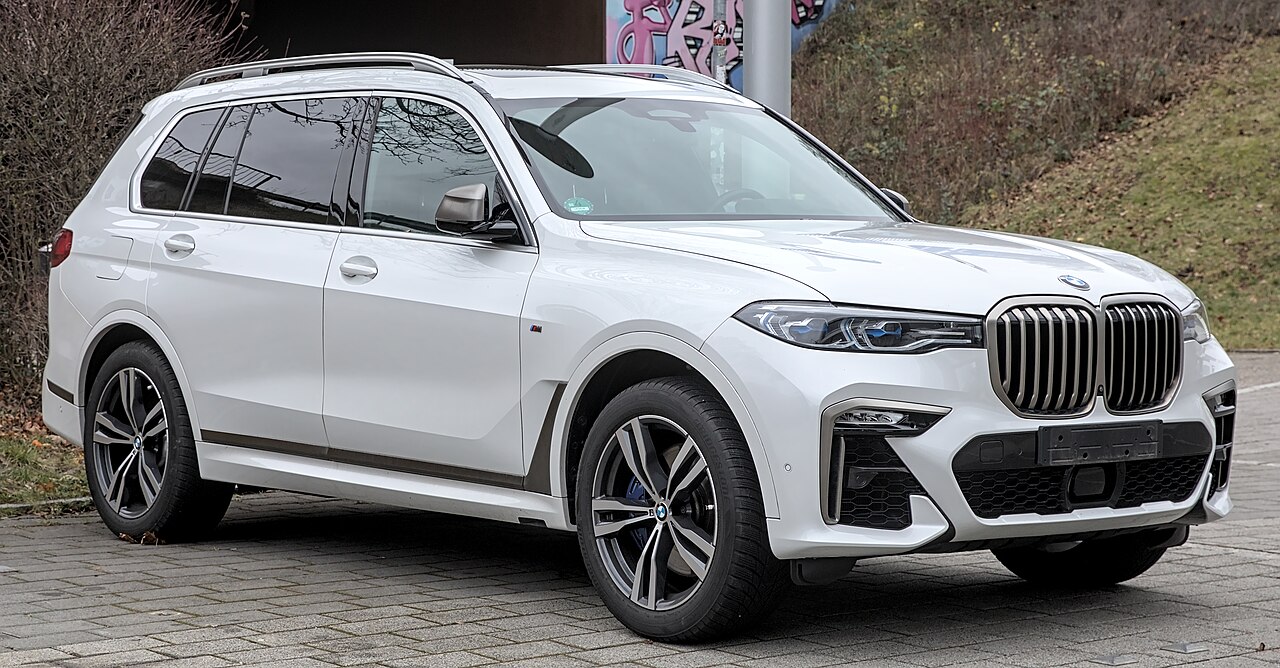
* BMW X7 (CLAR Architecture): High-rigidity steel-aluminum composite monocoque. Engine mounted longitudinally behind the front axle center line for optimal dynamic weight distribution. Torsional rigidity surpasses 30,000 Nm/degree.
* Mercedes-Benz GLS (MHA Platform): Modular High Architecture unibody sharing core structural geometry with the GLE. High-strength hydroformed floor pans and die-cast aluminum shock towers optimize NVH (Noise, Vibration, Harshness).
* Cadillac Escalade (GMT1XX Architecture): Fully boxed hydroformed high-strength steel ladder frame paired with a separate steel cabin structure. Employs a multi-link independent rear suspension (IRS) cradle with cast-aluminum control arms.
Structural Trade-offs & Dynamic Implications
The unibody construction of the BMW X7 and Mercedes GLS yields a significantly lower center of gravity (hCG) and reduced curb weight relative to overall physical footprint. The X7 xDrive40i tips the scales at 5,368 lbs (2,435 kg), while the Mercedes GLS 450 weighs 5,489 lbs (2,490 kg).
In contrast, the ladder-frame architecture of the Cadillac Escalade pushes base curb weight to 5,652 lbs (2,564 kg) for 2WD trims, swelling past 5,850 lbs (2,654 kg) for 4WD models. While the Escalade's boxed frame delivers indestructible off-road resilience and 8,200 lbs of towing capacity, high-frequency road vibrations transmit through the body mounts, producing subtle low-frequency chassis quiver that unibody structures naturally dampen.
| Architectural Metric | BMW X7 xDrive40i | Mercedes-Benz GLS 450 | Cadillac Escalade Premium Luxury |
|---|---|---|---|
| Chassis Platform | BMW CLAR (Unibody) | Mercedes MHA (Unibody) | GM GMT1XX (Body-on-Frame) |
| Overall Length (in / mm) | 203.2 in / 5,162 mm | 205.2 in / 5,212 mm | 211.9 in / 5,382 mm |
| Overall Width w/o Mirrors | 78.7 in / 2,000 mm | 77.0 in / 1,956 mm | 81.1 in / 2,060 mm |
| Overall Height | 71.6 in / 1,819 mm | 71.8 in / 1,823 mm | 76.7 in / 1,948 mm |
| Wheelbase | 122.2 in / 3,105 mm | 123.4 in / 3,135 mm | 120.9 in / 3,071 mm |
| Curb Weight (Base AWD/4WD) | 5,368 lbs / 2,435 kg | 5,489 lbs / 2,490 kg | 5,850 lbs / 2,654 kg |
| Torsional Stiffness | ~31,000 Nm/degree | ~29,500 Nm/degree | ~18,500 Nm/deg (Isolated body) |
| Max Towing Capacity | 7,500 lbs (3,402 kg) | 7,700 lbs (3,493 kg) | 8,200 lbs (3,719 kg) |
2. Suspension Physics: Two-Axle Air, E-Active Body Control & MagneRide
Managing the kinetic inertia of a 5,500+ lb vehicle traveling at 80 mph across broken pavement requires sophisticated active suspension technology. All three manufacturers reject traditional passive steel coil springs in favor of adaptive pneumatic and electromagnetic systems:
BMW X7: Two-Axle Air with Executive Drive Pro
The X7 features standard closed-loop 2-axle pneumatic air suspension paired with electronically controlled dynamic dampers (EDC). The air bellows operate at an internal system pressure of up to 18 bar (261 psi), managed by an onboard dual-piston electric compressor and reservoir tank.
BMW's dynamic party piece is the optional Executive Drive Pro system. Operating off a 48-volt vehicle electrical sub-grid, the system installs brushless electromechanical swivel motors in the center of the front and rear anti-roll sway bars:
Electromechanical Anti-Roll Operation:
* Straight-Line Cruising: The 48V central motors decouple the left and right sway bar halves completely. This eliminates single-wheel bump transfer across the axle, delivering an ultra-plush, decoupled glide over expansion joints.
* High-Speed Cornering: The motors generate up to 1,200 Nm (885 lb-ft) of counter-torsional twist across the sway bar within 20 milliseconds, counteracting lateral cornering force and holding the 71-inch-tall SUV completely level up to 0.90G lateral acceleration.
* Road Preview Radar: Stereo cameras mounted in the rearview mirror housing scan the road surface up to 50 feet ahead, pre-adjusting damper valving to neutralize potholes before the tires strike them.
Mercedes-Benz GLS: AIRMATIC vs. E-Active Body Control
The GLS comes standard with Mercedes' AIRMATIC four-corner air suspension and ADS+ continuously adaptive damping. For the ultimate in ride compliance, Mercedes offers E-Active Body Control (E-ABC).
Unlike BMW's active sway bars, E-ABC removes mechanical anti-roll bars entirely. Instead, each individual air spring strut is paired with an electrohydraulic pump connected to a 48-volt motor-generator. The system can independently adjust hydraulic pressure and ride height at each individual wheel in real time:
Mercedes E-ABC Distinctive Capabilities:
* Curve Dynamic Tilting: Leans the vehicle inward toward the apex of a turn by up to 3 degrees (similar to a motorcycle), reducing occupant lateral neck strain to near-zero.
* Free Driving Assist (Rocking Mode): In deep snow or sand, the system rapidly pulses hydraulic pressure, bouncing the entire vehicle up and down to create momentary ground clearance and pack down loose terrain for tire traction.
Cadillac Escalade: Air Ride Adaptive + Magnetic Ride Control 4.0
Cadillac combines two disparate, complementary suspension technologies. Spring rate is managed by Air Ride Adaptive Suspension, which adjusts ride height over a 4.0-inch range (dropping 2.0 inches for easy entry/exit or rising 2.0 inches for off-road clearance).
Damping is delegated to GM's benchmark Magnetic Ride Control 4.0:
- Monotube dampers are filled with synthetic hydrocarbon oil containing suspended microscopic carbonyl iron particles (approx. 3 to 10 microns).
- Electromagnetic coils embedded in the damper piston generate an instantaneous variable magnetic field.
- Within 5 milliseconds, the iron particles align into rigid microscopic fibrous chains, increasing fluid flow resistance (shear yield stress) and transforming the damper from pillowy soft to rock-hard without mechanical valve latency.
3. Powertrain Engineering & Fuel Economy Benchmark
Under the hood, these flagships demonstrate distinct engineering approaches to moving nearly three tons of luxury steel with effortless velocity:
Powertrain Paradigm: Twin-Scroll Inline-6 Refinement vs. Pushrod V8 Muscle
Inline-6 Mastery: BMW B58 vs. Mercedes M256
In their entry configurations, BMW and Mercedes demonstrate why the inherently balanced inline-6 configuration has supplanted the V6 in luxury engineering:
- BMW B58 (xDrive40i): Features closed-deck crankcase construction, forged steel connecting rods, plasma-transferred wire arc (PTWA) cylinder bore coatings, and a twin-scroll turbocharger. In LCI specification (B58B30M2), an internal 48V mild-hybrid electric motor integrated directly into the 8-speed Steptronic transmission bell housing adds 12 hp and 147 lb-ft of instant torque, boosting total system output to 375 hp and 398 lb-ft.
- Mercedes M256 (GLS 450): An inline-6 utilizing an electric auxiliary compressor (e-booster) spinning up to 70,000 RPM in 0.3 seconds to build manifold boost pressure before the large exhaust gas turbocharger spools. Output stands at 375 hp and 369 lb-ft, bolstered by an integrated starter-generator (ISG).
Big-Block V8 Power: Cadillac 6.2L L87 EcoTec3
Cadillac equips the standard Escalade with a traditional American pushrod overhead valve (OHV) 6.2-liter naturally aspirated V8 (L87) producing 420 hp and 460 lb-ft of torque.
While it lacks the twin-turbo midrange punch of BMW's S68 V8 or Mercedes' M176 V8, the Escalade delivers immediate off-idle throttle response and bulletproof mechanical simplicity. It features GM's Dynamic Fuel Management (DFM), capable of deactivating up to 7 cylinders under cruising conditions in 17 different firing permutations.
| Powertrain Metric | BMW X7 xDrive40i | Mercedes-Benz GLS 450 | Cadillac Escalade 6.2L V8 |
|---|---|---|---|
| Engine Architecture | 3.0L TwinPower Turbo I6 | 3.0L Turbocharged I6 | 6.2L EcoTec3 Naturally Aspirated V8 |
| Engine Code | B58B30M2 (48V MHEV) | M256M (48V ISG) | L87 (EcoTec3 V8 w/ DFM) |
| Horsepower @ RPM | 375 hp @ 5,500 RPM | 375 hp @ 5,500 RPM | 420 hp @ 5,600 RPM |
| Torque @ RPM | 398 lb-ft @ 1,850 RPM | 369 lb-ft @ 1,600 RPM | 460 lb-ft @ 4,100 RPM |
| Transmission Type | 8-Speed Steptronic (ZF 8HP) | 9-Speed Automatic (9G-TRONIC) | 10-Speed Automatic (Hydra-Matic) |
| 0–60 mph Acceleration | 5.8 seconds | 5.9 seconds | 6.1 seconds |
| Quarter-Mile Time | 14.3 sec @ 98 mph | 14.5 sec @ 96 mph | 14.6 sec @ 95 mph |
| EPA City / Highway / Combined | 21 / 25 / 22 MPG | 19 / 24 / 21 MPG | 14 / 19 / 16 MPG (4WD) |
| Fuel Tank Capacity | 21.9 gal / 83 liters | 23.8 gal / 90 liters | 24.0 gal / 91 liters |
| Highway Cruising Range | 547 miles (880 km) | 571 miles (919 km) | 456 miles (733 km) |
4. Interior Architecture, Third-Row Ergonomics & Cargo Space
While styling and chassis dynamics generate showroom desire, third-row usability dictates long-term family ownership satisfaction:
Interior Spatial Hierarchy:
1. Cadillac Escalade: The undisputed king of third-row room. By transitioning to an independent rear suspension in 2021, Cadillac dropped the rear floor pan by 5 inches. Adults up to 6'4" sit with thighs flat against the seat cushion without knee interference. Behind row three remains a vast 25.5 cubic feet of luggage space.
2. Mercedes-Benz GLS: Outstanding executive accommodations. Features standard power-sliding second-row captain's chairs or bench that electrically glide forward at the touch of a button. The third row comfortably accommodates passengers up to 6'0" with dedicated USB-C ports, padded armrests, and separate 5-zone climate vents.
3. BMW X7: Highly luxurious but tighter packaging. Features an individual glass panoramic sunroof over the third row (Sky Lounge) and electric heating elements, but foot space is restricted if second-row passengers slide their seats fully rearward.
| Cabin Ergonomic Metric | BMW X7 (G07) | Mercedes-Benz GLS (X167) | Cadillac Escalade (GMT1XX) |
|---|---|---|---|
| Seating Capacity | 6 or 7 passengers | 6 or 7 passengers | 7 or 8 passengers |
| Front Row Legroom | 39.8 in / 1,011 mm | 40.3 in / 1,024 mm | 44.5 in / 1,130 mm |
| Second Row Legroom | 37.6 in / 955 mm | 41.9 in / 1,064 mm | 41.7 in / 1,059 mm |
| Third Row Legroom | 33.3 in / 846 mm | 34.6 in / 879 mm | 34.9 in / 886 mm |
| Cargo Volume (Behind Row 3) | 12.8 cu ft / 362 L | 17.4 cu ft / 493 L | 25.5 cu ft / 722 L |
| Cargo Volume (Behind Row 2) | 48.6 cu ft / 1,376 L | 42.7 cu ft / 1,209 L | 72.9 cu ft / 2,064 L |
| Max Cargo Volume (All Folded) | 90.4 cu ft / 2,560 L | 84.7 cu ft / 2,398 L | 121.0 cu ft / 3,426 L |
| Infotainment Screen Setup | Curved 14.9" + 12.3" iDrive 8.5 | Dual 12.3" MBUX Cockpit | Curved 38-inch 4K OLED Display |
5. Five-Year Maintenance & Ownership Cost Analysis
Purchasing a six-figure flagship SUV is merely the initial expenditure; operating costs diverge dramatically across mechanical architectures over a 5-year, 75,000-mile ownership lifecycle:
BMW X7 Maintenance Profile
- Mechanical Strengths: The B58 3.0L inline-6 is arguably one of the most reliable modern German engines ever manufactured, featuring a robust timing chain system and durable closed-deck block.
- Vulnerabilities: Plastic cooling system components (coolant expansion tank hose nipples, water pump housing) undergo thermal embrittlement around 60,000–80,000 miles. Active front transfer case fluid shear requires proactive servicing every 45,000 miles to prevent low-speed shudder.
- Suspension Overhaul: Rear air springs typically develop microscopic micro-cracks at the lower folding bladder seam around year 6 to 8 ($1,800 to $2,400 replacement).
Mercedes-Benz GLS Maintenance Profile
- Mechanical Strengths: The 9G-TRONIC transmission shifts seamlessly and features heavy-duty planetary gearsets. M256 internal components exhibit minimal wear.
- Vulnerabilities: 48-volt auxiliary lithium-ion battery failures can trigger total drivetrain shutdown, necessitating dealer software recalibration ($2,200+ out of warranty). Front suspension upper control arm ball joints and hydro-bushings exhibit wear due to intense curb weight damping.
- Suspension Overhaul: Standard AIRMATIC struts require replacement every 75,000–100,000 miles ($3,500–$5,000 per axle for OEM assemblies).
Cadillac Escalade Maintenance Profile
- Mechanical Strengths: The 6.2L pushrod V8 uses conventional parts readily available across thousands of GM service centers. Independent truck rear differential and heavy-duty 10L80 transmission handle extreme abuse without complaint.
- Vulnerabilities: Dynamic Fuel Management (DFM) collapsible lifters can stick or fail, potentially wiping out the camshaft if oil change intervals exceed 5,000 miles ($3,500 engine teardown). Magnetic Ride Control dampers develop fluid weeping from rod seals around 70,000–90,000 miles ($2,800 for four-corner strut replacement).
| 5-Year Ownership Metric (75k Miles) | BMW X7 xDrive40i | Mercedes-Benz GLS 450 | Cadillac Escalade 4WD |
|---|---|---|---|
| Scheduled Routine Maintenance | $5,800 | $6,400 | $4,200 |
| Unscheduled Repairs / Wear Items | $3,900 | $4,800 | $3,200 |
| Estimated Fuel Costs (15k mi/yr) | $12,600 (Premium 91+) | $13,200 (Premium 91+) | $17,400 (Premium 91+) |
| 5-Year Depreciation Retention | ~52% retention | ~49% retention | ~56% retention |
| Tire Replacement (21"/22" Staggered) | $2,400 (every 25k mi) | $2,200 (every 28k mi) | $1,600 (Square setup) |
6. The Verdict: Selecting Your Ultimate Flagship Luxury SUV
Each of these three flagship SUVs masters a distinct operational discipline:
- Choose the BMW X7 if: You demand sports sedan agility in a full-size SUV. The X7's CLAR chassis, razor-sharp steering feedback, ultra-refined B58 powertrain, and 25 MPG highway economy make it the undisputed driver's choice. It delivers the most engaging canyon performance without compromising family luxury.
- Choose the Mercedes-Benz GLS if: Serene, cloud-like isolation and equal passenger comfort across all three rows are paramount. The GLS provides unmatched second-row legroom, whisper-quiet cabin acoustic sealing, and an imposing, elegant status presence on the interstate.
- Choose the Cadillac Escalade if: True adult third-row capacity, massive cargo hauling with all seats occupied, and 8,200 lbs of heavy boat or horse trailer towing take precedence. With its dramatic 38-inch OLED cockpit, commanding high driving position, and robust American V8 rumble, the Escalade remains the ultimate road-trip monument.
Frequently asked questions
Which luxury 3-row SUV has the most comfortable third-row seats for adults?
The Cadillac Escalade offers the most cavernous third-row accommodations for adults, providing 34.9 inches of legroom and generous headroom courtesy of its upright body-on-frame greenhouse and independent rear suspension packaging. The Mercedes-Benz GLS 450/580 is a close second, offering 34.6 inches of third-row legroom with power-adjustable second-row seats. The BMW X7 comfortably seats teens and average-sized adults up to 5'10", but taller passengers will find the GLS and Escalade significantly more spacious on extended cross-country journeys.
How does BMW Executive Drive Pro compare to Mercedes E-Active Body Control?
Both systems utilize 48-volt electrical architectures to eliminate body roll in corners, but their mechanical approaches differ fundamentally. BMW's Executive Drive Pro employs high-torque 48V electromechanical swivel actuators in the anti-roll bars, decoupling them on straightaways for pillow-soft compliance and instantly stiffening them in high-speed turns to keep the X7 completely flat. Mercedes E-Active Body Control goes further by eliminating conventional anti-roll bars entirely; it features high-pressure electrohydraulic pumps at each individual air strut, allowing the car to lean into turns like a motorcycle (Curve tilting mode) or pump individual wheels to free itself from sand.
Which flagship SUV tows the most weight?
The Cadillac Escalade leads the trio with a maximum towing capacity of up to 8,200 lbs (with the standard 6.2L V8 and Max Trailering Package) thanks to its heavy-duty truck chassis. The Mercedes-Benz GLS follows closely with a 7,700 lb towing rating across both GLS 450 and GLS 580 models. The BMW X7 is officially rated to tow up to 7,500 lbs when factory-equipped with the Class III/IV 2-inch hitch receiver.
Is the BMW B58 inline-6 powerful enough for a full-size 3-row luxury SUV?
Yes, emphatically. In the updated LCI X7 xDrive40i, the B58 twin-scroll turbocharged inline-6 generates 375 horsepower and 398 lb-ft of torque (surging to 383 lb-ft with 48V mild-hybrid overboost). Paired with the ultra-responsive ZF 8HP Steptronic transmission, it launches the 5,400 lb SUV from 0 to 60 mph in just 5.8 seconds, matching many V8 competitors while achieving 25 MPG on the open highway.
What are the common air suspension failure points in these executive SUVs?
After 7 to 9 years or 80,000 to 120,000 miles, rubber pneumatic air bladders develop microscopic fatigue fissures from constant road deflection and ozone exposure. A slow bladder leak causes the on-board electric air compressor to cycle continuously, leading to compressor overheating and eventual burnout. Solenoid valve block sticking and ride height level sensor corrosion are also common failure points that manifest as corner drooping after overnight parking.
Cite this page: https://cardataindex.com/blog/flagship-3-row-luxury-suvs-x7-vs-gls-vs-escalade
Keep researching
Cross-check the numbers in this guide against live factory data in our specification index or decode a specific car with the free VIN decoder.