AWD vs. 4WD vs. FWD vs. RWD: The Complete Drivetrain Guide (Mechanics, Snow, Towing & Efficiency)
Front, rear, all or four-wheel drive, what's the difference, and which drivetrain is right for your driving? Mechanics, pros, cons and examples.
Car Data Index Editorial
Automotive data desk · Sources: NHTSA · EPA · OEM records
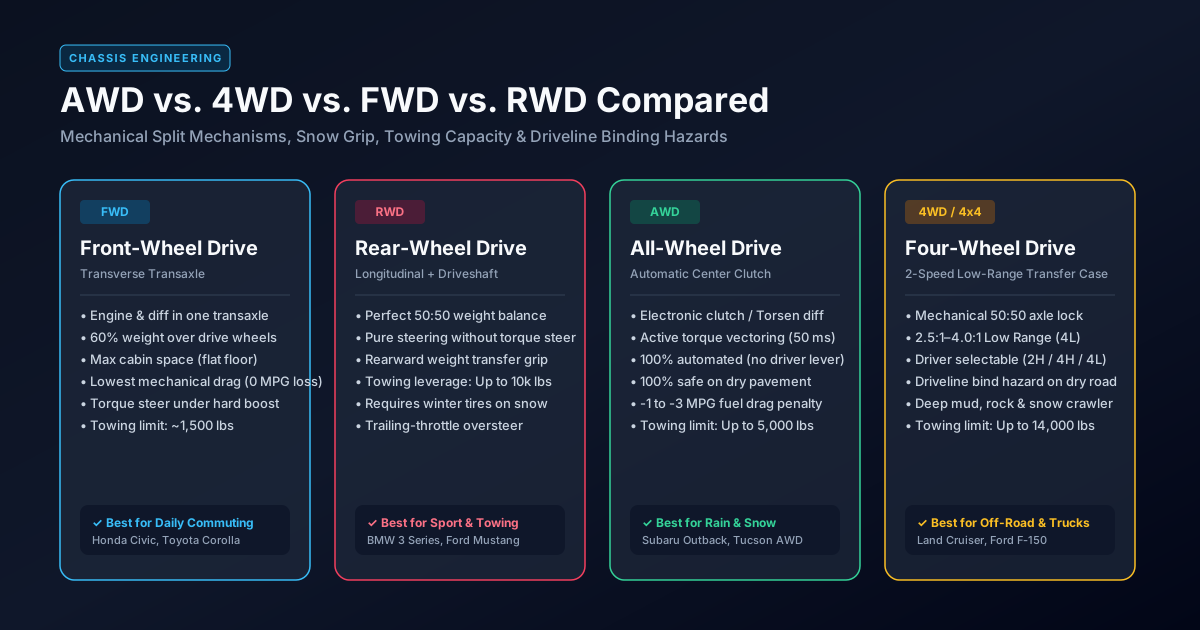
An automotive drivetrain is the coordinated mechanical assembly, comprising the transmission, driveshafts, differentials, transfer cases, and half-shaft axles, responsible for delivering engine or electric motor torque to the road contact patches.
Modern production vehicles are engineered around four primary drivetrain configurations:
- 1.Front-Wheel Drive (FWD)
- 2.Rear-Wheel Drive (RWD)
- 3.All-Wheel Drive (AWD)
- 4.Four-Wheel Drive (4WD / 4x4)
Selecting the correct drivetrain layout impacts annual fuel expenditures, cabin legroom, winter foul-weather safety, off-road capability, and long-term repair costs.
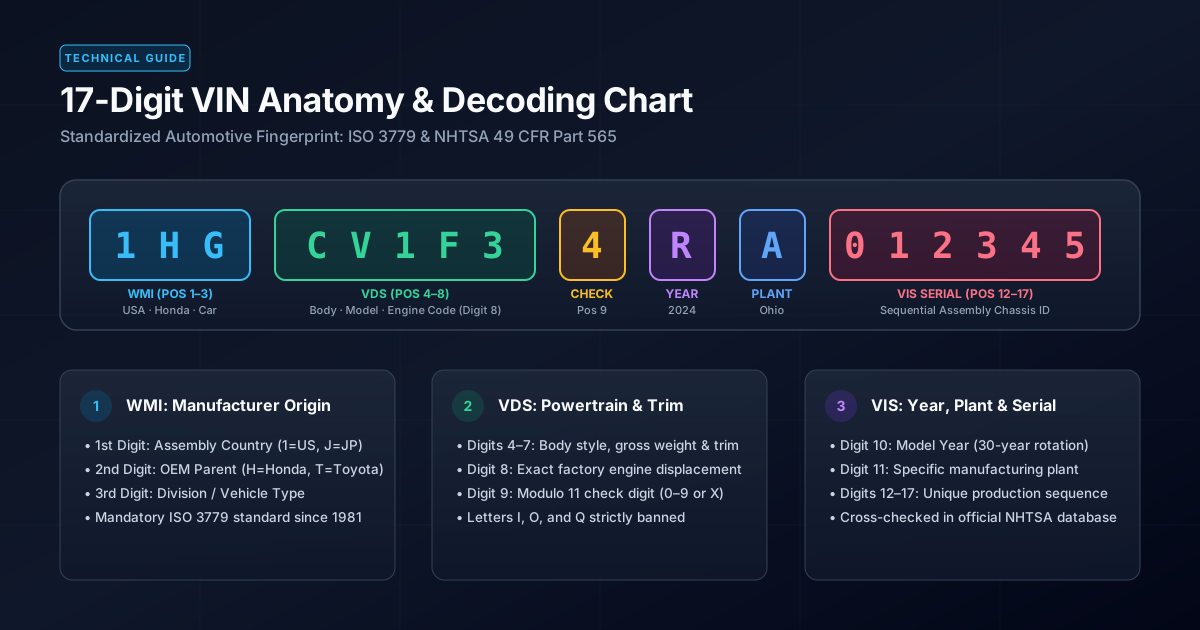
To check the exact factory drivetrain layout, axle ratio, and differential specifications on any pre-owned vehicle, enter its 17-digit code into our free NHTSA VIN decoder tool.
1. Master Drivetrain Architecture Comparison Matrix
The table below contrasts the mechanical engineering, operating principles, fuel penalties, and target use cases for all four drivetrain platforms:
| Architectural Metric | Front-Wheel Drive (FWD) | Rear-Wheel Drive (RWD) | All-Wheel Drive (AWD) | Four-Wheel Drive (4WD / 4x4) |
|---|---|---|---|---|
| Driven Wheels | Front Axle Only | Rear Axle Only | All 4 Wheels (Automated split) | All 4 Wheels (Mechanical 50:50 lock) |
| Engine Mounting | Transverse (Sideways) | Longitudinal (Front-to-Back) | Transverse or Longitudinal | Longitudinal |
| Core Split Device | Compact Integrated Transaxle | Central Driveshaft + Rear Diff | Electronic Clutch Pack / Center Diff | 2-Speed Mechanical Transfer Case |
| Driver Activation | Always Engaged | Always Engaged | Seamlessly Automatic | Selectable (2H, 4H, 4L via dial/lever) |
| Dry Pavement Safe? | Yes | Yes | Yes (Center diff absorbs wheel slip) | No in 4H/4L (Driveline binding hazard) |
| Snow & Ice Traction | Moderate to Good (Weight over drive axle) | Poor without dedicated winter tires | Exceptional (Active slip compensation) | Maximum (In deep snow/mud with lockers) |
| Towing Capability | Limited (Up to 1,500 – 3,500 lbs) | Heavy (Up to 10,000+ lbs) | Moderate to High (Up to 5,000 lbs) | Extreme (Up to 14,000+ lbs) |
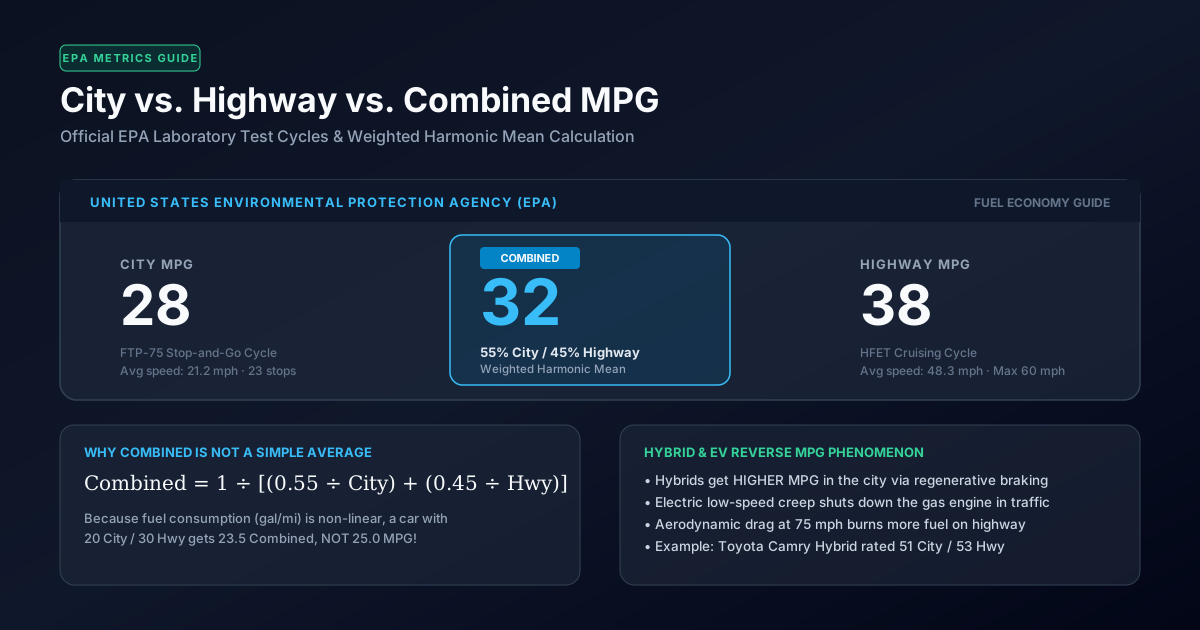
| EPA Fuel Penalty | Baseline (Lowest mechanical drag) | ~0 to +0.5 MPG drag | -1 to -3 MPG penalty | -2 to -4 MPG penalty |
| Representative Models | Honda Civic, Toyota Corolla | BMW 3 Series, Ford Mustang | Subaru Outback, Hyundai Tucson HTRAC | Toyota Land Cruiser, Ford F-150 |
2. Front-Wheel Drive (FWD): Efficiency & Packaging Supremacy
Front-Wheel Drive is the dominant architecture for modern passenger sedans, hatchbacks, and compact crossovers:
Mechanical Architecture
In an FWD vehicle, the engine is installed transversely (perpendicular to vehicle travel). Instead of a separate gearbox and rear differential, an FWD powertrain integrates both components into a single compact casing called a transaxle. Two equal-length or intermediate half-shafts transmit power directly to the front wheel hubs.
Engineering Advantages
- Maximum Interior Volume: Because no driveshaft tunnel or rear differential pumpkin intrudes into the passenger compartment, rear floorboards remain completely flat and trunk space is maximized.
- Minimal Parasitic Drag: Eliminating the heavy longitudinal driveshaft and 90-degree hypoid ring-and-pinion gears reduces rotational drivetrain friction, delivering superior EPA highway and combined MPG ratings.
- Inherent Snow Traction: The engine block, battery, and transaxle place roughly 60% of total curb weight directly over the driven front contact patches, generating natural mechanical biting grip in moderate rain and light snow.
Limitations & Torque Steer
- Torque Steer: Under full throttle, unequal axle angles or slight variations in half-shaft torsional stiffness cause high-output turbocharged front-drivers to pull or yank the steering wheel sideways.
- Traction Limits Under Acceleration: When launching from a stop, physical weight transfers backward toward the rear axle, unloading the front tires and causing wheelspin in high-horsepower configurations.
3. Rear-Wheel Drive (RWD): Dynamic Balance & Towing Dominance
Rear-Wheel Drive remains the undisputed benchmark for performance sports cars, luxury grand tourers, and heavy-duty utility vehicles:
Mechanical Architecture
The internal combustion engine is mounted longitudinally along the chassis centerline. Power exits the rear of the transmission into a high-strength tubular steel or carbon-fiber driveshaft, entering a chassis-mounted rear differential that divides torque across the left and right rear drive wheels.
Engineering Advantages
- Balanced 50:50 Weight Distribution: Separating the heavy engine/transmission assembly at the front from the differential assembly at the rear achieves a balanced center of gravity, exemplified by track-tuned sedans like the BMW 3 Series.
- Pure Steering Precision: The front wheels are dedicated solely to directional steering and lateral cornering loads, completely isolated from driving torque pulses.
- Dynamic Grip Under Acceleration: As vehicle weight shifts toward the rear under wide-open throttle, the rear tires are driven down into the asphalt, maximizing grip without breaking traction.
- Commercial Towing Leverage: Attaching a heavy trailer hitch compresses the rear axle, stabilizing trailer sway and increasing rear-wheel traction during hill ascents.
Limitations in Winter
On icy or snow-packed roads, an unladen rear axle has insufficient vertical weight over the drive tires. Inexperienced drivers can induce trailing-throttle oversteer (the rear of the vehicle stepping out), requiring rapid counter-steering and electronic stability control intervention.
4. All-Wheel Drive (AWD): Intelligent Seamless Traction
All-Wheel Drive is engineered to deliver all-weather security for daily commuters and family crossovers without requiring mechanical expertise from the driver:
How Modern AWD Systems Operate
Modern AWD vehicles utilize one of two primary mechanical approaches:
- 1.On-Demand Electronic Multi-Plate Clutch (Hang-On AWD): Under standard highway cruising conditions, 100% of engine torque flows to the primary axle (usually the front wheels in vehicles like the Hyundai Kona or Hyundai Santa Fe). When wheel speed sensors detect as little as a 2% rotational variance between axles, an electro-hydraulic clutch pack tightens within 50 milliseconds, routing up to 50% of available torque to the rear axle.
- 2.Permanent Mechanical AWD with Center Differential: Utilized by systems like Audi's Torsen Quattro or Subaru Symmetrical AWD. A permanent planetary or worm-gear center differential continuously divides torque (typically 40:60 front-to-rear) while allowing the front and rear axles to rotate at slightly different speeds during tight cornering on dry pavement.
Torque Vectoring
Advanced AWD architectures incorporate active rear differentials with twin clutch packs (such as Acura SH-AWD or Hyundai N Corner-Carving Differentials). During aggressive cornering, the system overdrives the outside rear wheel, mechanically rotating the car into the apex to eliminate understeer.
To explore how advanced automated gearboxes interface with AWD layouts, review our technical breakdown of dual-clutch vs torque-converter automatic transmissions.
5. Four-Wheel Drive (4WD / 4x4): Extreme Off-Road Capability
Four-Wheel Drive is a specialized mechanical powertrain designed for heavy commercial trucks, rock crawlers, and dedicated overland utility vehicles:
The Mechanical Transfer Case
A true 4WD vehicle features a heavy cast-iron or aluminum transfer case mounted behind the transmission. Inside the transfer case:
- A heavy-duty chain or planetary gearset locks the front and rear output shafts together mechanically.
- A 2-Speed Planetary Low Range (4L) provides high reduction gear ratios (typically 2.5:1 to 4.0:1), multiplying engine wheel torque by hundreds of percent for steep hill climbing, deep rock crawling, and heavy extraction.
Operating Modes Explained
- 2H (Two-Wheel Drive High): 100% torque to the rear wheels for dry highway cruising and maximum fuel efficiency.
- 4H (Four-Wheel Drive High): 50:50 torque split between front and rear axles at standard speeds. Restricted strictly to low-friction surfaces (gravel, mud, packed snow, ice).
- 4L (Four-Wheel Drive Low): Maximum mechanical torque multiplication with locked axles at speeds under 25 mph.
The Danger of Driveline Binding on Dry Pavement
Because a traditional part-time 4WD transfer case contains no center differential, both driveshafts must spin at the exact same rotational speed. When making a U-turn or tight corner on dry asphalt, the front wheels travel a longer radius than the rear wheels.
Because dry pavement offers immense friction, the tires cannot slip to release rotational tension. The kinetic energy twists the steel driveshafts and differential gears, a destructive phenomenon known as driveline windup. Continued driving will sheer transfer case chain links, crack differential housings, or snap half-shaft splines.
Dedicated off-roaders like the Toyota Land Cruiser frequently utilize full-time 4WD with an unlockable Torsen center differential, providing off-road capability without dry-pavement binding risks.
6. The Winter Driving Safety Myth: Drivetrain vs. Tires
Automotive consumer surveys reveal a dangerous misconception: many car shoppers believe purchasing an AWD vehicle makes them invulnerable to winter weather.
Here is the physical reality:
$$\text{Total Braking Deceleration} = \mu \times g$$
Where $\mu$ represents the frictional coefficient between tire rubber and road surface, and $g$ is gravitational acceleration.
- AWD Accelerates, Tires Stop: AWD only provides advantages when applying throttle to gain forward momentum from a standstill. It provides zero assistance when attempting to brake from 60 mph on ice or steer around an unexpected hazard.
- Every Car Has 4-Wheel Brakes: Regardless of whether your car is FWD, RWD, or AWD, all four wheels are equipped with disc brakes.
- Tire Compound Dictates Stopping Distance: A front-wheel-drive sedan equipped with dedicated winter tires (compound remaining pliable below 45°F / 7°C with hundreds of biting micro-sipes) stops up to 35 feet shorter on hard-packed snow than an AWD SUV riding on hard, cold all-season rubber.
7. Which Drivetrain Should You Buy? A Buyer's Decision Framework
Use this practical checklist to match your driving patterns to the optimal drivetrain:
1. Choose Front-Wheel Drive (FWD) If: - You prioritize maximum fuel economy, lowest routine maintenance expenses, and maximum interior trunk room. - You commute primarily in urban/suburban environments with mild to moderate winter snow cleared by municipal plows. 2. Choose All-Wheel Drive (AWD) If: - You live in regions subject to frequent unplowed snow, steep hillside driveways, or heavy seasonal rainstorms. - You require seamless, computerized foul-weather traction without ever having to engage levers or think about mechanical binding. 3. Choose Rear-Wheel Drive (RWD) If: - You demand pristine sports-car steering feel, track-day handling balance, or tow heavy recreational trailers with commercial durability. 4. Choose Four-Wheel Drive (4WD / 4x4) If: - You regularly venture into unpaved backcountry trails, deep sand dunes, muddy job sites, or extreme rock-crawling terrain requiring low-range gearing and mechanical differential lockers.
Frequently asked questions
What is the primary difference between AWD and 4WD?
AWD (All-Wheel Drive) is an automated, full-time system designed primarily for on-road traction and foul weather. It utilizes an electronic multi-plate clutch pack or a center differential to seamlessly vary torque between wheels without driver intervention. 4WD (Four-Wheel Drive) is a rugged, driver-selectable mechanical system with a transfer case that locks the front and rear driveshafts together at a fixed 50:50 rotational speed, engineered strictly for low-traction off-road surfaces or deep snow.
Can you drive a 4WD vehicle on dry pavement?
No. Traditional part-time 4WD locks the front and rear axles to rotate at identical speeds. When turning a corner on dry asphalt, outer wheels must travel along a wider arc than inner wheels. Without a differential between the front and rear axles to compensate, the drivetrain binds mechanically, causing tire scuffing, severe vibrations, and catastrophic gear teeth shear inside the transfer case.
Is Front-Wheel Drive (FWD) good in the snow?
Yes. FWD vehicles perform remarkably well in moderate winter conditions because approximately 60% of the vehicle's total curb weight (engine, transmission, and transaxle) sits directly over the driven front wheels, providing strong gravitational contact patch grip. When paired with dedicated Three-Peak Mountain Snowflake (3PMSF) winter tires, an FWD car often outperforms an AWD vehicle on worn all-season tires.
Why do sports cars and commercial trucks prefer Rear-Wheel Drive (RWD)?
Under hard acceleration, physics dictates dynamic rearward weight transfer, pressing the rear tires down for maximum mechanical traction. RWD also frees the front wheels to handle pure steering duty without torque steer. For commercial trucks, loading a heavy trailer tongue weight directly over the rear drive axle increases grip and towing stability.
How much fuel economy do you lose with All-Wheel Drive?
Adding AWD typically imposes an EPA fuel economy penalty of 1 to 3 MPG compared to an equivalent front-wheel-drive model. This deficit results from the added curb weight (typically 150 to 250 lbs for the rear driveshaft, rear differential, and half-shafts) plus continuous parasitic rotational drag and viscous fluid friction in the drivetrain.
Does All-Wheel Drive help you stop faster in snow?
No. All-Wheel Drive only aids vehicle acceleration and forward momentum. Every passenger car already possesses four-wheel braking regardless of drivetrain configuration. AWD provides zero reduction in braking distance on snow or ice: stopping capability is governed entirely by tire rubber compound, tread siping, and vehicle momentum.
Cite this page: https://cardataindex.com/blog/awd-4wd-fwd-rwd-drivetrains-explained
Keep researching
Cross-check the numbers in this guide against live factory data in our specification index or decode a specific car with the free VIN decoder.