What Is a VIN Number? How to Decode All 17 Digits (NHTSA & ISO Chart)
Every car built since 1981 carries a unique 17-character VIN. Learn where to find it, what each position means, and how to decode it free in seconds.
Car Data Index Editorial
Automotive data desk · Sources: NHTSA · EPA · OEM records
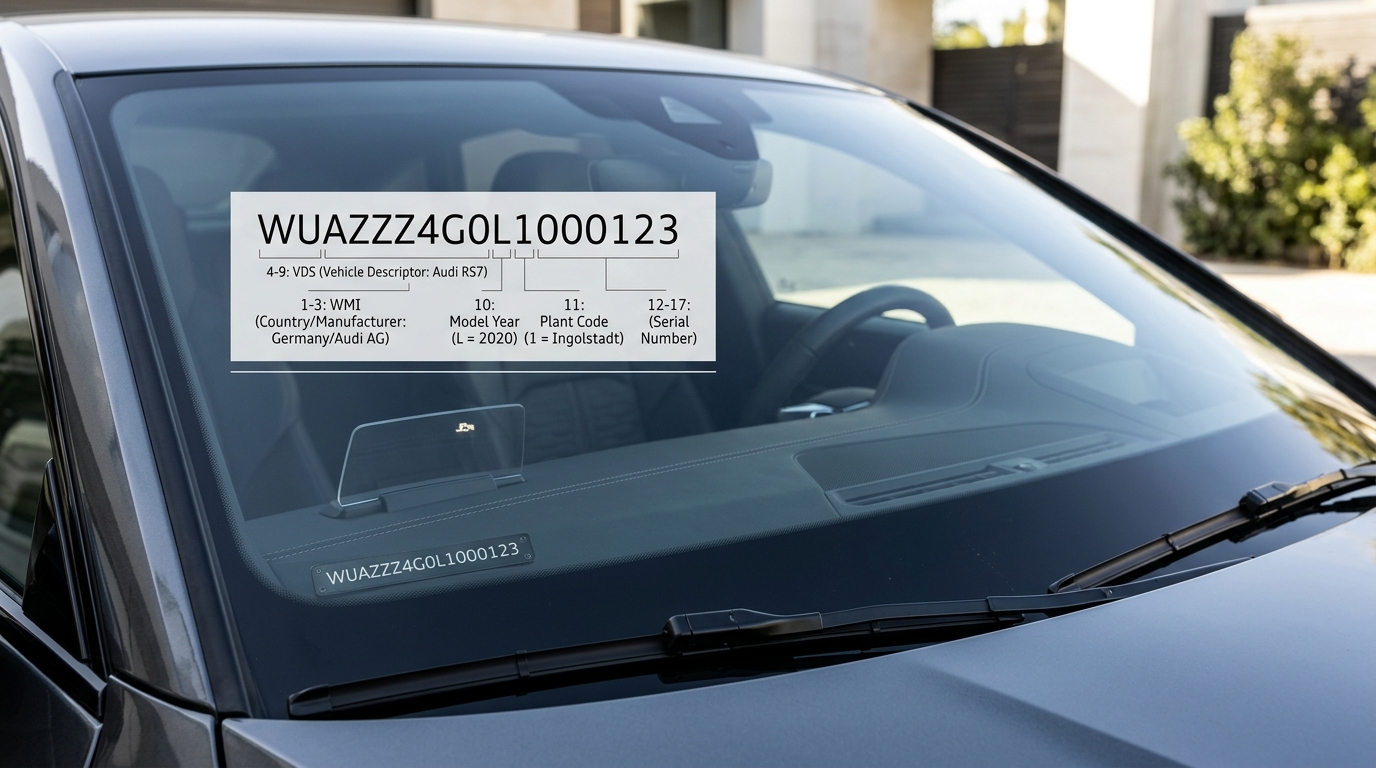
Every passenger automobile, commercial truck, and multipurpose vehicle manufactured worldwide since model year 1981 carries a standardized Vehicle Identification Number (VIN). Far more than a random registration code, this 17-character sequence acts as an immutable automotive DNA strand.
Governed in North America by the National Highway Traffic Safety Administration (NHTSA 49 CFR Part 565) and globally by the International Organization for Standardization (ISO 3779 and ISO 3780), every digit in a VIN encodes verifiable technical specifications: country of assembly, manufacturing division, engine displacement, safety restraint layout, model year, and factory build sequence.
To instantly look up any 17-character vehicle code against official federal records, run it through our free NHTSA VIN decoder tool.
1. Master 17-Character VIN Anatomy & Breakdown Matrix
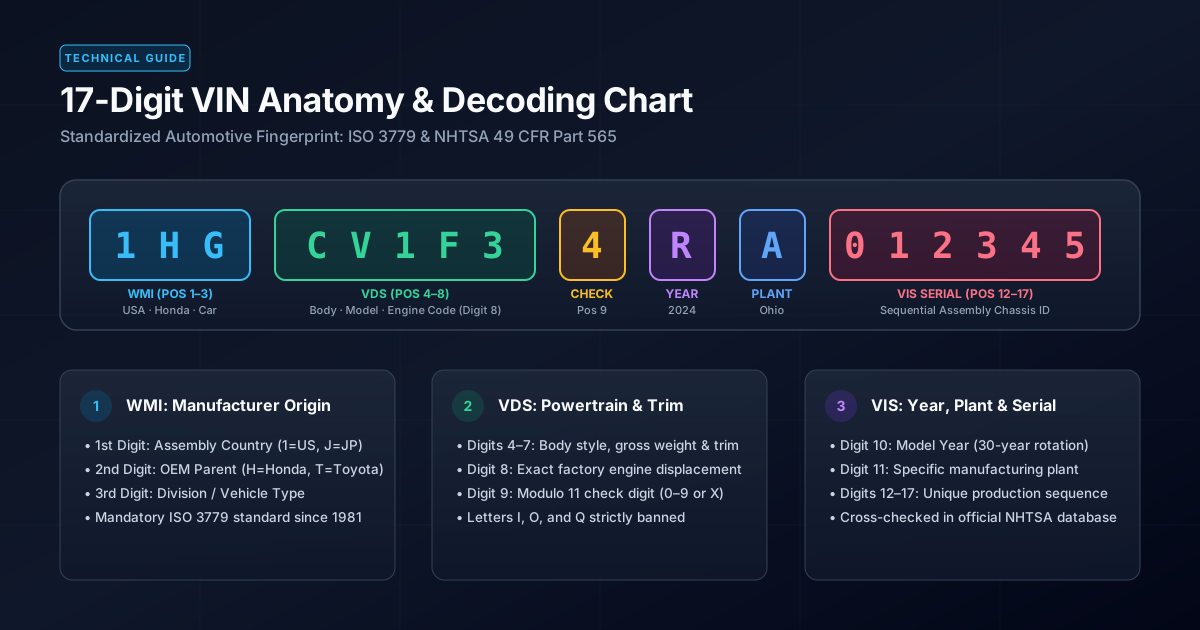
A modern 17-character VIN contains zero spaces and strictly excludes the letters I, O, and Q. The sequence is broken down into three regulatory blocks:
``` Positions: 1 2 3 | 4 5 6 7 8 | 9 | 10 | 11 | 12 13 14 15 16 17 Section: [--- WMI ---] | [------- VDS -------] | Check | Year | Plant | [------- VIS -------] Definition: Country & Make| Body, Model & Engine | Check | Mod. | Assy | Serial Production
| (Digit 8 = Engine) | Digit | Year | Plant | Number ```
Here is the exact legal mandate and technical function of every single position from left to right:
| Position | Section Code | Technical Designation | Regulatory Function & Decode Logic | Database Example |
|---|---|---|---|---|
| Digit 1 | WMI | Country of Manufacture | Geographic region and country where final assembly took place | 1, 4, 5 = USA, 2 = Canada, 3 = Mexico, J = Japan, K = South Korea, W = Germany |
| Digit 2 | WMI | Automaker / Parent Corporation | Primary manufacturing entity or parent corporate group | H = Honda, T = Toyota, F = Ford, B = BMW, M = Hyundai |
| Digit 3 | WMI | Vehicle Division or Category | Differentiates passenger cars from light trucks, MPVs, or specialized divisions | 8 = Hyundai Multipurpose Passenger Vehicle (MPV/SUV) |
| Digit 4 | VDS | Vehicle Weight Class / Model Line | Gross Vehicle Weight Rating (GVWR) or primary model chassis family | Identifies vehicle class (e.g., Compact C-SUV vs Mid-Size D-SUV) |
| Digit 5 | VDS | Body Style & Drivetrain Configuration | Specific body layout: 4-Door Sedan, 5-Door Hatchback, Crew Cab, or AWD/FWD | Distinguishes front-wheel drive from HTRAC or mechanical AWD |
| Digit 6 | VDS | Model Series / Trim Level | Specific grade designation: Base, Premium, Limited, or Sport trim | Identifies factory luxury or tech equipment package |
| Digit 7 | VDS | Safety Restraint & Airbag Package | Type of seatbelts, side-curtain airbags, knee airbags, and active occupant sensors | Verifies compliance with federal crash safety standards |
| Digit 8 | VDS | Engine Specification Code | Exact engine displacement, cylinder count, aspiration, and horsepower output | Distinguishes 2.0L NA from 2.5L Turbo or 1.6L Hybrid powertrains |
| Digit 9 | Check | Mathematical Check Digit | Calculated algorithmic checksum (0–9 or X) validating VIN authenticity | Multiplied against federal weight table; flags forged or cloned VINs |
| Digit 10 | VIS | Model Year Identifier | Official vehicle model year (operates on a 30-year alphanumeric rotation) | R = 2024, S = 2025, T = 2026, V = 2027 |
| Digit 11 | VIS | Assembly Plant Code | The specific manufacturing facility or assembly line building the chassis | U = Ulsan, South Korea; H = Montgomery, Alabama, USA |
| Digits 12–17 | VIS | Sequential Production Number | Unique 6-digit production serial number assigned on the assembly line | E.g. 104258 = The 4,258th chassis produced for that model year run |
2. World Manufacturer Identifier (WMI): Digits 1 to 3
The first three characters identify the geographic origin and manufacturing corporation. The International Society of Automotive Engineers (SAE) allocates WMI blocks to sovereign countries and vehicle manufacturers:
Primary Country Origin Codes (Digit 1)
- North America:
1,4,5= United States;2= Canada;3= Mexico. - Asia:
J= Japan;K= South Korea;L= China;M= India / Thailand. - Europe:
S= United Kingdom;V= France / Spain;W= Germany;Z= Italy / Sweden. - South America & Oceania:
6= Australia;8,9= Brazil / Argentina.
Real-World Database Entities: WMI Decoding
Look at how WMI codes differ across vehicles cataloged in our index:
- **Hyundai Santa Fe (MX5)**: Built in South Korea displays
KM8, while units assembled at Hyundai Motor Manufacturing Alabama carry5NM. - **Toyota Land Cruiser**: Built at the Yoshiwara Plant in Japan carries the legendary
JTMorJTEprefix. - **BMW 3 Series**: Sedans assembled in Munich or Dingolfing, Germany carry
WBA, while South African plant builds carryWBAor3MWfor Mexican San Luis Potosí production.
3. The 8th Digit: Unlocking Engine Displacement & Powertrain
One of the most frequent questions from prospective buyers is: "What does the 8th character in a VIN mean?"
Under NHTSA requirements, Digit 8 is universally reserved for the Engine Identifier. Automakers assign a unique letter or number to each engine variant. This prevents dishonest sellers from rebadging a base vehicle as a performance variant:
- Why It Matters: On vehicles like the Hyundai Tucson, two cars may look visually identical on the exterior. However, Digit 8 reveals whether the vehicle houses a 2.5L Smartstream naturally aspirated 4-cylinder or the high-output 1.6L Turbo Hybrid powertrain.
- Forced Induction vs. Natural Aspiration: For a detailed mechanical breakdown of how these factory engine designs differ in long-term maintenance, review our guide on turbocharged vs naturally aspirated engines.
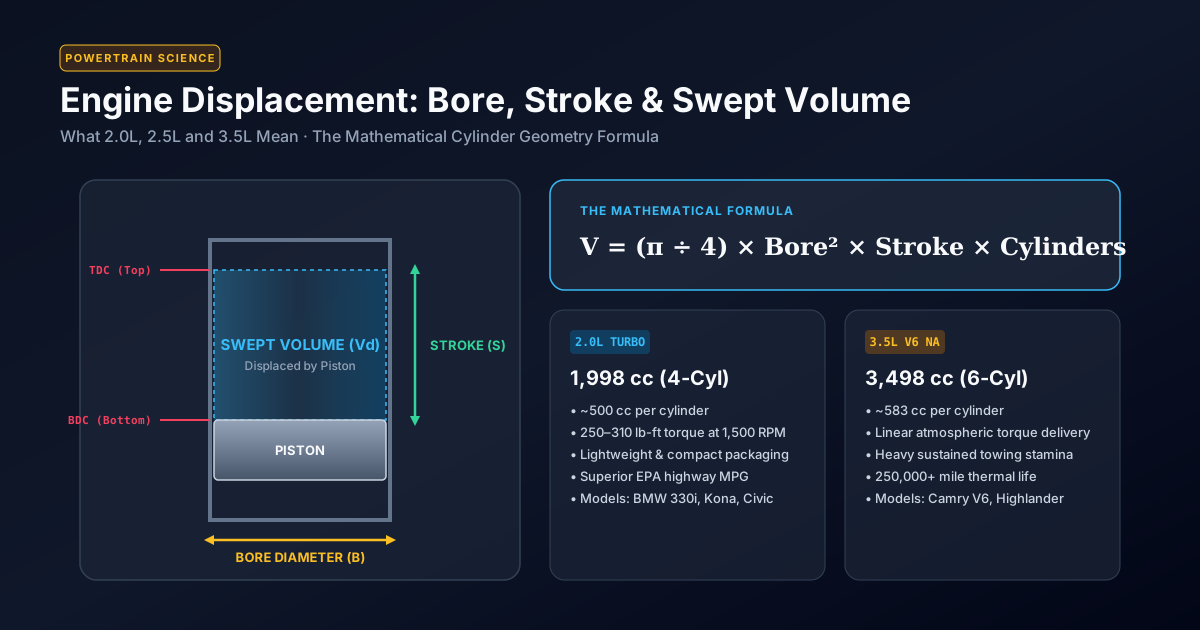
- Engine Size Comparison: If your decoded engine code indicates a 2.0L or 3.5L unit, understand the cylinder displacement metrics with our guide on what engine liters mean.
4. The 9th Digit Checksum: How Modulo 11 Catches Fraud
Position 9 is a mathematical check digit. It does not describe any physical component of the vehicle. Instead, it is a cryptographic barrier against stolen vehicle cloning, altered paperwork, and counterfeit VIN plates.
The Transliteration Key
Every letter in the VIN (except I, O, Q) is converted into a predetermined numerical integer:
| A | B | C | D | E | F | G | H | J | K | L | M | N | P | R | S | T | U | V | W | X | Y | Z |
|---|---|---|---|---|---|---|---|---|---|---|---|---|---|---|---|---|---|---|---|---|---|---|
| 1 | 2 | 3 | 4 | 5 | 6 | 7 | 8 | 1 | 2 | 3 | 4 | 5 | 7 | 9 | 2 | 3 | 4 | 5 | 6 | 7 | 8 | 9 |
(Numbers 0 through 9 retain their own face value).
Positional Weight Factors
Each character in positions 1 through 17 is multiplied by a positional weight factor dictated by federal formula:
| Position | 1 | 2 | 3 | 4 | 5 | 6 | 7 | 8 | 9 | 10 | 11 | 12 | 13 | 14 | 15 | 16 | 17 |
|---|---|---|---|---|---|---|---|---|---|---|---|---|---|---|---|---|---|
| Weight | 8 | 7 | 6 | 5 | 4 | 3 | 2 | 10 | 0 | 9 | 8 | 7 | 6 | 5 | 4 | 3 | 2 |
Calculation Steps
1. Multiply the numeric value of each character by its assigned positional weight. (Notice the check digit position 9 is multiplied by 0). 2. Sum the resulting 16 products together. 3. Divide the grand total by 11. 4. The remainder of that division is your check digit: - If the remainder is 0 to 9, digit 9 must be that exact number. - If the remainder is 10, digit 9 must be the Roman numeral **X**.
If a stolen vehicle ring attempts to grind down a VIN character and replace an '8' with a '3', the sum will fail the Modulo 11 check digit verification instantly when scanned.
5. Model Year Decoding (Digit 10): 1981 to 2039 Reference Schedule
The 10th position reveals the vehicle's official model year. To prevent visual confusion, the letters I, O, Q, U, and Z and the number 0 are never used as year codes.
Because the system uses 30 alphanumeric characters, the sequence repeats every 30 years:
| Code | Year | Code | Year | Code | Year | Code | Year |
|---|---|---|---|---|---|---|---|
| B | 1981 / 2011 | K | 1989 / 2019 | V | 1997 / 2027 | 5 | 2005 / 2035 |
| C | 1982 / 2012 | L | 1990 / 2020 | W | 1998 / 2028 | 6 | 2006 / 2036 |
| D | 1983 / 2013 | M | 1991 / 2021 | X | 1999 / 2029 | 7 | 2007 / 2037 |
| E | 1984 / 2014 | N | 1992 / 2022 | Y | 2000 / 2030 | 8 | 2008 / 2038 |
| F | 1985 / 2015 | P | 1993 / 2023 | 1 | 2001 / 2031 | 9 | 2009 / 2039 |
| G | 1986 / 2016 | R | 1994 / 2024 | 2 | 2002 / 2032 | A | 2010 / 2040 |
| H | 1987 / 2017 | S | 1995 / 2025 | 3 | 2003 / 2033 | , | , |
| J | 1988 / 2018 | T | 1996 / 2026 | 4 | 2004 / 2034 | , | , |
Pro-Tip for Car Shoppers: Automakers frequently release "next year's model" early in the calendar year. A vehicle built in March 2024 can legally carry an **S** (2025) if the manufacturer designated it as such. Always inspect Digit 10 to establish legal model year standing.
6. Why Letters I, O, and Q Are Federally Prohibited
Under NHTSA 49 CFR § 565.15(a) and ISO 3779 clause 4.1, the letters I, O, and Q are banned from every position in any VIN.
The engineering and legal rationale is straightforward:
- Letter 'I' is easily mistaken for the numeral '1' or lowercase 'l'.
- Letters 'O' and 'Q' are easily mistaken for the numeral '0' (zero) or each other, particularly when stamped onto rough cast-iron engine blocks or viewed through scratched windshields.
If any vehicle listing, registration title, or online seller provides a VIN containing an I, O, or Q, the number is either an unintentional clerical typo or an overt forgery.
7. Pre-Purchase VIN Inspection Checklist: 5 Physical Verification Spots
When evaluating a used car, never rely on photos or verbal seller statements. Follow this 5-point physical audit before transferring funds:
- 1.Dashboard Windshield Plate: Look through the lower driver's side corner of the front windshield from outside. Check the metal plate: the factory rivets should be pristine rosette or hex-shaped rivets. Wobbly, standard pop-rivets or scratched paint around the window opening indicate a swapped VIN plate.
- 2.B-Pillar Federal Safety Certification Label: Open the driver's door and inspect the certification sticker on the door latch pillar. Verify that the 17-digit VIN matches the dashboard exactly, and verify gross vehicle weight ratings (GVWR) and tire inflation sizes.
- 3.Under-Hood Stamped Firewall: Open the engine hood and locate the vehicle chassis stamp, typically etched into the center firewall or passenger suspension strut tower.
- 4.Window Glass Date Stamps: Compare the VIN year (Digit 10) against the tiny manufacturer logo dots on the side door glass and rear windshield. If the VIN designates a 2021 model but the passenger window has a 2024 date code, that side experienced a major collision and glass replacement.
- 5.Open NHTSA Safety Recalls: Run the 17 characters through our VIN search portal to confirm whether urgent recalls (airbags, fuel lines, electrical systems) remain unaddressed. Dealerships are required by federal law to remedy all open recalls at zero cost.
Summary & Instant VIN Lookup
The 17-digit VIN is your ultimate defense against title fraud, flooded salvage vehicles, and mismatched trim levels. Before making any vehicle purchase, verify each character against official manufacturing databases.
Ready to audit your vehicle? Enter your 17-character number into our free Car Data Index VIN Decoder to inspect complete factory mechanical specifications, EPA fuel economy ratings, crash test histories, and recall status.
Frequently asked questions
What is a VIN number and why is it legally required?
A Vehicle Identification Number (VIN) is a unique 17-character alphanumeric code that serves as a motor vehicle's permanent legal fingerprint. Standardized worldwide by ISO 3779 and in the United States by NHTSA under 49 CFR Part 565 in 1981, it identifies the country of manufacture, automaker, vehicle platform, engine code, model year, assembly plant, and production sequence. It legally binds vehicle titles, insurance policies, safety recall campaigns, and collision history.
What does each digit mean in a 17-character VIN?
Positions 1–3 represent the World Manufacturer Identifier (WMI: country, manufacturer, division). Positions 4–8 represent the Vehicle Descriptor Section (VDS: body style, trim line, restraint system, and engine code at digit 8). Position 9 is the mathematical check digit (0–9 or X). Position 10 indicates the model year. Position 11 identifies the assembly plant. Positions 12–17 form the Vehicle Identifier Section (VIS) representing the unique serial production number.
What does the 8th digit in a VIN number mean?
The 8th character in a VIN specifies the engine code. Automakers use this single position to distinguish engine displacement, cylinder layout, fuel delivery (turbocharged vs naturally aspirated vs hybrid), and horsepower calibration. For instance, in modern vehicles, digit 8 reveals whether a crossover carries an entry-level naturally aspirated engine or an upgraded turbocharged powertrain.
Why are the letters I, O, and Q never used in a VIN?
Federal regulation 49 CFR Part 565 and ISO 3779 strictly prohibit the letters I, O, and Q in all motor vehicle identification numbers. This mandatory exclusion prevents clerical errors, optical character recognition (OCR) scanning errors, and visual confusion between 'I' and the number '1', and between 'O' or 'Q' and the number '0'. Any 17-digit code containing I, O, or Q is counterfeit or mistyped.
How does the 9th check digit detect fraudulent or cloned VINs?
Digit 9 is mathematically calculated using a weighted Modulo 11 checksum algorithm defined by the US Department of Transportation. Each letter is converted to an assigned numeric value (1 to 9) and multiplied by its positional weight factor. The sum is divided by 11; the remainder (0–9, or X for 10) must match digit 9 exactly. If a counterfeit VIN plate is altered or re-riveted, the mathematical check digit immediately fails verification.
Which digit reveals the model year, and how does the cycle work?
The 10th character indicates the vehicle's model year using a 30-year rotating sequence of letters and numbers. For example, 2020 is 'L', 2021 is 'M', 2022 is 'N', 2023 is 'P', 2024 is 'R', 2025 is 'S', 2026 is 'T', and 2027 is 'V'. Letters I, O, Q, U, and Z are never used for model years. If a used car is advertised as a 2025 model but digit 10 is 'R', the vehicle is legally a 2024 model year.
Cite this page: https://cardataindex.com/blog/what-is-a-vin-number
Keep researching
Cross-check the numbers in this guide against live factory data in our specification index or decode a specific car with the free VIN decoder.