Engine Displacement Explained: What Do 2.0L, 2.5L and 3.5L Mean? (Formula & Charts)
Liters, cubic centimeters, cylinders, what engine size really tells you about performance and efficiency, and why modern small turbos beat old V6s.
Car Data Index Editorial
Automotive data desk · Sources: NHTSA · EPA · OEM records
When researching technical specifications in any automotive catalog, the single most prominent powertrain metric listed next to horsepower is engine displacement—typically stated as 2.0L, 2.5L, 3.5L, or measured in cubic centimeters (cc) and cubic inches (ci).
Understanding what engine displacement actually measures, how it is calculated, and why modern turbocharged engines have dismantled the old adage "there is no replacement for displacement" is crucial when buying a modern vehicle.
To decode your vehicle's exact factory engine displacement and powertrain code directly from its 17-digit identifier, use our free NHTSA VIN decoder.
1. What Is Engine Displacement? (The Technical Definition)
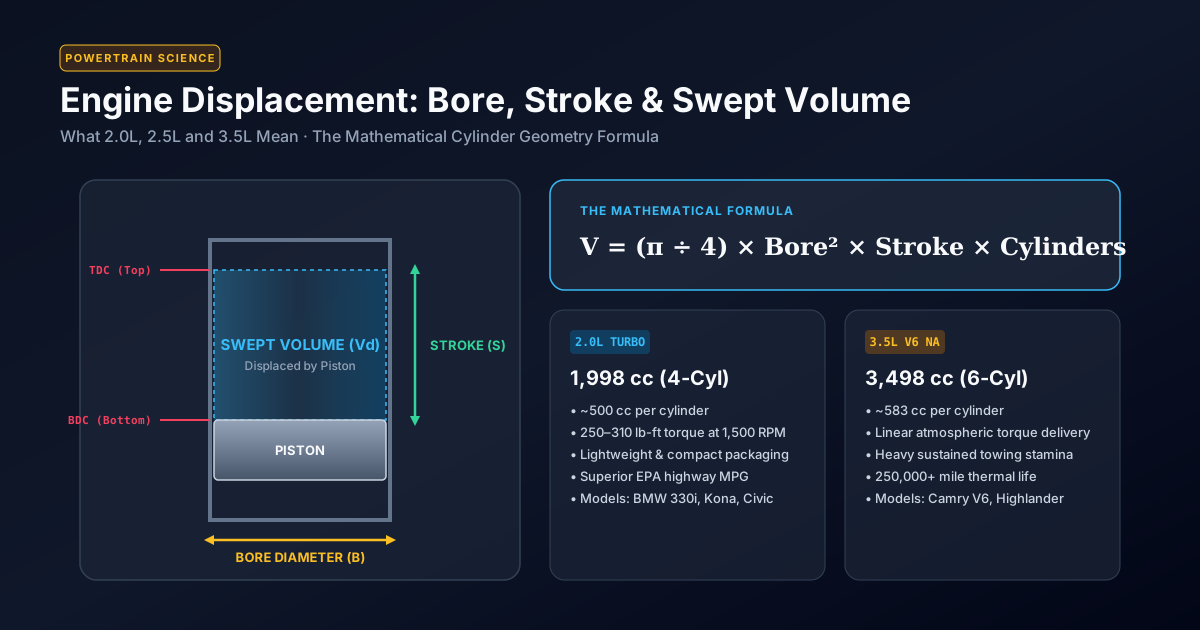
Engine displacement represents the total swept volume of air and fuel that all pistons inside an internal combustion engine displace as they travel from their lowest point (Bottom Dead Center, BDC) to their highest point (Top Dead Center, TDC) during one complete stroke.
In simple terms, displacement measures the physical lung capacity of an engine:
- A vehicle labeled 2.0L has an internal engine capacity of approximately 2,000 cubic centimeters (cc) or 122 cubic inches.
- A vehicle labeled 3.5L has an internal capacity of approximately 3,500 cc or 214 cubic inches.
The more volume an engine has, the more air it can ingest in a single cycle. Because gasoline requires a fixed air-fuel ratio (approximately 14.7 parts air to 1 part fuel by weight for complete stoichiometric combustion), a larger cylinder volume allows the engine to burn more fuel per combustion stroke, generating greater chemical energy and rotational torque.
2. The Mathematical Displacement Formula: Bore × Stroke
Engine displacement is not an arbitrary marketing estimate; it is an exact geometric calculation based on two physical cylinder dimensions:
`` Total Engine Displacement = (? ÷ 4) × (Bore)² × Stroke × Number of Cylinders ``
Where:
- Bore: The internal diameter of the cylinder barrel (measured in millimeters or inches).
- Stroke: The vertical distance the piston moves from Bottom Dead Center (BDC) to Top Dead Center (TDC) (measured in millimeters or inches).
- ? (Pi): Mathematical constant (~3.14159265).
- Number of Cylinders: The total number of combustion chambers (3, 4, 6, 8, etc.).
Step-by-Step Calculation: A Real 2.0L 4-Cylinder Engine
Let us calculate the exact displacement of a benchmark 2.0-liter turbocharged engine (such as the BMW B48 found in the BMW 3 Series):
- Cylinder Bore: 82.0 mm (8.20 cm)
- Piston Stroke: 94.6 mm (9.46 cm)
- Cylinder Count: 4 Cylinders
- 1.Calculate the radius squared: $(8.20 ÷ 2)^2 = 4.10^2 = 16.81 ext{ cm}^2$
- 2.Multiply by Pi (?): $16.81 imes 3.14159 = 52.81 ext{ cm}^2$ (Area of cylinder cross-section)
- 3.Multiply by the stroke length: $52.81 imes 9.46 ext{ cm} = 499.58 ext{ cm}^3$ (Volume of a single cylinder)
- 4.Multiply by total cylinders: $499.58 ext{ cc} imes 4 = mathbf{1,998.3 ext{ cc}}$
Because 1,998 cubic centimeters rounds mathematically to 2.0 liters, automakers badge the car as a 2.0L.
3. Displacement Conversion Matrix & Real Database Entities
Automotive displacement standards vary across global markets. The metric system uses Liters (L) and Cubic Centimeters (cc), while American manufacturers traditionally used Cubic Inches (ci) ($1 ext{ Liter} approx 61.024 ext{ cubic inches}$).
Here is how displacement tiers align across real vehicles indexed in our database:
| Metric Liter | Cubic Centimeters (cc) | Cubic Inches (ci) | Typical Cylinder Count | Real Vehicle Example & Engine Code | Primary Application |
|---|---|---|---|---|---|
| 1.0L – 1.2L | 998 – 1,199 cc | 61 – 73 ci | 3-Cylinder Turbo | Ford EcoBoost / Hyundai 1.0T | Ultra-compact urban economy |
| 1.5L – 1.6L | 1,498 – 1,598 cc | 91 – 98 ci | 4-Cylinder Turbo | Hyundai Kona 1.6T GDI / Honda Civic 1.5T | Compact sedans and crossover commuters |
| 2.0L | 1,984 – 1,998 cc | 121 – 122 ci | 4-Cylinder (NA or Turbo) | BMW 330i (B48 2.0T) / Hyundai Kona 2.0L | Global standard for mid-size sedans and crossovers |
| 2.5L | 2,487 – 2,497 cc | 152 ci | 4-Cylinder (NA or Turbo) | Hyundai Santa Fe 2.5T (Smartstream) / Toyota Camry 2.5L | Mid-size SUVs, family sedans, and light utility |
| 3.0L – 3.5L | 2,998 – 3,498 cc | 183 – 214 ci | Inline-6 or V6 Twin-Turbo | BMW M340i (B58 3.0T) / Toyota Land Cruiser 3.4TT V6 | Luxury performance, full-size SUVs, and heavy hauling |
| 5.0L – 6.2L | 4,951 – 6,162 cc | 302 – 376 ci | Naturally Aspirated V8 | Ford Mustang 5.0L Coyote / Chevy Tahoe 6.2L V8 | Traditional muscle cars and full-size body-on-frame trucks |
For a complete breakdown of vehicle sizing, cargo volumes, and powertrain options across crossover segments, explore our Hyundai SUV lineup comparison guide.
4. Why "No Replacement for Displacement" Is Obsolete: The Turbo Downsizing Revolution
For nearly a century, car enthusiasts lived by the mantra: "There is no replacement for displacement." In the era of naturally aspirated engines, this was undeniable physics: an engine could only draw in ambient atmospheric air at standard pressure (~14.7 psi). To burn twice as much air and fuel, the cylinders had to be physically twice as big.
Turbocharging and direct fuel injection completely destroyed this mechanical limitation:
Consider a direct comparison between a classic 3.5-liter V6 and a modern downsized 2.0-liter turbocharged 4-cylinder:
| Engineering Parameter | Classic 3.5L Naturally Aspirated V6 | Modern 2.0L Turbocharged 4-Cylinder | Advantage |
|---|---|---|---|
| Physical Displacement | 3,498 cc (3.5 Liters) | 1,998 cc (2.0 Liters) | 43% smaller physical footprint |
| Intake Pressure | Atmospheric ~14.7 psi (vacuum) | Boosted: 15 to 22 psi forced manifold boost | High oxygen density |
| Horsepower Output | 268 hp @ 6,200 RPM | 255 hp @ 5,000 RPM | Comparable peak power |
| Peak Torque Output | 248 lb-ft @ 4,700 RPM | 295 lb-ft @ 1,550 RPM | Turbo delivers +47 lb-ft at 1/3 the RPM |
| Cruising Fuel Economy | 22 MPG Combined | 28–31 MPG Combined | Up to 35% higher EPA fuel efficiency |
| Engine Weight | ~420 lbs (190 kg) | ~310 lbs (140 kg) | Better front-to-rear vehicle weight balance |
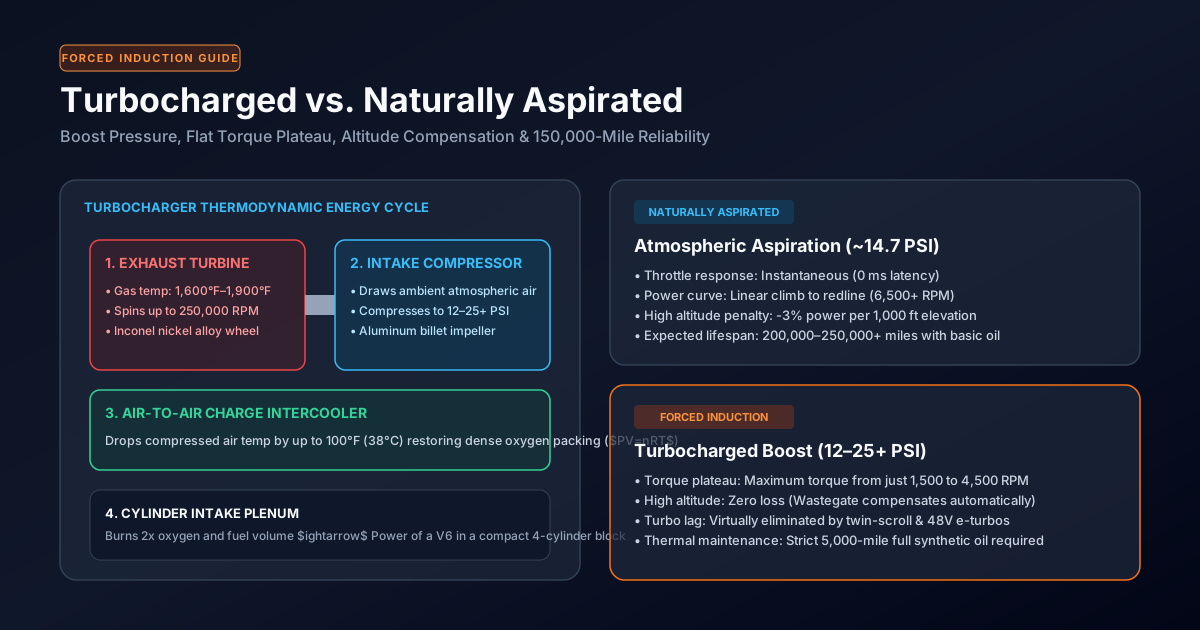
By forcing compressed air into a 2.0L engine at 18 psi of boost, the small engine burns the same volume of air and fuel as a 3.5L V6 under hard acceleration. When cruising at steady highway speeds, the turbo wastegate opens, boost drops to zero, and the engine sips gasoline with the frugal appetite of a subcompact 2.0L engine.
To learn more about the thermal and mechanical differences between these systems, read our dedicated guide on turbocharged vs naturally aspirated engines.
5. What Engine Displacement Still Tells You as a Car Buyer
Even with advanced turbocharging and hybrid electrification, displacement remains a critical indicator of vehicle character:
- 1.Sustained Heavy Towing and Thermal Load: While a 2.0T engine can tow a light trailer, sustained heavy pulling (such as towing a 7,000-lb travel trailer up an 8% mountain grade) forces the turbo to run under continuous full boost, creating extreme exhaust gas temperatures exceeding 1,700°F (925°C). Larger displacement engines (such as 3.5L twin-turbo V6s or 5.7L V8s in the Toyota Land Cruiser) distribute thermal loads across more surface area, providing superior long-term durability.
- 2.Cylinder Harmonics and Smoothness: Displacement distributed across more cylinders produces smoother power delivery. A 3.0L Inline-6 engine possesses perfect natural primary and secondary mechanical balance. Conversely, a 1.2L 3-cylinder engine exhibits inherent shaking forces that require heavy balance shafts.
- 3.Global Tax and Registration Brackets: In many European, Asian, and Latin American countries, annual vehicle ownership taxes, import duties, and road fees are scaled directly to engine displacement brackets (typically spiking above 1,600 cc and 2,000 cc).
To compare real-world fuel economy across engine sizes, review our comprehensive breakdown on how city, highway, and combined MPG is calculated, or audit individual models in our Car Data Index Catalog.
Frequently asked questions
What does 2.0L mean on a car?
When a car badge or spec sheet says '2.0L', it means the combined internal volume of all the engine's combustion cylinders is approximately 2.0 liters (or roughly 1,998 to 2,000 cubic centimeters). During one complete piston stroke from Bottom Dead Center to Top Dead Center, all cylinders together displace 2.0 liters of air-fuel mixture.
What does a 3.5L engine mean compared to a 2.0L?
A 3.5L engine has an internal swept cylinder capacity of 3,500 cubic centimeters (cc), which is 75% larger than a 2.0L engine (2,000 cc). Historically, a 3.5L engine was configured as a 6-cylinder (V6) producing more natural torque without turbochargers. Modern 2.0L turbocharged 4-cylinders now match or exceed 3.5L V6 torque outputs while providing superior cruising fuel efficiency.
Is a bigger engine displacement always better?
Not necessarily. Larger displacement engines burn more fuel at idle and in stop-and-go driving because they have larger cylinders and higher internal friction. However, large displacement engines excel in heavy sustained towing, off-road crawling, and long-term thermal endurance under continuous heavy loads.
How do you calculate engine displacement?
Engine displacement is calculated with the cylinder geometry formula: Displacement = (? ÷ 4) × (Bore)² × Stroke × Number of Cylinders. 'Bore' is the internal diameter of the cylinder in millimeters, and 'Stroke' is the distance the piston travels up and down.
Why are modern car engines shrinking in displacement?
Automakers downsize engine displacement to meet stringent international emissions and fuel economy regulations. Pairing a smaller 1.5L or 2.0L engine with a turbocharger allows the car to produce V6-level passing power under acceleration while consuming subcompact levels of gasoline when cruising off-boost.
Cite this page: https://cardataindex.com/blog/engine-displacement-explained
Keep researching
Cross-check the numbers in this guide against live factory data in our specification index or decode a specific car with the free VIN decoder.