Turbocharged vs. Naturally Aspirated Engines: Boost, Lag, Reliability & Fuel Economy
Factory turbos now dominate new cars, but naturally aspirated engines still have real advantages. A balanced look at power, economy and reliability.
Car Data Index Editorial
Automotive data desk · Sources: NHTSA · EPA · OEM records
In modern automotive engineering, internal combustion engines are divided into two primary aspiration philosophies: Naturally Aspirated (NA) engines and Forced-Induction Turbocharged engines.
Over the past decade, strict federal emissions and Corporate Average Fuel Economy (CAFE) mandates have driven automakers to replace large displacement naturally aspirated V6 and V8 engines with compact, boosted 4-cylinder and 6-cylinder powerplants.
Understanding the mechanical distinctions, thermodynamic realities, high-altitude performance variations, and long-term 150,000-mile reliability risks of each engine type will help you select the ideal powertrain for your ownership timeline.
To verify the exact engine displacement, aspiration type, cylinder count, and fuel induction on any pre-owned vehicle, enter its 17-digit code into our free NHTSA VIN decoder tool.
1. Turbocharged vs. Naturally Aspirated Engineering Matrix
Here is how atmospheric aspiration and turbocharged forced induction compare across vital mechanical, thermal, and performance specifications:
| Engineering Dimension | Naturally Aspirated (NA) | Turbocharged (Forced Induction) |
|---|---|---|
| Intake Manifold Pressure | Atmospheric ~14.7 psi (Absolute vacuum pull) | Boosted: 12 to 24+ psi gauge pressure (26–38 psi absolute) |
| Peak Torque Availability | Peak at high RPM (typically 3,800 to 5,200 RPM) | Broad low-RPM plateau (1,500 to 4,500 RPM) |
| Throttle Latency (Response) | Instantaneous (0 ms mechanical delay) | Slight hesitation (150 to 500 ms turbo lag) |
| High Altitude Performance | Loses ~3% power per 1,000 ft elevation | Virtually 0% loss (Wastegate compensates dynamically) |
| Operating Temperatures | Standard exhaust temp (~1,200°F / 650°C) | Extreme exhaust temp (1,600°F – 1,900°F / 1,040°C) |
| Mechanical Complexity | Low (Fewer moving parts and seals) | High (Turbine, compressor, intercooler, wastegate, BOV) |
| Oil Degradation Rate | Standard thermal oxidation | Rapid thermal shearing and coking risk under high heat |
| Expected Service Lifespan | 200,000 – 250,000+ miles with basic maintenance | 150,000 – 200,000 miles before turbo cartridge service |
| Representative Catalog Models | Hyundai Kona 2.0L NA, Ford Mustang 5.0L V8 | BMW 3 Series B48/B58, Toyota Land Cruiser 3.4L Twin-Turbo |
2. Combustion Physics: How A Turbocharger Recaptures Wasted Thermal Energy
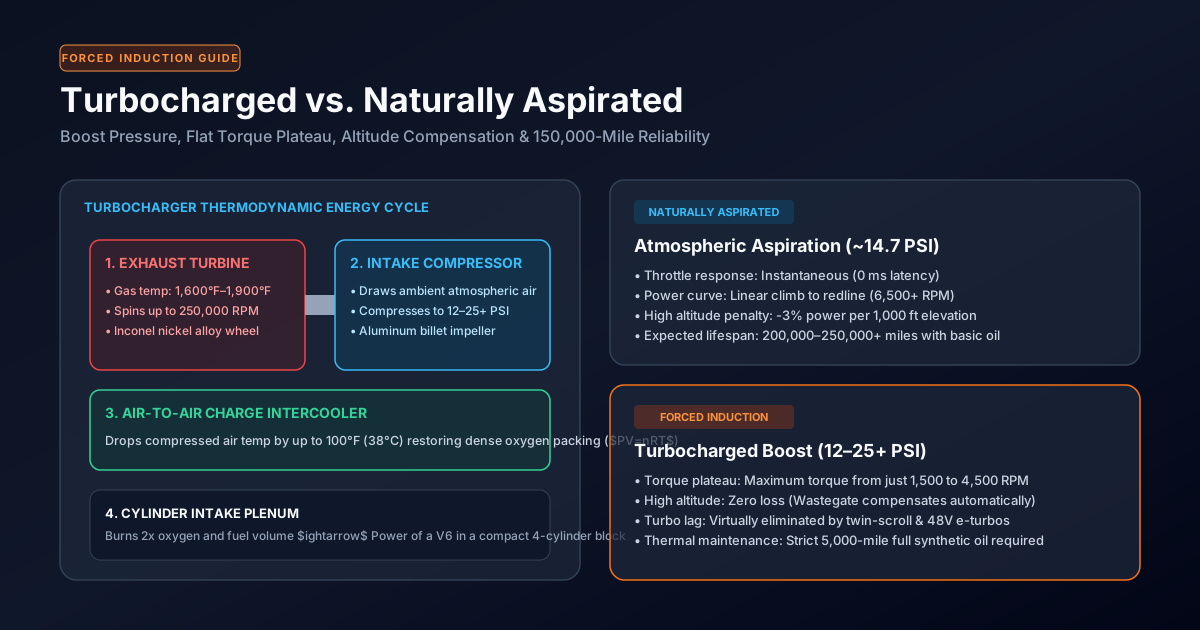
An internal combustion engine is thermodynamically inefficient: roughly one-third of the chemical energy in gasoline is wasted as scorched exhaust heat rushing out the tailpipe. A turbocharger recaptures this discarded kinetic and thermal energy.
The 4-Stage Turbocharger Cycle
- 1.Exhaust Gas Flow: Scorching exhaust gases exiting the combustion chambers flow into a cast-iron snail-shaped turbine housing.
- 2.Turbine Spinning: The velocity and expansion of the hot gas spin a nickel-alloy (Inconel) turbine wheel at rotational velocities reaching 150,000 to 250,000 RPM.
- 3.Shaft-Driven Compressor: A central rotating assembly (CHRA) transfers this rotational kinetic energy via a hardened steel shaft to an aluminum compressor impeller wheel located on the intake side.
- 4.Air Compression & Intercooling: The compressor draws ambient air and packs it into the intake tract. Compressing air heats it dramatically ($PV = nRT$). To restore oxygen density, the pressurized air passes through an air-to-air or air-to-liquid intercooler, dropping intake charge temperatures by up to 100°F before entering the combustion cylinders.
By forcing twice as much air into the cylinder, the engine can inject twice as much fuel, generating the power and torque of an engine twice its physical displacement.
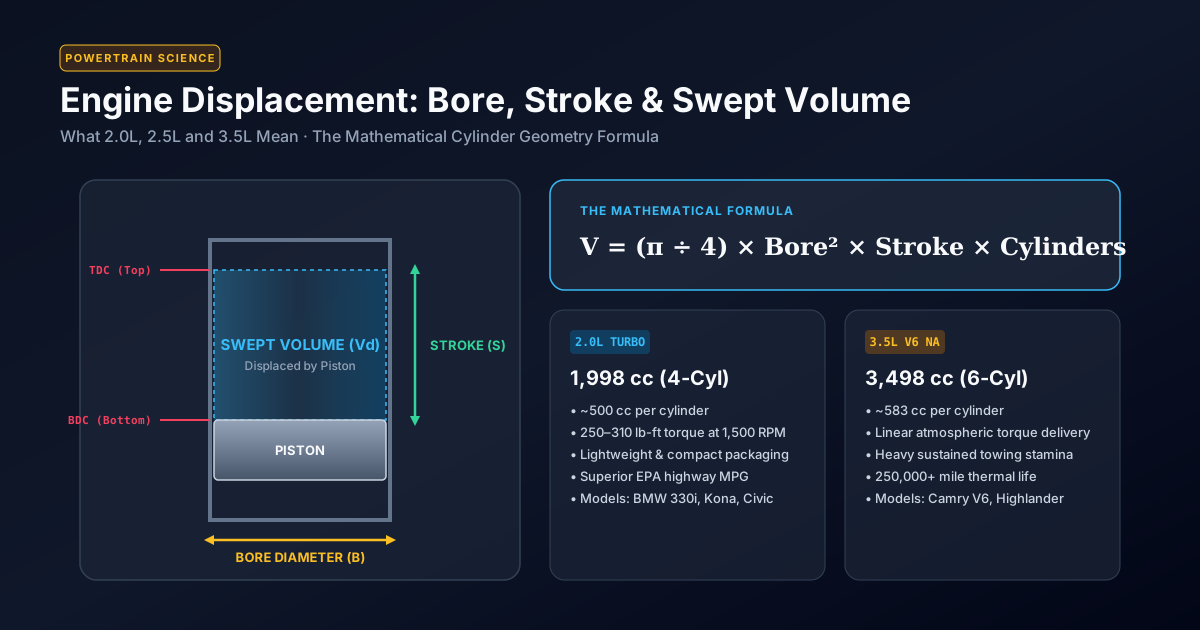
To see how engine swept volume is calculated mathematically, consult our guide on engine displacement explained (2.0L vs 2.5L vs 3.5L).
3. Power Delivery: Low-End Torque Plateau vs. Linear Progression
The most immediate practical difference you will feel behind the wheel is the engine's torque curve profile:
The Turbo Torque Plateau
Naturally aspirated engines require high rotational speeds to draw in substantial air volume. A naturally aspirated 2.5L 4-cylinder might generate 180 lb-ft of torque, but that peak torque is only delivered when the engine revs up to 4,400 RPM.
In contrast, a modern 2.0L turbocharged engine (such as the B48 in the BMW 3 Series or the Smartstream 2.5T in the Hyundai Santa Fe):
- Produces 311 lb-ft of peak torque.
- Delivers 100% of that maximum torque starting at just 1,500 RPM.
- Holds that flat torque plateau continuously all the way to 4,000 RPM.
In daily driving, this means you can merge onto highways, pass tractor-trailers, or climb steep grades without downshifting through multiple gears or revving the engine loudly.
The Natural Aspirated Linear Progression
Naturally aspirated engines deliver perfectly proportional power delivery: $$\text{Power Output} \propto \text{Engine RPM}$$
As engine RPM climbs, power builds seamlessly in a straight diagonal line up to redline. For spirited driving on twisty mountain passes or racetracks, this linear throttle connection gives the driver surgical control over rear-wheel grip without unexpected mid-corner boost spikes.
4. Turbo Lag: Mechanical Causes & Modern Engineering Fixes
Turbo lag is the physical delay between the moment you depress the throttle pedal and when the turbocharger produces full manifold boost pressure.
Because the turbocharger relies on the velocity and pressure of exhaust gas to spool its turbine wheel, a low-RPM engine requires a brief fraction of a second to build enough exhaust volume to accelerate the turbine.
Automakers have virtually eliminated perceptible turbo lag in modern vehicles through four engineering innovations:
- 1.Twin-Scroll Turbochargers: Divides the exhaust manifold into two separate channels separating cylinders whose exhaust pulses would otherwise interfere with each other, maintaining exhaust velocity at low engine speeds.
- 2.Integrated Cylinder Head Exhaust Manifolds: Automakers cast the exhaust manifold directly inside the aluminum cylinder head, shortening the physical distance exhaust gases must travel to reach the turbine.
- 3.Electronic Wastegates: Computerized electric actuators close the internal bypass valve instantly upon throttle tip-in, spooling boost up to 300% faster than older vacuum-diaphragm wastegates.
- 4.48-Volt Mild-Hybrid e-Turbos: Systems equipped with small electric motor compressors that spin the intake impeller within 200 milliseconds before exhaust gases arrive, delivering instantaneous launch torque.
5. High-Altitude Performance: The Mountain Advantage
If you drive in elevated regions (such as the Rocky Mountains, Denver, or Alpine passes), forced induction is vastly superior to atmospheric aspiration:
- Atmospheric Thinning: As elevation increases, atmospheric air density decreases by roughly 3% per 1,000 feet.
- The NA Penalty: At an elevation of 6,000 feet, a naturally aspirated engine suffers an unavoidable 18% loss in peak horsepower and torque, feeling sluggish and struggling up steep inclines.
- The Turbo Advantage: A turbocharged engine utilizes ambient barometric sensors. When it detects lower atmospheric pressure, the engine control unit (ECU) commands the wastegate to stay closed longer. The turbo simply spins slightly faster to maintain its designated sea-level manifold boost target (e.g., 18 psi absolute), suffering virtually zero loss in sea-level passing power.
To understand how high-altitude driving affects EPA fuel economy ratings across city and highway cycles, check our EPA fuel economy guide.
6. The Downsizing Paradox: EPA Ratings vs. Real-World Fuel Economy
Automakers heavily promote "engine downsizing" (replacing a 3.5L V6 with a 2.0L Turbo 4-cylinder) as an environmental breakthrough. However, real-world fuel economy frequently surprises drivers:
Why Turbos Win in the EPA Lab
During the gentle, low-acceleration driving cycles used in federal EPA dynamometer testing, a 2.0L turbocharged engine operates with the throttle barely open, staying completely out of positive boost. It runs with the mechanical friction and pumping losses of a small 2.0L engine, returning stellar EPA window sticker ratings.
Why Real-World Fuel Economy Drops Under Load
When you tow a heavy trailer, accelerate vigorously up a highway on-ramp, or cruise at 80 mph:
- The engine enters high boost pressure (15–20+ psi).
- To prevent catastrophic pre-ignition (engine knock) caused by immense cylinder heat, the engine computer commands fuel enrichment (dumping excess gasoline into the cylinder to cool the exhaust valves and piston crowns).
- As a result, fuel consumption can surge dramatically, often matching or exceeding the fuel consumption of a larger naturally aspirated engine doing the same work.
7. 150,000-Mile Reliability & Essential Maintenance Protocols
If you plan to own your vehicle past 100,000 to 150,000 miles, turbocharged engines demand stricter mechanical discipline:
Thermal Stress & Oil Coking
Exhaust gas passing through the turbocharger reaches temperatures between 1,600°F and 1,900°F (870°C to 1,040°C). The central bearing shaft must be continuously lubricated by engine motor oil.
- If cheap conventional oil is used, or if oil change intervals are stretched to 10,000 miles, the extreme heat bakes and solidifies the oil into abrasive carbon granules, a failure mode called oil coking.
- Carbon coking clogs the oil feed passages, starving the turbo bearings and causing the turbine shaft to seize or shatter.
The 3 Rules for Turbo Longevity:
- 1.Strict 5,000-Mile Full-Synthetic Intervals: Always utilize manufacturer-approved high-temperature full synthetic oil meeting API SP / ILSAC GF-6 standards to resist thermal breakdown.
- 2.Idle Cool-Down Routine: After spirited driving or heavy towing, allow the engine to idle for 60 to 90 seconds before shutting off the ignition. This allows circulating engine oil and coolant to draw heat away from the turbine housing, preventing hot spots.
- 3.High-Flow Engine Air Filter Maintenance: Because a turbo compressor wheel spins at 200,000 RPM, any micro-debris bypassing a dirty or damaged air filter will sandblast the aluminum compressor blades, eroding boost efficiency.
8. Summary: Which Engine Architecture Should You Choose?
Use this targeted recommendation guide when evaluating your next vehicle:
1. Choose a Naturally Aspirated Engine If: - You intend to keep the vehicle for 10 to 15+ years (200,000+ miles) with minimal maintenance anxiety and the lowest cost of long-term ownership. - You demand pristine, instantaneous throttle response and love the acoustic character of an un-muffled engine revving to redline. - You primarily drive in flat, low-elevation regions with moderate driving habits. 2. Choose a Turbocharged Engine If: - You want effortless passing power, heavy low-RPM pulling torque, and quick acceleration without noisy engine downshifts. - You live or drive frequently at high altitudes or in mountainous terrain. - You lease or purchase vehicles for 3 to 6-year ownership cycles where warranty coverage protects forced-induction hardware.
Frequently asked questions
What is the primary difference between a turbo and naturally aspirated engine?
A naturally aspirated (NA) engine draws air into its combustion chambers solely through the negative pressure (vacuum) created by the downward stroke of the pistons at ambient atmospheric pressure (14.7 psi at sea level). A turbocharged engine uses a turbine driven by high-velocity exhaust gases to spin an intake compressor wheel, forcing pressurized air (boost) into the cylinders, allowing a smaller engine to burn more fuel and generate the power of a much larger engine.
Do turbocharged engines wear out faster than naturally aspirated engines?
Historically, turbocharged engines experience higher thermal stress and internal cylinder pressures (BMEP). Exhaust turbine housings regularly exceed 1,700°F (925°C), which can degrade conventional motor oil and cause carbon coking around the turbocharger bearing cartridge. With modern water-cooled turbo housings, high-temperature synthetic motor oil, and 5,000-mile maintenance intervals, contemporary turbo engines regularly reach 150,000 to 200,000 miles without failure.
What is turbo lag and can it be eliminated?
Turbo lag is the brief hesitation between when the driver steps down on the accelerator and when the engine produces full boost pressure. Because the turbine wheel relies on exhaust gas volume to spool up to operating speeds of 150,000+ RPM, there is a mechanical delay of 0.2 to 0.8 seconds. Modern automakers minimize lag using low-inertia twin-scroll turbine housings, electric 48V auxiliary compressors, and integrated exhaust manifolds.
Why do turbocharged engines perform dramatically better at high elevations?
At high altitudes (such as Denver, Colorado at 5,280 ft), atmospheric pressure drops significantly, thinning the air. Naturally aspirated engines lose roughly 3% horsepower per 1,000 feet of elevation (~16% power loss at 5,000 ft). Turbocharged engines utilize an electronically controlled wastegate that automatically commands the turbo to spin faster, packing standard sea-level air density into the engine and preventing horsepower degradation.
Do small turbocharged engines actually get better real-world fuel economy?
On official EPA laboratory dynamometer test cycles, small turbocharged engines achieve outstanding fuel economy because they operate predominantly off-boost under gentle throttle. However, in aggressive real-world driving or heavy towing, the engine stays in high boost, requiring rich air-fuel mixtures (fuel enrichment to prevent knock and cool exhaust valves), which often causes real-world MPG to drop well below EPA estimates.
Why do automotive enthusiasts still prefer naturally aspirated engines?
Enthusiasts cherish naturally aspirated engines for their instantaneous zero-latency throttle modulation, intoxicating high-revving exhaust symphony (up to 7,000–9,000 RPM), and predictable, linear power delivery that allows pinpoint chassis balance on racetracks.
Cite this page: https://cardataindex.com/blog/turbocharged-vs-naturally-aspirated
Keep researching
Cross-check the numbers in this guide against live factory data in our specification index or decode a specific car with the free VIN decoder.