Best 50+ MPG Commuter Cars: Official EPA Fuel Economy Rankings (Atkinson Cycle, e-CVT Planetary Gears & High-Efficiency Hybrids Compared)
Discover every non-plug-in production vehicle achieving over 50 MPG: Toyota Prius, Hyundai Elantra Hybrid, Toyota Camry, and Corolla Hybrid technical analysis.
Car Data Index Editorial Desk
Automotive data desk · Sources: NHTSA · EPA · OEM records
The Elite 50+ MPG Efficiency Frontier
In the automotive world, crossing the 50 Miles Per Gallon (MPG) threshold without requiring a wall plug or external high-voltage charging cable represents a masterclass in thermodynamic optimization, aerodynamic packaging, and electric power regeneration. While fully electric vehicles (BEVs) dominate urban efficiency headlines, non-plug-in full hybrid vehicles (HEVs) remain the pinnacle of convenience for high-mileage commuters, offering 600-mile cruising ranges, sub-five-minute refueling, and total immunity to charging infrastructure bottlenecks.
To exceed 50 MPG on the rigorous United States Environmental Protection Agency (EPA) five-cycle dynamometer testing procedure, an automobile cannot simply rely on lightweight materials. It requires an internal combustion engine (ICE) operating with thermal efficiency above 40%, ultra-efficient electric motor-generators, low-drag aerodynamic profiling (Cd < 0.27), and predictive kinetic energy recapture.
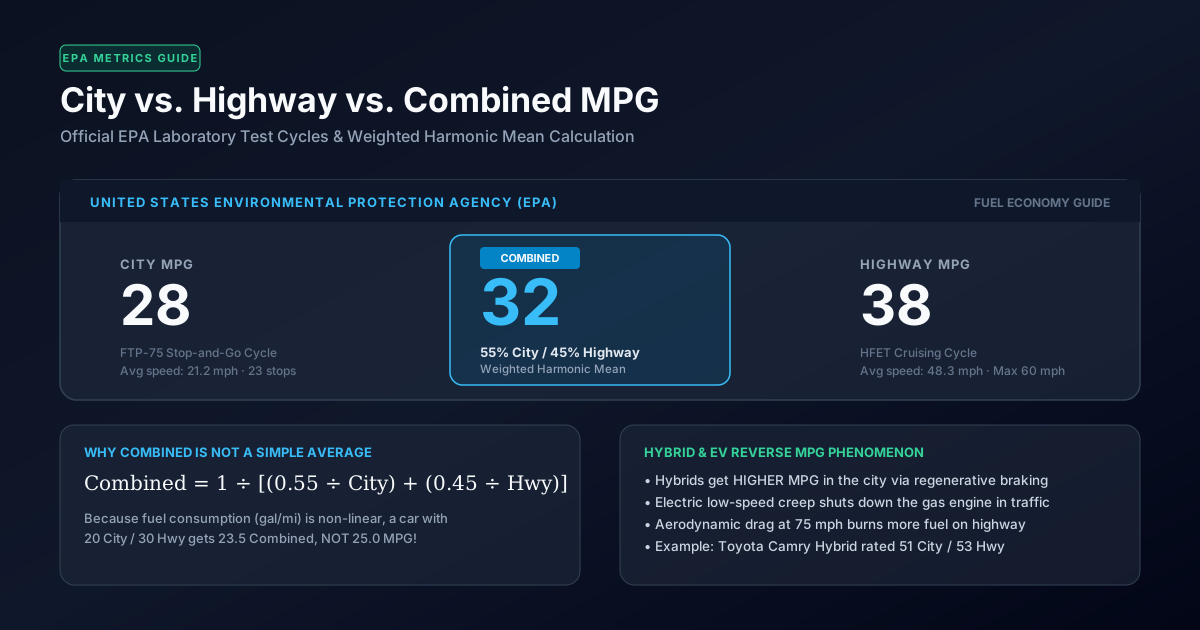
Explore our foundational technical guides on EPA City, Highway and Combined Fuel Economy Metrics and Toyota Hybrid Lineup Engineering Analysis.
Ranked: The Best 50+ MPG Production Commuter Cars (Official EPA Data)
Below are the elite production vehicles certified by the EPA that achieve or exceed 50 MPG in combined city and highway driving:
| Vehicle Model & Trim | Powertrain Configuration | System Power (hp) | EPA City MPG | EPA Hwy MPG | EPA Combined MPG | Cruising Range (Miles) | Annual Fuel Cost (15k mi @ $3.60) |
|---|---|---|---|---|---|---|---|
| Toyota Prius LE (FWD) | 2.0L Atkinson I4 + THS-II e-CVT | 194 hp | 57 MPG | 56 MPG | 57 MPG | 644 miles | $947 |
| Hyundai Elantra Hybrid Blue | 1.6L Atkinson I4 + TMED 6-Speed DCT | 139 hp | 51 MPG | 58 MPG | 54 MPG | 594 miles | $1,000 |
| Toyota Camry LE (FWD) | 2.5L Atkinson I4 + THS-II e-CVT | 225 hp | 53 MPG | 50 MPG | 51 MPG | 663 miles | $1,058 |
| Toyota Corolla Hybrid LE (FWD) | 1.8L Atkinson I4 + THS-II e-CVT | 138 hp | 53 MPG | 46 MPG | 50 MPG | 565 miles | $1,080 |
| Honda Civic Hybrid (Sedan) | 2.0L Atkinson I4 + Two-Motor Hybrid | 200 hp | 50 MPG | 47 MPG | 49 MPG | 519 miles | $1,102 |
| Hyundai Sonata Hybrid Blue | 2.0L Atkinson I4 + TMED 6-Speed Auto | 192 hp | 45 MPG | 51 MPG | 47 MPG | 620 miles | $1,148 |
The Thermodynamics of 50+ MPG: The Atkinson / Miller Combustion Cycle
Standard passenger cars operate on the traditional Otto Cycle, where the intake, compression, power, and exhaust strokes all sweep identical cylinder volumes. In an Otto engine, the compression ratio is strictly limited by the octane rating of the fuel; compressing the air-fuel mixture too aggressively creates premature self-ignition (detonation or engine knock).
``` OTTO CYCLE VS. ATKINSON / MILLER CYCLE
Otto Cycle: Compression Volume (Vc) = Expansion Volume (Ve) [ Intake ] -> [ Compress 10:1 ] -> [ Ignite ] -> [ Expand 10:1 ] -> [ Exhaust ]
Atkinson Cycle (Late Intake Valve Closing - LIVC): Compression Volume (Vc) < Expansion Volume (Ve) [ Intake ] -> [ Valve Stays Open During Early Compression ] -> [ Compress 8:1 ] -> [ Ignite ] -> [ Expand 13:1 ] ^
|-- Pushes part of charge back to intake; Eliminates pumping loss & maximizes expansion work! ```
Late Intake Valve Closing (LIVC)
In the Atkinson/Miller cycle employed by Toyota's Dynamic Force (M20A-FXS, A25A-FXS) and Hyundai's Smartstream engines:
- 1.Intake Valve Stays Open: As the piston begins its upward compression stroke, electronic variable valve timing (VVT-iE) keeps the intake valves open for the first 20–30% of upward piston travel.
- 2.Reduced Pumping Losses: A portion of the trapped intake charge is pushed back into the intake manifold. This lowers the effective compression ratio, preventing pre-ignition knock while dramatically lowering throttle pumping resistance.
- 3.Over-Expansion Work Extraction: Once the combustion occurs, the piston travels the entire stroke downward. The expansion ratio (often 13.0:1 or 14.0:1) is significantly greater than the actual compression ratio. The burning gases continue expanding, extracting maximum thermodynamic enthalpy and lowering exhaust gas temperatures.
- 4.Thermal Efficiency Over 40%: Conventional gasoline engines convert only 25% to 30% of fuel energy into mechanical motion. Toyota’s 2.0L and 2.5L hybrid engines achieve 40% to 41% brake thermal efficiency, placing them among the most efficient internal combustion powerplants in history.
Hybrid Transmission Architectures: Planetary e-CVT vs. Parallel Dual-Clutch
A super-efficient combustion engine cannot achieve 50 MPG in stop-and-go driving alone; it must be coupled with an electrified transmission capable of isolating the engine from inefficient low-RPM dragging and recapturing decelerative inertia.
``` TOYOTA POWER SPLIT DEVICE (e-CVT) PLANETARY GEARSET
[ Sun Gear ] <========> Motor-Generator 1 (MG1 - Generator/Starter)
|
[ Planetary Carrier ] <====> Atkinson Engine Crankshaft
|
[ Ring Gear ] <========> Motor-Generator 2 (MG2 - Traction Motor) + Output Differential ```
1. Toyota Power Split Device (Planetary e-CVT)
Found in the Prius, Camry, and Corolla Hybrid, Toyota's e-CVT contains no belts, pulleys, friction bands, or torque converters:
- The gasoline engine is bolted to the planetary carrier.
- The smaller Motor-Generator (MG1) is connected to the central sun gear.
- The larger Motor-Generator (MG2) is linked directly to the outer ring gear, which is mechanically geared to the vehicle's front differential.
- By electronically controlling the rotational speed and direction of MG1, the computer can seamlessly alter the gear ratio between the engine and the wheels infinitely. The engine operates purely at its optimal specific fuel consumption (BSFC) sweet spot, completely disconnected from road speed.
2. Hyundai TMED (Transmission Mounted Electric Drive)
Found in the Hyundai Elantra Hybrid, Hyundai takes a divergent engineering approach:
- A 1.6-liter naturally aspirated direct-injected Atkinson engine is mated to a 6-speed dry dual-clutch transmission (DCT).
- Sandwiched between the engine clutch and the gearbox input shaft is a 32 kW (43 hp) permanent-magnet synchronous electric motor.
- An engine disconnect clutch allows the vehicle to drive purely on electric power up to 75 mph. When high load is demanded, the clutch engages seamlessly, and the dual-clutch transmission shifts through six physical mechanical gears.
- Driver Feel: Drivers who dislike the constant-RPM drone of planetary e-CVTs favor the Elantra Hybrid because it shifts with distinct, crisp gear changes while still delivering 54 MPG combined.
For a detailed evaluation of transmission durability, see our analysis of Dual-Clutch (DSG/DCT) vs. Torque-Converter Transmissions.
Aerodynamics, Tires, and Regenerative Braking
Reaching 50+ MPG requires addressing every aerodynamic and frictional parasite that leaches kinetic energy at highway velocities:
``` AERODYNAMIC DRAG VS. SPEED FORCE IMPACT
Force of Drag = 1/2 Air Density (Velocity)^2 Drag Area (Cd Frontal Area) At 75 mph, aerodynamic drag consumes over 60% of total powertrain energy! ```
Aerodynamic Packaging (Cd < 0.27)
- 1.Toyota Prius (Cd = 0.27): The teardrop profile directs air smoothly across the roofline, while a full underbody flat tray prevents high-drag turbulence around suspension arms, exhaust pipes, and the fuel tank.
- 2.Active Grille Shutters: When coolant and inverter temperatures are low, motorized slats in the front lower bumper seal completely shut, forcing air around the sleek front fenders rather than through the radiator core.
- 3.Aero-Discs and Wheel Spoke Deflectors: Flush wheel covers prevent the spinning wheels from acting like air centrifuges, reducing parasitic wake turbulence.
Ultra-Low Rolling Resistance (LRR) Tires
Rolling resistance accounts for roughly 15% to 20% of an automobile's energy consumption:
- Vehicles like the Prius LE ride on narrow 195/60R17 or 195/65R15 tires with high silica compounds that resist tread block deformation.
- Lower tread squirm reduces heat generation, lowering the coefficient of rolling resistance (Crr) from 0.010 (standard all-season) down to 0.0065 (high-efficiency LRR).
Regenerative Braking Efficiency
When the brake pedal is depressed, the friction calipers do not initially clamp the rotors. Instead, the vehicle's electric motor (MG2 or TMED motor) switches into a high-capacity AC generator:
- Vehicle momentum spins the rotor against magnetic resistance, generating three-phase AC electricity.
- The power inverter converts this to high-voltage DC (200V–270V), funneling kinetic energy into a 0.9 to 1.4 kWh lithium-ion battery pack.
- Mechanical friction brakes only engage below 5 mph or under emergency stopping thresholds, allowing brake pads on 50+ MPG hybrids to routinely last over 100,000 miles without replacement.
Head-to-Head: Choosing the Right 50+ MPG Commuter
``` ANNUAL GASOLINE EXPENDITURES (Based on 15,000 Miles @ $3.60/Gallon)
Toyota Prius LE (57 MPG) ------------> [ $947 / Year ] Hyundai Elantra Hybrid (54 MPG) ------> [ $1,000 / Year ] Toyota Camry LE (51 MPG) ------------> [ $1,058 / Year ] Average Midsize Car (28 MPG) --------> [ $1,928 / Year ] <--- $981 MORE EVERY YEAR! Large V8 SUV (16 MPG) ---------------> [ $3,375 / Year ] <--- $2,428 MORE EVERY YEAR! ```
1. The Maximum Mileage Champion: Toyota Prius LE (57 MPG) With a sleek liftback silhouette, 194 horsepower (0-60 mph in 7.1 seconds), and an astonishing 57 MPG combined rating, the fifth-generation Prius dispels all stereotypes of slow, dull economy cars. It is the ultimate high-efficiency commuter. 2. The High-Value Traditional Sedan: Hyundai Elantra Hybrid Blue (54 MPG) For buyers who want an affordable, highly-equipped compact sedan with physical transmission gear shifts and a 10-year/100,000-mile powertrain warranty, the Elantra Hybrid is an unbeatable financial equation. 3. The Executive Long-Distance Cruiser: Toyota Camry LE (51 MPG) Redesigned exclusively as a hybrid for 2025, the Camry LE proves you do not have to sacrifice passenger comfort, rear legroom, or 225 horsepower to achieve 51 MPG. It is the gold standard for highway road trips and family commuting.
Frequently asked questions
What non-plug-in production car achieves the highest official EPA fuel economy?
The front-wheel-drive Toyota Prius LE holds the highest non-plug-in EPA rating on the market, achieving 57 MPG City / 56 MPG Highway / 57 MPG Combined. It is powered by Toyota's fifth-generation 2.0L Dynamic Force inline-4 hybrid powertrain generating 194 total system horsepower.
How does the Atkinson cycle engine achieve 40% thermal efficiency in hybrid cars?
The Atkinson cycle uses variable valve timing to keep the intake valve open into the beginning of the compression stroke, effectively pushing part of the air-fuel mixture back into the intake manifold. This creates an expansion ratio significantly larger than the compression ratio, extracting more mechanical work from each combustion event without triggering engine knock.
Does a 50+ MPG hybrid actually get 50 MPG on the highway during winter months?
In real-world winter conditions (freezing temperatures), hybrid fuel economy typically drops by 10% to 20% (down to roughly 42–46 MPG). This is caused by three factors: the internal combustion engine must run frequently to generate cabin heater core warmth, cold lithium-ion battery chemistry has higher internal resistance, and winter-blend gasoline contains slightly lower energy density (BTU per gallon).
Which 50+ MPG commuter car offers the best rear-seat passenger room and trunk space?
The redesigned 2025 Toyota Camry LE delivers the best passenger space among 50+ MPG vehicles, offering 38.0 inches of rear legroom, 15.1 cubic feet of trunk volume, and an EPA rating of 53 MPG City / 50 MPG Highway / 51 MPG Combined, functioning as a full midsize family sedan.
How does Toyota's e-CVT differ from conventional belt-and-pulley CVTs that drivers dislike?
Toyota's e-CVT does not use any push-belts, pulleys, or cones. Instead, it utilizes a planetary gear set (Power Split Device) where the gasoline engine connects to the planet carrier, Motor-Generator 1 (MG1) connects to the sun gear, and Motor-Generator 2 (MG2) connects directly to the outer ring gear driving the differential. It is mechanically bulletproof and lacks the slipping belts or friction bands of conventional CVTs.
Cite this page: https://cardataindex.com/blog/best-50-mpg-commuter-cars-fuel-economy-guide
Keep researching
Cross-check the numbers in this guide against live factory data in our specification index or decode a specific car with the free VIN decoder.