City vs. Highway vs. Combined MPG Explained: EPA Formula & Real-World Guide
What do the three MPG numbers on a spec sheet actually mean, why is your real-world figure lower, and which should you care about? A complete guide.
Car Data Index Editorial
Automotive data desk · Sources: NHTSA · EPA · OEM records
On every new vehicle window sticker (Monroney label) sold in the United States, the Environmental Protection Agency (EPA) mandates three primary fuel economy metrics: City MPG, Highway MPG, and Combined MPG.
While most car shoppers glance at these numbers as simple benchmarks, understanding how the EPA calculates combined mileage, how laboratory dynamometer cycles work, and why hybrid vehicles flip traditional fuel economy rules upside down is essential for budgeting long-term vehicle ownership costs.
To explore top-ranking fuel-efficient vehicles across all powertrain classes, explore our curated Best MPG Cars Guide.
1. City vs. Highway vs. Combined MPG: Core Testing Parameters
The EPA evaluates vehicles inside controlled climate-regulated laboratory environments using chassis dynamometers (large rolling road test benches) to eliminate wind, weather, and traffic variables:
| Testing Metric | Official Test Cycle | Distance & Duration | Average Speed | Max Speed & Stops | Primary Engineering Challenge |
|---|---|---|---|---|---|
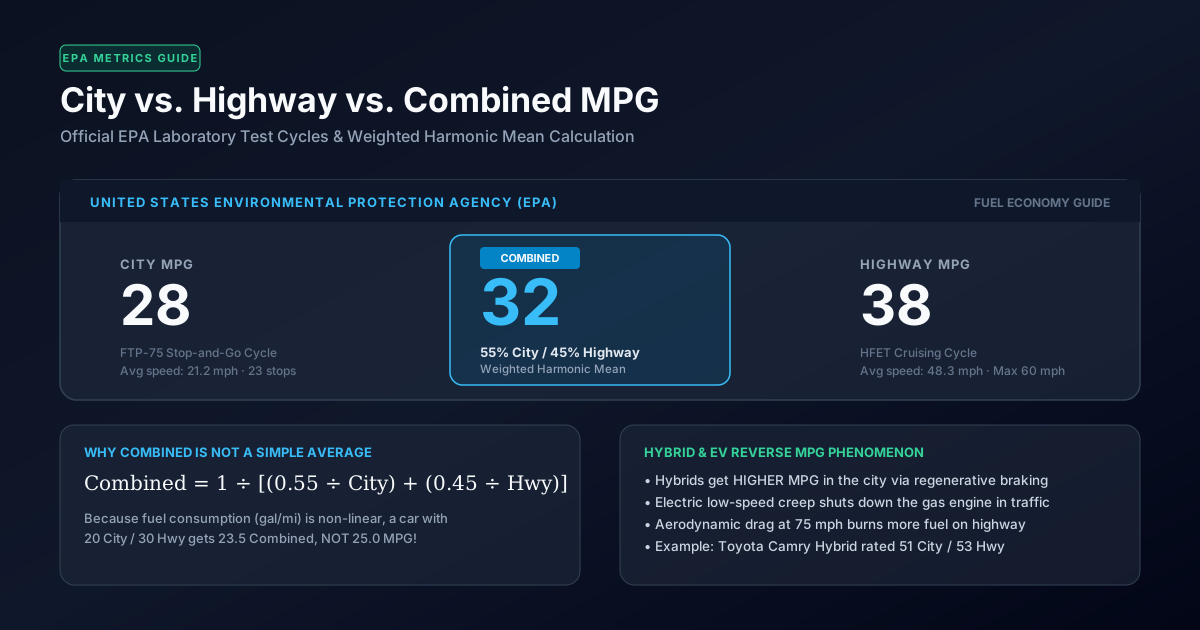
| City MPG | FTP-75 (Federal Test Procedure) | 11.04 miles (17.77 km) / 31 minutes | 21.2 mph (34.1 km/h) | 56.7 mph / 23 stops (18% idle time) | Overcoming inertia during repeated vehicle acceleration |
| Highway MPG | HFET (Highway Fuel Economy Test) | 10.26 miles (16.51 km) / 12.75 minutes | 48.3 mph (77.7 km/h) | 59.9 mph / Zero stops (continuous) | Overcoming aerodynamic drag at sustained highway velocity |
| Combined MPG | Weighted Harmonic Formulation | 55% City + 45% Highway blend | Blended calculation | Representative typical mix | Gallons consumed per mile weighted across driving cycles |
Notice that the official EPA highway test maxes out at 59.9 mph with an average speed under 50 mph. Because interstate speed limits across the United States frequently reach 70 to 80 mph, modern drivers often find their real-world highway consumption higher than the window sticker.
2. The Math Behind Combined MPG: The Harmonic Mean Formula
A frequent misconception among car buyers is assuming that Combined MPG is simply the arithmetic average of City and Highway ratings.
For example, if a car is rated at 19 City / 30 Highway, many assume the combined rating is: $(19 + 30) ÷ 2 = 24.5 ext{ MPG}$. This is mathematically incorrect.
Because fuel consumption scales with gallons consumed per unit of distance rather than miles traveled per gallon, the EPA mandates a weighted harmonic mean:
`` Combined MPG = 1 ÷ [(0.55 ÷ City MPG) + (0.45 ÷ Highway MPG)] ``
Example 1: Calculating 19 City / 30 Highway
- City fuel portion (55%): $0.55 ÷ 19 = mathbf{0.028947 ext{ gallons/mile}}$
- Highway fuel portion (45%): $0.45 ÷ 30 = mathbf{0.015000 ext{ gallons/mile}}$
- Total weighted fuel consumption: $0.028947 + 0.015000 = mathbf{0.043947 ext{ gallons/mile}}$
- Combined MPG: $1 ÷ 0.043947 = mathbf{22.75 ext{ MPG}}$ (Rounds on window sticker to 23 MPG, not 24.5!)
Example 2: Calculating 20 City / 26 Highway
- City portion: $0.55 ÷ 20 = mathbf{0.027500 ext{ gallons/mile}}$
- Highway portion: $0.45 ÷ 26 = mathbf{0.017308 ext{ gallons/mile}}$
- Total consumption: $0.027500 + 0.017308 = mathbf{0.044808 ext{ gallons/mile}}$
- Combined MPG: $1 ÷ 0.044808 = mathbf{22.32 ext{ MPG}}$ (Rounds to 22 MPG).
Because urban stop-and-go driving burns significantly more fuel per mile, low city ratings heavily penalize the vehicle's combined score.
3. Real Database Vehicle Ratings: Gas vs. Hybrid vs. Electric
To understand how powertrain architectures impact EPA fuel efficiency, look at real vehicles cataloged across our database:
| Vehicle Model & Trim | Powertrain Architecture | Drivetrain | City MPG | Highway MPG | Combined MPG | Annual Fuel Expense (Est.) |
|---|---|---|---|---|---|---|
| **Hyundai Kona Electric** | 64.8 kWh Pure EV (201 hp) | FWD | 129 MPGe | 103 MPGe | 116 MPGe | \$650 |
| **Hyundai Tucson Hybrid** | 1.6L Turbo HEV (226 hp) | HTRAC AWD | 38 MPG | 38 MPG | 38 MPG | \$1,250 |
| **Hyundai Santa Fe 2.5T** | 2.5L Turbo GDI (281 hp) | FWD | 20 MPG | 29 MPG | 24 MPG | \$2,000 |
| **Hyundai Santa Fe 2.5T** | 2.5L Turbo GDI (281 hp) | HTRAC AWD | 19 MPG | 26 MPG | 22 MPG | \$2,200 |
| **BMW 330i Sedan** | 2.0L Turbo (B48 255 hp) | RWD | 25 MPG | 34 MPG | 28 MPG | \$1,950 |
| **Toyota Land Cruiser** | 3.4L Twin-Turbo V6 (409 hp) | Full-Time 4WD | 17 MPG | 22 MPG | 19 MPG | \$2,750 |
For a segment-by-segment comparison of dimensions, towing capabilities, and powertrain efficiency across crossovers, read our Hyundai SUV lineup comparison guide.
4. Why Hybrids Invert the Rule: Higher City Than Highway MPG
For conventional internal combustion cars, Highway MPG is always 20% to 40% higher than City MPG. However, hybrid vehicles (like the Toyota Camry Hybrid or Hyundai Tucson Hybrid) routinely demonstrate the opposite: equal or higher City MPG than Highway MPG.
Three engineering factors explain this inversion:
- 1.Regenerative Braking: When a gas car brakes, kinetic momentum is turned into wasted friction heat. Hybrids reverse the electric motor into a generator during braking, converting kinetic deceleration back into high-voltage battery storage.
- 2.Engine Shut-Off at Low Speeds: During low-speed stop-and-go commuting, crawling in traffic, or idling at red lights, the gasoline engine completely shuts off. The car moves on electric power alone.
- 3.Aerodynamic Resistance at Highway Speeds: On the highway, the car travels continuously at 70+ mph without braking opportunities. Continuous aerodynamic drag forces the internal combustion engine to run continuously, neutralizing the hybrid's battery-regeneration advantage.
5. What Is MPGe? (Miles Per Gallon Equivalent for EVs)
Because electric vehicles do not consume liquid fuel, the EPA established MPGe (Miles Per Gallon of Gasoline Equivalent) in 2010 to allow consumers to compare EVs with gasoline cars:
- Energy Benchmark: One US gallon of regular unleaded gasoline contains approximately 114,989 British Thermal Units (BTU) of potential chemical energy.
- Electrical Equivalent: Converted into electricity, this equals exactly 33.705 kilowatt-hours (kWh).
- Calculation: If an electric vehicle uses 33.7 kWh of electricity to travel 100 miles, its rating is 100 MPGe.
Because electric drivetrains convert over 85% of electrical energy directly into wheel movement (compared to only 20–30% thermal efficiency in gasoline combustion engines), EVs routinely score between 100 and 130 MPGe.
6. Real-World Factors That Reduce MPG
If your vehicle rarely achieves its EPA window sticker rating, five physical variables are usually responsible:
- 1.Highway Cruising Speeds: Aerodynamic drag increases with the square of vehicle speed. Cruising at 75 mph requires nearly 40% more horsepower to overcome wind resistance than cruising at 55 mph, reducing fuel economy by 12% to 18%.
- 2.Cold Weather Operation: Below 35°F (2°C), engines take twice as long to reach optimal operating temperature, winter-blend gasoline contains 1.5% less energy per gallon, and cold air is denser, creating higher aerodynamic drag.
- 3.Tire Inflation Pressure: Every 3 psi drop in tire pressure increases rolling resistance, penalizing fuel economy by 1%.
- 4.Drivetrain Drag (AWD vs FWD): Driving all four wheels through transfer cases, propeller shafts, and rear differentials adds mechanical parasitic drag, lowering fuel economy by 1 to 3 MPG. See our guide on AWD vs 4WD vs FWD drivetrains.
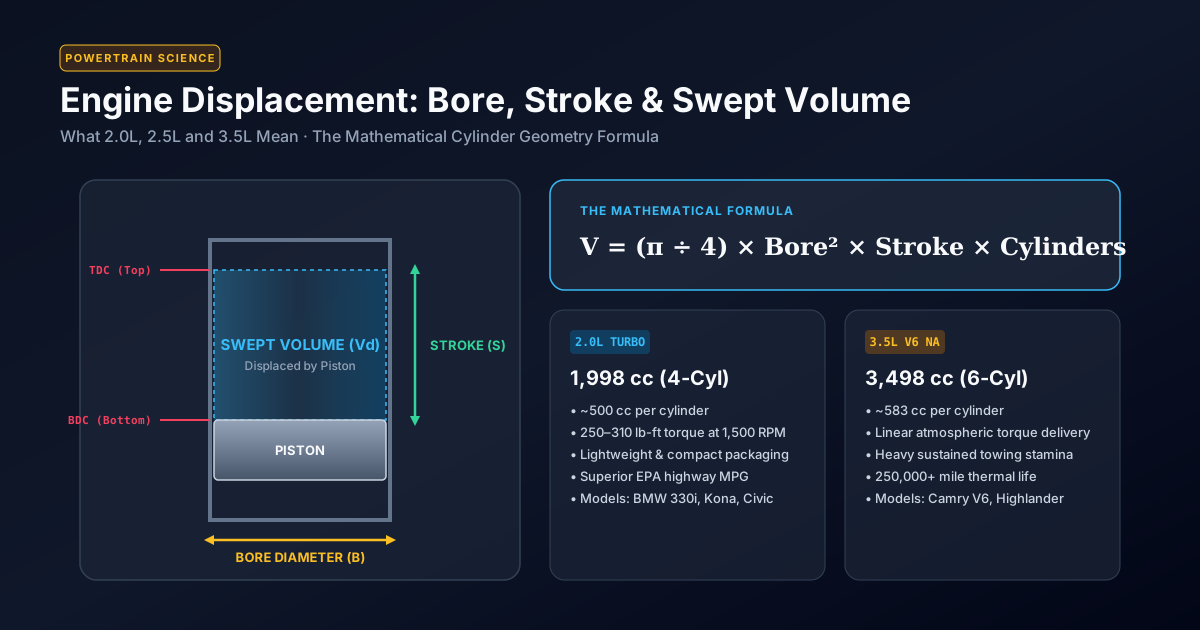
- 5.Engine Displacement & Turbo Boost: Driving an aggressive turbocharged engine under continuous boost forces the engine to enrich its fuel mixture. Learn how displacement metrics influence consumption in our guide on what engine displacement means.
7. How to Convert MPG to Liters Per 100 km (L/100km)
In Europe, Canada, and global markets, fuel consumption is expressed inversely as Liters consumed per 100 kilometers (L/100km):
`` L/100km = 235.215 ÷ US MPG ``
- 20 MPG = $235.215 ÷ 20 = mathbf{11.76 ext{ L/100km}}$
- 30 MPG = $235.215 ÷ 30 = mathbf{7.84 ext{ L/100km}}$
- 40 MPG = $235.215 ÷ 40 = mathbf{5.88 ext{ L/100km}}$
To audit any vehicle's official 17-digit VIN code, factory engine specifications, and fuel delivery system, use our free VIN decoder tool.
Frequently asked questions
What does combined MPG mean?
Combined MPG is an official EPA fuel economy metric that reflects the blended mileage of typical American driving. Rather than taking a simple mathematical average, the EPA uses a weighted harmonic mean assuming 55% urban/city driving and 45% highway cruising based on gallons consumed per mile.
Why is combined MPG lower than the average of city and highway?
Because fuel consumption is non-linear. The EPA formula calculates gallons consumed per mile: Combined MPG = 1 / [(0.55 / City MPG) + (0.45 / Highway MPG)]. A car with 20 City and 30 Highway consumes far more fuel per mile in the city, dragging the combined rating down to 23.5 MPG rather than 25.0 MPG.
Why do hybrid cars get better MPG in the city than on the highway?
Hybrids excel in city driving because regenerative braking recaptures kinetic energy during frequent braking, storing electricity in the battery. Additionally, low-speed stop-and-go commuting operates mostly on the electric motor with the gas engine shut off. On the highway, continuous aerodynamic drag forces the gasoline engine to run constantly.
What is MPGe and how does it compare to MPG?
MPGe stands for Miles Per Gallon Equivalent. The EPA calculates it by equating the chemical energy in one gallon of gasoline (114,989 BTU) to electrical energy: exactly 33.7 kilowatt-hours (kWh). An electric vehicle that consumes 33.7 kWh to travel 116 miles is rated at 116 MPGe.
How do you convert MPG to Liters per 100 Kilometers (L/100km)?
To convert US MPG to the metric L/100km standard used in Europe and internationally, divide 235.215 by the MPG rating: L/100km = 235.215 / MPG. For example, 30 MPG equals approximately 7.84 L/100km.
Cite this page: https://cardataindex.com/blog/mpg-explained-city-highway-combined
Keep researching
Cross-check the numbers in this guide against live factory data in our specification index or decode a specific car with the free VIN decoder.