Hyundai SUV Lineup Compared: Kona vs. Tucson vs. Santa Fe (Sizes, Towing, MPG & Engines)
Choosing the right crossover or sport-utility vehicle within the modern [Hyundai vehicle index](/makes/hyundai) comes down to three key metrics: physical exteri...
Car Data Index Automotive Research Desk
Automotive data desk · Sources: NHTSA · EPA · OEM records
Choosing the right crossover or sport-utility vehicle within the modern Hyundai vehicle index comes down to three key metrics: physical exterior footprint, powertrain requirements (gasoline, hybrid, or EV), and passenger/cargo packaging.
Hyundai's crossover family is methodically organized into distinct dimensional classes. Rather than simply scaling the same chassis, each vehicle is engineered for a specific buyer lifecycle:
- 1.**Hyundai Kona**: Subcompact B-segment crossover engineered for urban maneuverability, tight parking, and entry-level efficiency.
- 2.**Hyundai Tucson**: Compact C-segment SUV built to serve as the single primary vehicle for small families, offering class-leading cargo space and hybrid options.
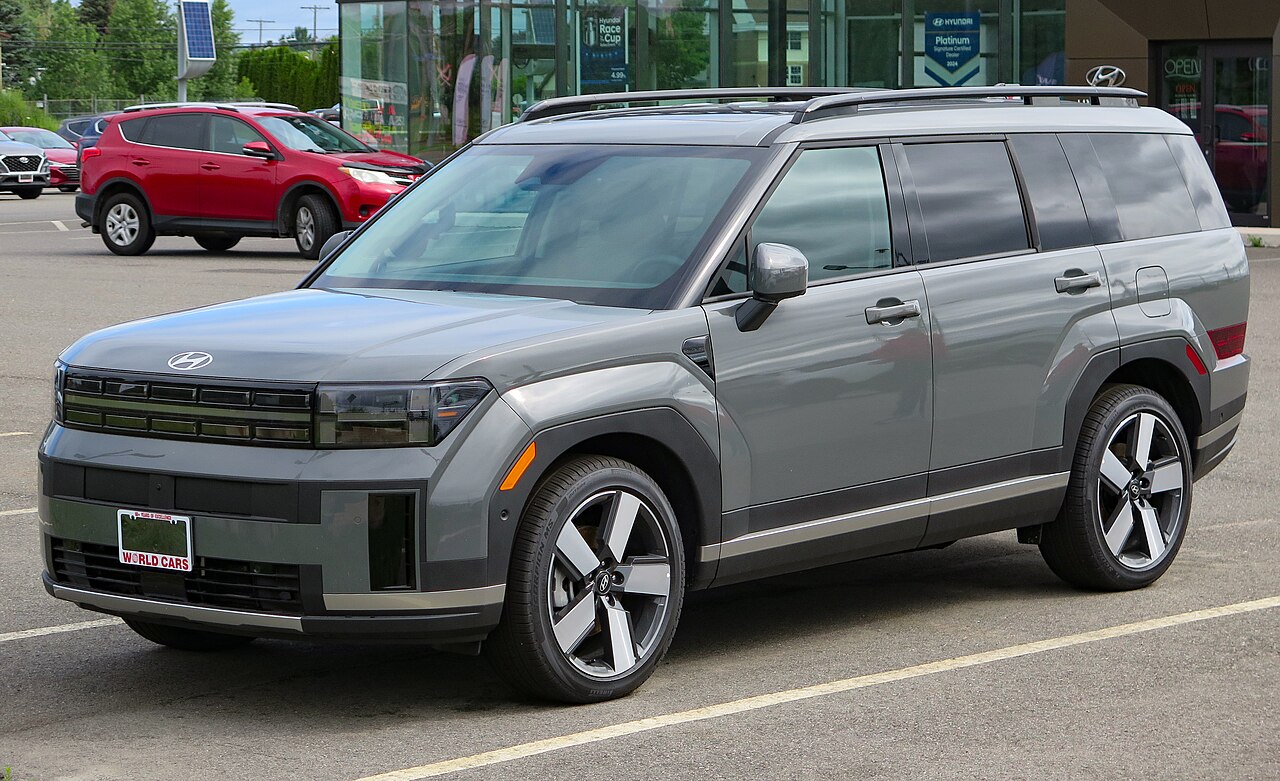
- 3.**Hyundai Santa Fe**: Mid-size D-segment SUV featuring standard three-row seating, substantial towing capability, and high-output turbocharged engines.
Below is an engineering-first comparison dissecting dimensions, real-world fuel economy, mechanical drivetrains, and verified safety data.
1. Technical Dimension & Packaging Matrix
Exterior dimensions dictate garage fitment, interior passenger room, and cargo flexibility. Here is how all three tiers compare across official manufacturer and EPA specifications:
| Metric | Hyundai Kona (SX2) | Hyundai Tucson (NX4) | Hyundai Santa Fe (MX5) |
|---|---|---|---|
| Segment Class | Subcompact Crossover (B-SUV) | Compact SUV (C-SUV) | Mid-Size 3-Row SUV (D-SUV) |
| Seating Capacity | 5 Passengers | 5 Passengers | 6 or 7 Passengers (3 Rows) |
| Overall Length | 171.5 in (4,355 mm) | 182.3 in (4,630 mm) | 190.2 in (4,830 mm) |
| Wheelbase | 104.7 in (2,660 mm) | 108.5 in (2,755 mm) | 110.8 in (2,815 mm) |
| Overall Width | 71.9 in (1,825 mm) | 73.4 in (1,865 mm) | 74.8 in (1,900 mm) |
| Overall Height | 62.4 in (1,585 mm) | 65.6 in (1,665 mm) | 69.7 in (1,770 mm) |
| Base Curb Weight | 3,005 - 3,505 lbs | 3,349 - 4,034 lbs | 4,343 - 4,575 lbs |
| Cargo Space (Behind Row 2) | 25.5 cu ft (723 L) | 38.7 cu ft (1,096 L) | 40.5 cu ft (1,147 L) |
| Max Cargo (Seats Folded) | 63.7 cu ft (1,804 L) | 74.8 cu ft (2,118 L) | 79.6 cu ft (2,254 L) |
| Max Towing Capacity | 1,000 lbs (unbraked) | 2,000 lbs (braked) | 4,500 lbs (with trailer brakes) |
For complete generation breakdowns, check our detailed Hyundai Santa Fe generation history and chassis codes, including the 4th-generation Santa Fe TM and the boxy 5th-generation Santa Fe MX5.
2. Powertrain Architecture: Naturally Aspirated vs. Turbo vs. Hybrid
Each SUV utilizes distinct variations of Hyundai's Smartstream powertrain family. Understanding the mechanical differences helps avoid buying underpowered or unnecessarily thirsty setups.
Hyundai Kona Powertrain Choices
- 2.0L Smartstream MPI 4-Cylinder: Produces 147 hp and 132 lb-ft of torque paired with an Intelligent Variable Transmission (IVT/CVT). Engineered strictly for urban fuel economy.
- 1.6L Gamma II Turbo GDI: Delivers 190 hp and 195 lb-ft of torque mated to an 8-speed automatic transmission. For drivers seeking brisk passing power, see our explainer on turbocharged vs naturally aspirated engines.
- Kona Electric: 64.8 kWh lithium-ion pack delivering 201 hp, 188 lb-ft of instant torque, and an EPA-estimated 261-mile driving range.
Hyundai Tucson Powertrain Choices
- 2.5L Smartstream GDI/MPI 4-Cylinder: 187 hp and 178 lb-ft of torque through an 8-speed hydraulic automatic.
- 1.6L Turbo Hybrid (HEV): Combines a 1.6L turbocharged engine with a 44.2 kW permanent magnet electric motor, delivering a combined 226 hp and 258 lb-ft of torque with standard HTRAC AWD.
- 1.6L Plug-in Hybrid (PHEV): Adds a 13.8 kWh battery yielding 261 combined horsepower and 33 miles of all-electric commuting range.
Hyundai Santa Fe Powertrain Choices
- 2.5L Smartstream Turbo GDI (G2.5T): Standard on most gasoline trims, producing a robust 281 hp and 311 lb-ft of torque mated to an 8-speed wet dual-clutch transmission (Wet DCT). This provides effortless highway acceleration even with a full cabin.
- 1.6L Turbo Hybrid (HEV): Delivers 231 hp combined with 271 lb-ft of torque, targeting family buyers who want 3-row space without 6-cylinder fuel penalties.
3. Real-World Fuel Economy & EPA Ratings
Fuel expenses form the largest portion of five-year ownership costs. We cross-referenced official EPA laboratory cycles to highlight real-world consumption across all three models:
| Vehicle & Powertrain | Drivetrain | EPA City | EPA Highway | EPA Combined | Annual Fuel Cost (Est.) |
|---|---|---|---|---|---|
| Kona 2.0L Gas | FWD | 29 MPG | 34 MPG | 31 MPG | \$1,550 |
| Kona 1.6T AWD | AWD | 24 MPG | 29 MPG | 26 MPG | \$1,850 |
| Kona Electric | FWD | 129 MPGe | 103 MPGe | 116 MPGe | \$650 |
| Tucson 2.5L Gas | FWD | 25 MPG | 32 MPG | 28 MPG | \$1,700 |
| Tucson 1.6T Hybrid | AWD | 38 MPG | 38 MPG | 38 MPG | \$1,250 |
| Santa Fe 2.5T Gas | FWD | 20 MPG | 29 MPG | 24 MPG | \$2,000 |
| Santa Fe 2.5T Gas | AWD | 19 MPG | 26 MPG | 22 MPG | \$2,200 |
| Santa Fe 1.6T Hybrid | FWD / AWD | 36 / 35 MPG | 35 / 34 MPG | 36 / 34 MPG | \$1,350 |
To learn more about how government test cycles simulate city and highway driving, review our guide on how EPA city, highway, and combined MPG is calculated.
4. Drivetrain & AWD System Performance: Hyundai HTRAC
All three crossovers offer Hyundai's electronic HTRAC All-Wheel Drive system.
Unlike mechanical full-time 4WD setups that lock differentials, HTRAC utilizes an electro-hydraulic clutch pack integrated into the rear differential. It actively monitors vehicle speed, wheel slip, and steering yaw angles, modulating front-to-rear torque distribution:
- Eco Mode: Routes 100% of torque to the front wheels to minimize parasitic drag and maximize fuel economy.
- Comfort / Smart Mode: Splits torque dynamically between 80:20 and 60:40 (front:rear) for neutral cornering behavior.
- Sport Mode: Distributes up to 50% of available torque to the rear axle, improving launch traction and reducing understeer.
- Snow / Off-Road Mode: Electronically limits wheel spin on low-friction surfaces.
For a full mechanical comparison between all-wheel-drive and traditional transfer-case four-wheel drive, read our guide on AWD vs. 4WD vs. FWD vs. RWD drivetrains.
5. NHTSA Safety Records, Crash Tests, and Recalls
Safety engineering is a primary purchase motivator in the family SUV market. We audited the National Highway Traffic Safety Administration (NHTSA) database for crash-test scores and active safety campaigns:
NHTSA Crash Test Scores
- Hyundai Kona: 5-Star Overall Safety Rating (5 stars frontal, 5 stars side barrier, 4 stars rollover resistance).
- Hyundai Tucson: 5-Star Overall Safety Rating with Top Safety Pick+ recognition from the IIHS.
- Hyundai Santa Fe: 5-Star Overall Safety Rating across both the TM generation and the latest MX5 chassis.
Active Safety Suites: Hyundai SmartSense
Every trim across the Kona, Tucson, and Santa Fe includes:
- Forward Collision-Avoidance Assist (FCA) with pedestrian and cyclist detection.
- Lane Keeping Assist (LKA) and Lane Following Assist (LFA).
- Blind-Spot Collision-Avoidance Warning (BCW).
- Rear Cross-Traffic Alert (RCTA).
The Santa Fe adds available Highway Driving Assist 2 (HDA 2) with automatic lane-change capability and a Driver Monitoring System (DMS) with an infrared steering column sensor.
Before purchasing any pre-owned Hyundai crossover, always verify the 17-digit VIN to confirm that all manufacturer safety recalls have been resolved using our free NHTSA VIN check tool.
6. Which Hyundai SUV Fits Your Needs? (Buyer Decision Guide)
To make an informed purchase, evaluate your primary usage patterns against each model's strengths:
Choose the Hyundai Kona If:
- You primarily commute in dense urban environments and prioritize easy parallel parking.
- You want the lowest acquisition price (starting under \$25,000) while retaining modern driver-assistance tech.
- You want a pure electric vehicle (Kona Electric) with 260+ miles of range without paying luxury EV premiums.
- Full Spec Sheet: Explore complete trims on our Hyundai Kona technical specifications page.
Choose the Hyundai Tucson If:
- You are a family of 3 to 5 looking for the single best balance of rear legroom and cargo capacity.
- You want exceptional fuel economy without sacrificing cargo space (Tucson Hybrid at 38 MPG combined).
- You occasionally tow light utility trailers or carry roof-mounted bicycles and kayaks.
- Full Spec Sheet: Access engine codes and ratings on our Hyundai Tucson specifications profile.
Choose the Hyundai Santa Fe If:
- You need occasional or daily 3-row seating for up to seven passengers or carpool duties.
- You tow travel trailers, small boats, or heavy gear requiring up to 4,500 lbs of towing capacity.
- You desire high-torque highway passing power from the 281-hp 2.5L Turbo engine.
- You prefer an upright, adventure-oriented silhouette with a tailgate that opens into a wide terrace lounge.
- Full Spec Sheet: Review all powertrain variants and crash test data on our Hyundai Santa Fe model hub.
Frequently asked questions
What is the main difference between the Hyundai Kona, Tucson, and Santa Fe?
The core difference lies in exterior footprint, passenger seating, and powertrain tier. The Kona is a nimble subcompact crossover (171.5 inches long) for urban commuting. The Tucson is a roomy 2-row compact SUV (182.3 inches long) ideal for small families. The Santa Fe is a boxy, 3-row mid-size SUV (190.2 inches long) offering seating for up to seven passengers, higher towing capacity, and more powerful 2.5L turbocharged engines.
Which Hyundai SUV has 3 rows of seating?
Beginning with the fifth-generation (MX5 chassis, 2024+), the Hyundai Santa Fe comes standard with three rows of seating for 6 or 7 passengers. Neither the Kona nor the Tucson offers a third row; both are strictly two-row, five-passenger crossovers.
Which Hyundai SUV gets the best gas mileage?
Among purely gasoline-powered variants, the front-wheel-drive Hyundai Kona 2.0L achieves up to 31 MPG combined (29 city / 34 hwy). In hybrid configurations, the Tucson Hybrid achieves up to 38 MPG combined. For zero-emissions driving, the Kona Electric leads the entire lineup with a 116 MPGe combined rating and up to 261 miles of EPA-rated range.
Can a Hyundai Tucson tow a small camper or trailer?
Yes. When equipped with trailer brakes, the Hyundai Tucson has a maximum towing capacity of 2,000 lbs (1,650 lbs without trailer brakes). This is sufficient for lightweight teardrop trailers, jet skis, or small utility trailers. If you need to tow heavier travel trailers or boats, the Hyundai Santa Fe 2.5T is rated for up to 4,500 lbs.
Are Hyundai Smartstream engines reliable?
Hyundai's Smartstream engine family (including the 2.5L naturally aspirated G2.5 and 2.5T turbo GDI) represents a significant evolutionary upgrade over earlier Theta engines. They incorporate dual-port multi-point and direct injection (GDI/MPI) to prevent carbon buildup, thermal management modules, and electronic variable timing. According to NHTSA complaint and recall records, Smartstream engines have demonstrated a much cleaner safety and reliability profile.
How do safety ratings compare between Kona, Tucson, and Santa Fe?
All three models perform exceptionally well in federal safety tests. Recent model years of the Kona, Tucson, and Santa Fe have each earned 5-Star Overall Safety Ratings from the NHTSA and Top Safety Pick honours from the IIHS. Every trim level comes standard with Hyundai SmartSense, featuring Forward Collision-Avoidance Assist, Lane Keeping Assist, and Blind-Spot Collision Warning.
Cite this page: https://cardataindex.com/blog/hyundai-suv-lineup-compared-kona-tucson-santa-fe
Keep researching
Cross-check the numbers in this guide against live factory data in our specification index or decode a specific car with the free VIN decoder.