Dual-Clutch (DSG/DCT) vs. Torque-Converter Automatic: Which Transmission Lasts Longer?
Engineering comparison: Dual-clutch transmissions (DSG/DCT) vs stepped hydraulic planetary automatics. Compare clutch pack wear, mechatronic failures, and 150k-mile maintenance.
Car Data Index Editorial Desk
Automotive data desk · Sources: NHTSA · EPA · OEM records
Executive Summary: The Modern Automatic Transmission Battle
The modern automobile transmission has undergone a profound technological revolution. The traditional three-speed hydraulic automatic and three-pedal manual gearbox have been largely supplanted by two dominant computer-controlled technologies: the Planetary Hydraulic Torque-Converter Automatic and the Dual-Clutch Transmission (DCT)—frequently designated as DSG (Direct-Shift Gearbox) by the Volkswagen Group and PDK (Porsche Doppelkupplung) by Porsche.
While both transmissions eliminate the physical clutch pedal and execute seamless automatic gear changes, their underlying mechanical architectures, power transmission physics, and durability profiles are fundamentally opposing:
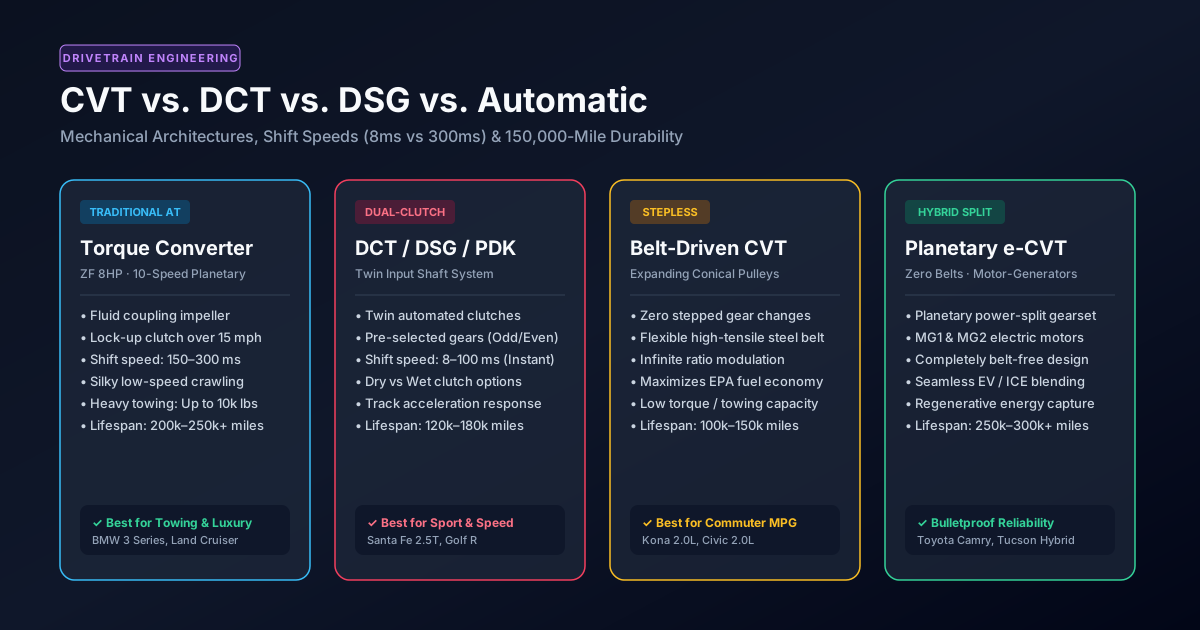
- Torque-Converter Automatics (such as the ZF 8HP, Ford/GM 10R80, and Toyota Direct-Shift 8AT) transfer kinetic energy from the engine crankshaft to the gearbox through a hydrodynamic fluid coupling. This virtually eliminates mechanical friction wear during low-speed crawling, stop-and-go commuting, and heavy trailer towing.
- Dual-Clutch Transmissions (such as Volkswagen's DSG, Hyundai's 8-speed N-DCT, and Porsche's PDK) operate as two automated manual gearboxes housed within a single casing. Utilizing two separate friction clutches for odd and even gear sets, a DCT pre-selects the next gear ratio, executing lightning-fast gear changes in as little as 8 to 40 milliseconds with near-zero torque interruption.
This technical engineering analysis examines fluid dynamics, clutch metallurgy, shift response times, thermal dissipation, creeping behavior, and verified 150,000-mile reliability across both automatic transmission architectures.
Side-by-Side Mechanical Architecture Matrix
The comparative engineering matrix below analyzes physical design parameters and operational characteristics across modern torque-converter automatics and dual-clutch transmissions:
| Engineering Parameter | Planetary Torque-Converter Automatic (e.g. ZF 8HP / 10R80) | Dual-Clutch Transmission (e.g. VW DSG / Hyundai N-DCT) |
|---|---|---|
| Primary Coupling Mechanism | Hydrodynamic Torque Converter (Impeller, Turbine, Stator) | Twin Friction Clutch Packs (Odd & Even Input Shafts) |
| Clutch Construction | Multi-Plate Wet Lockup Clutch inside Converter | Dual Multi-Plate Wet Clutches (or Dry Clutches on entry cars) |
| Gear Train Architecture | Epicyclic / Planetary Gearsets with Brake Bands | Twin Concentric Input Shafts with Helical Manual Gears |
| Typical Gear Ratios | 8 to 10 Forward Speeds (Ratio Spread up to 9.8:1) | 6 to 8 Forward Speeds (Ratio Spread up to 7.8:1) |
| Shift Speed (Upshift) | 150 to 300 ms (Fast modern units down to 100 ms) | 8 to 40 ms (Near-Instantaneous / Formula 1 Speed) |
| Torque Interruption | Minimal (Smoothed by hydraulic fluid damper) | Zero (Power handed off seamlessly between twin clutches) |
| Mechanical Efficiency | 86% to 92% (95%+ when lockup clutch engaged) | 95% to 98% (Manual transmission efficiency) |
| Low-Speed Creeping Heat | Dissipated safely into Automatic Transmission Fluid (ATF) | Friction heat builds as clutches slip below 5 mph |
| Low-Speed Smoothness | Silky, seamless, zero rollback on steep inclines | Can exhibit slight shudder or robotic engagement in traffic |
| Maximum Towing Rating | Up to 14,000+ lbs (Standard on full-size pickup trucks) | Typically limited to 3,500–5,000 lbs in crossover SUVs |
| Fluid Service Interval | Every 50,000–60,000 miles (ATF drain and filter) | Strictly every 40,000 miles (Specialized dual-clutch fluid) |
| Typical Overhaul Cost | $3,500 to $5,500 (Wide remanufacturing availability) | $5,000 to $9,000 (Complex mechatronic valve bodies) |
| Expected Service Life | 200,000 to 300,000+ miles with scheduled fluid changes | 120,000 to 180,000 miles before clutch replacement |
Hydrodynamic Physics: How Torque Converters Protect Powertrains
The torque converter is an engineering marvel of fluid mechanics. To learn how gearbox ratios interact with engine output, consult our pillar guide on Every Car Transmission Compared.
1. The Fluid Cushion: Impeller, Turbine, and Stator
Inside the donut-shaped torque converter housing bolted to the engine flexplate, three internal components manage power transfer:
- The Impeller (Pump): Spun directly by the engine crankshaft, its curved blades fling automatic transmission fluid outward via centrifugal force.
- The Turbine: Facing the impeller, its vanes catch the pressurized fluid stream, forcing the transmission input shaft to rotate.
- The Stator: Located between the impeller and turbine, the stator contains a one-way freewheel clutch. It redirects returning fluid back into the impeller at an optimal angle, multiplying engine torque by up to 2.2 times during initial acceleration from a complete stop.
Because there is no mechanical friction contact when creeping forward at 2 mph or idling in drive at a red light, heat is transferred entirely into the transmission fluid and dissipated through an external oil cooler. This makes torque converters nearly immune to premature wear during severe urban traffic jams or heavy boat towing.
2. Lockup Clutch Engagement
In modern automatics (such as the ZF 8HP), an integrated multi-plate lockup clutch locks the impeller and turbine together mechanically as soon as the vehicle reaches 10 to 15 mph. This eliminates hydraulic slippage, matching the direct throttle connection and fuel efficiency of a manual gearbox.
Dual-Clutch Mechanics: Twin Concentric Shafts & Pre-Selected Ratios
Rather than planetary gears and fluid couplings, a dual-clutch transmission operates on manual gearbox principles automated by high-speed electrohydraulic solenoids:
1. The Concentric Input Shaft Architecture
A DCT houses two independent manual gearboxes inside one case:
- Outer Hollow Shaft: Controls even gears (2nd, 4th, 6th, and Reverse) via Clutch 1.
- Inner Solid Shaft: Passes directly through the hollow shaft and controls odd gears (1st, 3rd, 5th, and 7th) via Clutch 2.
When accelerating in 1st gear, the electronic transmission control unit (TCU) has already engaged the synchronizers for 2nd gear on the other shaft. At the shift point, Clutch 1 disengages simultaneously as Clutch 2 clamps shut. The shift occurs in as little as 8 to 20 milliseconds—faster than a human driver can blink, providing seamless continuous acceleration without power sag.
2. Wet vs. Dry Clutch Packs: The Critical Durability Difference
The single most decisive engineering factor in DCT longevity is clutch cooling:
- Dry-Clutch DCTs (e.g. Ford PowerShift DPS6, Early VW DQ200): These units used air-cooled dry friction plates to reduce manufacturing costs and fluid drag. However, in stop-and-go traffic, the constant micro-slipping generated extreme heat with no liquid cooling, warping the clutch plates and causing notorious shuddering, stalling, and premature clutch burnout by 50,000 miles.
- Wet-Clutch DCTs (e.g. VW DQ381/DQ500, Porsche PDK, Hyundai 8-Speed N-DCT): Modern performance DCTs submerge the multi-plate clutch packs in an active oil bath. Dedicated electric oil pumps continuously circulate transmission fluid over the friction surfaces, dissipating heat and extending clutch lifespans to 150,000 miles or more.
Driving Behaviors That Destroy Dual-Clutch Transmissions
Dual-clutch transmissions require specific driving awareness to prevent premature friction wear:
- 1."Creeping" in Traffic Without Full Brake Release: In a torque-converter automatic, releasing 20% of brake pressure allows the car to crawl via fluid coupling without wear. In a DCT, light brake pressure forces the computer to continuously slip the 1st-gear friction clutch, generating extreme heat and accelerating friction disc wear. Drivers should release the brake decisively or use Auto-Hold.
- 2.Holding on an Incline Using the Throttle: Using gentle accelerator pressure to keep a DCT stationary on a steep hill burns the clutch pack rapidly. Always utilize the foot brake, electronic parking brake, or Hill-Start Assist.
- 3.Repetitive Launch Control Cycles: While wet-clutch DCTs are engineered for explosive standing-start acceleration, executing multiple full-boost launch control starts in rapid succession elevates clutch oil temperatures beyond 280°F (138°C), triggering protective limp-mode protocols.
Transmission Fluid Maintenance: The 40,000-Mile Imperative
Automakers frequently market modern gearboxes with misleading "Lifetime Transmission Fluid" claims. Automotive mechanical engineers strongly advise against this marketing gimmick:
- Dual-Clutch Transmissions (Strict 40,000-Mile Flush): In a wet DCT, the transmission fluid serves two opposing purposes: it acts as a hydraulic fluid for the delicate mechatronic valve solenoids and a friction modifier for the clutch discs. Microscopic clutch friction debris accumulates in the fluid; failure to replace the oil and pressure filters every 40,000 miles results in clogged solenoid valves, erratic shift pressures, and costly mechatronic failures ($3,000+).
- Torque-Converter Automatics (50,000–60,000-Mile Service): Over tens of thousands of thermal cycles, ATF undergoes molecular shearing, losing its anti-foaming additives and viscosity stability. Draining the fluid and replacing the integrated pan/filter every 50,000 to 60,000 miles ensures smooth valve body operation and protects planetary gear bushings well beyond 200,000 miles.
Mechatronic Valve Body Diagnostics & Clutch Adaptation Cycles
A decisive advantage of modern electronic transmission controllers is their onboard diagnostic capability:
- DCT Clutch Wear Adaptations: The transmission control unit (TCU) continuously measures input shaft deceleration and hydraulic pressure ramp times during clutch engagement. As friction linings wear down by tenths of a millimeter over years of commuting, the TCU automatically recalibrates solenoid pulse-width modulation (PWM) to maintain uniform clutch bite points. When scanning a pre-owned DCT vehicle, mechanics can connect VAG-COM or diagnostic scan tools to read live clutch adaptation values, determining the exact percentage of friction material remaining without disassembling the transmission.
- Torque Converter Lockup Slip Monitoring: In modern torque-converter automatics, the transmission computer monitors slip speed across the torque converter lockup clutch down to within 5 RPM. If the lockup clutch exhibits microscopic slip under high cruising torque, the computer flags diagnostic trouble codes (such as P0741) long before complete mechanical failure occurs.
CDI Engineering Verdict: Which Transmission Should You Choose?
- Choose a Torque-Converter Automatic if your daily driving consists of heavy urban stop-and-go gridlock, steep hill parallel parking, heavy trailer towing, or if you plan to keep your vehicle past 150,000 miles with minimal maintenance costs and silky ride comfort.
- Choose a Dual-Clutch Transmission (DSG/DCT) if you prioritize sports-car driving dynamics, instantaneous paddle-shift track response, maximum mechanical fuel efficiency, and the exhilarating snap of immediate full-throttle gear changes.
Frequently asked questions
Which transmission lasts longer: a dual-clutch (DSG/DCT) or a torque-converter automatic?
Traditional torque-converter automatics generally last longer, routinely exceeding 200,000 to 300,000 miles with standard fluid maintenance because their hydraulic fluid coupling eliminates low-speed friction wear. Modern wet-clutch DCTs are durable but their friction clutch packs typically require replacement between 120,000 and 180,000 miles.
Why do dual-clutch transmissions shift faster than traditional automatics?
A DCT houses two separate manual gearboxes with two concentric input shafts. When driving in an odd gear (e.g. 3rd), the computer has already pre-selected the next even gear (4th) on the secondary shaft. Shifting merely requires releasing one clutch while engaging the other, taking just 8 to 40 milliseconds with zero torque drop.
What is the difference between a wet clutch and a dry clutch DCT?
A dry-clutch DCT uses unlubricated friction plates exposed to air, which overheat and shudder in stop-and-go traffic. A wet-clutch DCT submerges the clutch packs in an active oil bath, utilizing transmission fluid to cool the friction discs and dissipate heat, providing vastly superior durability and high-torque handling.
Is it bad to creep in traffic with a dual-clutch transmission?
Yes. Letting a DCT vehicle crawl forward at 2 mph with light brake pedal pressure forces the clutch pack to continuously slip, generating severe friction heat. In heavy stop-and-go traffic, drivers should allow a gap to open and release the brake fully, or utilize Auto-Hold.
How often should dual-clutch transmission fluid be changed?
Dual-clutch transmissions require strict fluid and filter replacement every 40,000 miles. Neglecting this service allows microscopic clutch friction material to contaminate the mechatronic valve solenoids, leading to rough shifts and costly hydraulic unit failures.
Cite this page: https://cardataindex.com/blog/dual-clutch-dsg-vs-torque-converter-reliability
Keep researching
Cross-check the numbers in this guide against live factory data in our specification index or decode a specific car with the free VIN decoder.