Audi A6 C7
Produced from 2011–2018, the Audi A6 C7 (4G) is catalogued here with 2 powertrains. 2 petrol, spanning 180 to 300 hp. The quickest version, the 3.0 TFSI quattro, covers 0–100 km/h in 5.6 seconds. For fuel costs, the 2.0 TFSI leads the range at 33 MPG (EPA combined). Externally it measures 4915 × 1874 × 1455 mm on a 2912 mm wheelbase. Full engine, transmission, performance, economy and weight data is compared trim-by-trim below, with EPA and NHTSA sources cited at the bottom of the page.
Generation Quick Facts: The Audi A6 C7 (4G) was manufactured from 2011 – 2018 (2011, 2012, 2013, 2014, 2015, 2016, 2017, 2018 model years) as a sedan. Across 2 verified powertrains, power outputs range from 180 to 300 hp, with top fuel economy reaching 33.0 MPG combined (2.0 TFSI).
Power range
180–300 hp
Quickest 0–100
5.6 s
Best combined
33 MPG
Length
4.92 m
01Decision support
Which A6 C7 suits you?
Daily driver · least fuel
2.0 TFSI
33.0 MPG combined
It burns up to 24% less fuel per mile than the thirstiest A6 C7.
Performance · quickest
3.0 TFSI quattro
0–100 km/h in 5.6s · 300 hp
The straight-line choice of this generation.
022 powertrains (2 petrol)
Full specifications
| Specification | 2.0 TFSIPetrol | 3.0 TFSI quattroPetrol |
|---|---|---|
| Engine | ||
| Engine code | EA888 gen2 | EA837 |
| Fuel type | Petrol | Petrol |
| Displacement | 2.0L (1,984 cc) | 3.0L (2,995 cc) |
| Aspiration | Turbocharged | Supercharged |
| Cylinders | I4 | V6 |
| Power & Performance | ||
| Power | 180 hp / 134 kW | 300 hp / 224 kW |
| Torque | 320 Nm / 236 lb-ft | 440 Nm / 325 lb-ft |
| 0–100 km/h | 8.3 s | 5.6 s |
| Top speed | 226 km/h (140 mph) | 250 km/h (155 mph) |
| Transmission & Drivetrain | ||
| Transmission | CVT | Dual-clutch |
| Gears | — | 7 |
| Drivetrain | FWD | AWD |
| Fuel Economy & Emissions | ||
| City | 28 MPG (8.4 L/100km) | 22 MPG (10.7 L/100km) |
| Highway | 39 MPG (6.0 L/100km) | 30 MPG (7.8 L/100km) |
| Combined | 33 MPG (7.1 L/100km) | 25 MPG (9.4 L/100km) |
| Electric range | — | — |
| Battery | — | — |
| CO₂ emissions | 149 g/km | 184 g/km |
| Weight & Body | ||
| Curb weight | 1,595 kg (3,516 lbs) | 1,745 kg (3,847 lbs) |
| Seats | 5 | 5 |
| Doors | 4 | 4 |
| Model years | 2011–2018 | 2011–2018 |
0Exterior
Dimensions
Length
4,915 mm
193.5 in
Width
1,874 mm
73.8 in
Height
1,455 mm
57.3 in
Wheelbase
2,912 mm
114.6 in
Curb weight spans 1,595–1,745 kg depending on powertrain. Battery and AWD hardware add the most mass.
05Long-tail answers
A6 C7: questions answered
What engines and trims are available on the Audi A6 C7 (4G)?
The Audi A6 C7 (4G) lineup offers 2 petrol: 2.0 TFSI (180 hp), 3.0 TFSI quattro (300 hp).
How quick is the Audi A6 C7 (4G) from 0 to 100 km/h?
The fastest trim, the 3.0 TFSI quattro, accelerates from 0 to 100 km/h in 5.6s, reaching a top speed of 250 km/h (155 mph) with the 3.0 TFSI quattro.
What is the most fuel-efficient Audi A6 C7 (4G) trim?
The 2.0 TFSI delivers the highest fuel economy at 33.0 MPG (EPA combined). Across the 2 powertrains, fuel economy spans 25–33 combined MPG.
What model years are included in the Audi A6 C7 (4G)?
The Audi A6 C7 (4G) was produced from 2011 – 2018, spanning the following model years: 2011, 2012, 2013, 2014, 2015, 2016, 2017, 2018.
What are the exterior dimensions of the Audi A6 C7 (4G)?
4915 mm long, 1874 mm wide, 1455 mm tall on a 2912 mm wheelbase (193.5 in overall length).
Sources for this page
- EPA fuel-economy records: Audi A6Certification data, 2011–2018
- NHTSA vehicle file: recalls, complaints and investigations2011 Audi A6, official safety record
- NHTSA vPIC vehicle databasePowers our VIN decoder, the federal manufacturer registry
- Audi official: data sheets and archiveManufacturer-published specifications
Figures on this page are compiled from the sources above and cross-checked against manufacturer data sheets. US-market EPA cycle where noted; European WLTP values are measured differently and are not directly comparable.
Guides worth reading before you choose
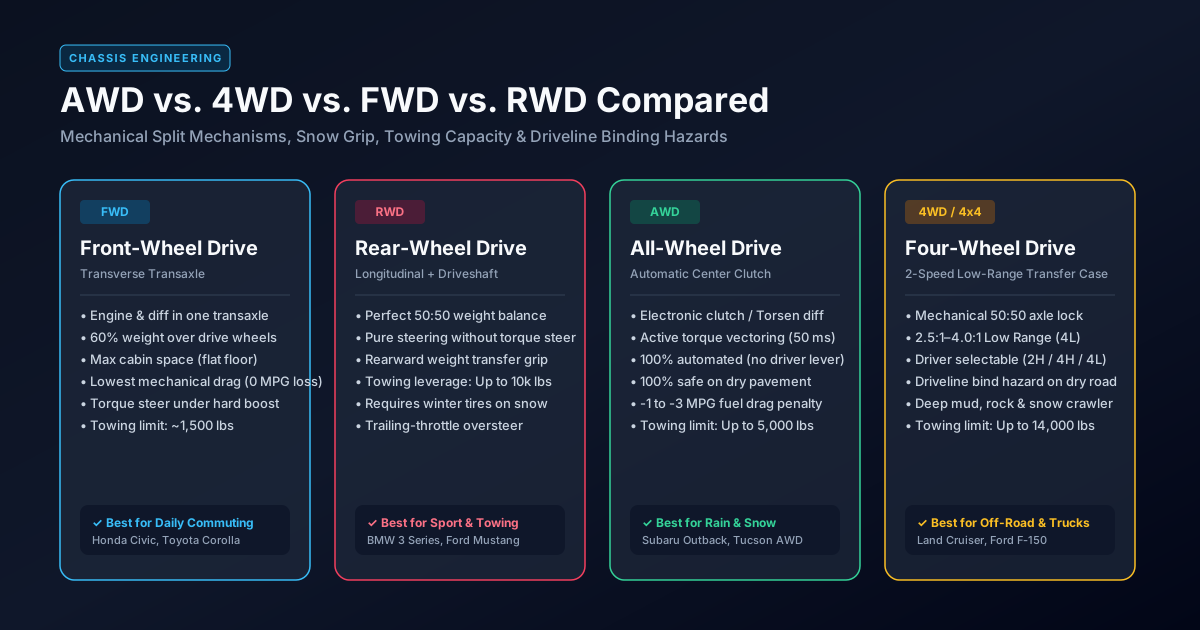
AWD vs. 4WD vs. FWD vs. RWD: The Complete Drivetrain Guide (Mechanics, Snow, Towing & Efficiency)
Front, rear, all or four-wheel drive, what's the difference, and which drivetrain is right for your driving? Mechanics, pros, cons and examples.
September 19, 2026
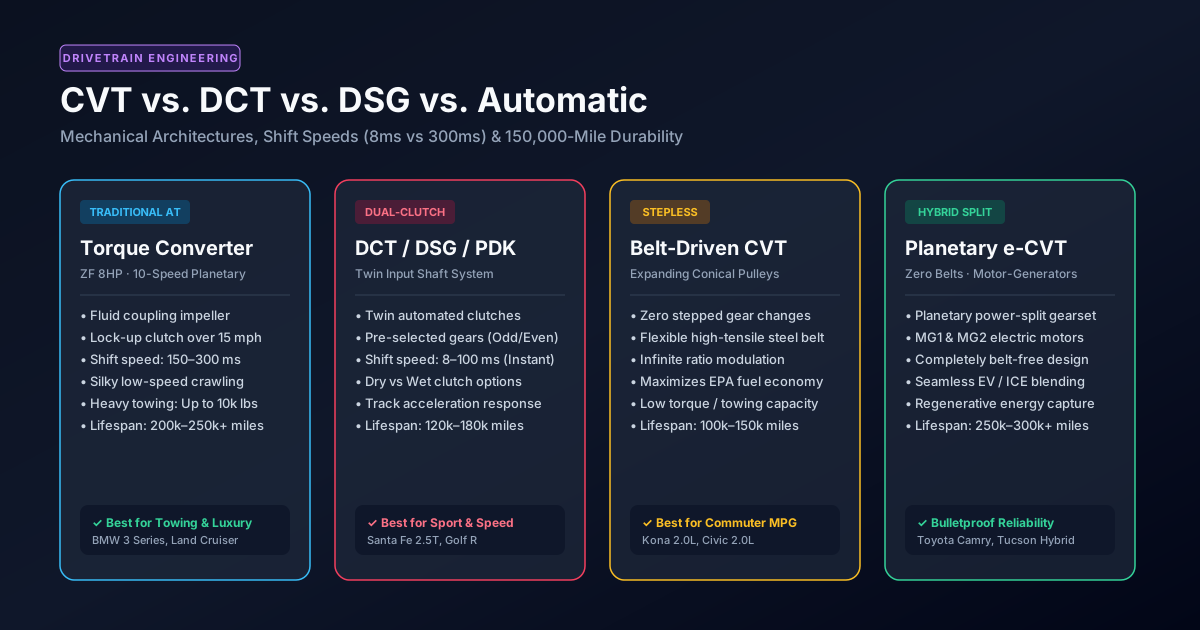
CVT vs. DCT vs. DSG vs. Automatic: Every Car Transmission Compared
Torque converter, dual-clutch, CVT or manual, how each gearbox works, how it feels to drive, and which one belongs in your next car.
September 5, 2026
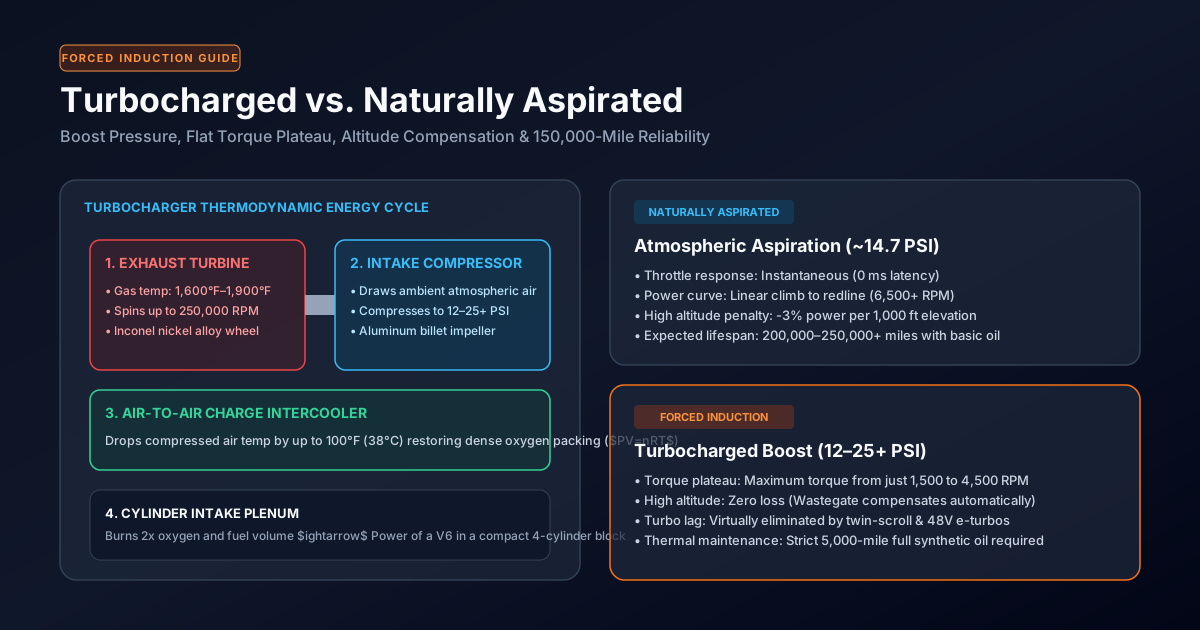
Turbocharged vs. Naturally Aspirated Engines: Boost, Lag, Reliability & Fuel Economy
Factory turbos now dominate new cars, but naturally aspirated engines still have real advantages. A balanced look at power, economy and reliability.
August 29, 2026