Hyundai Elantra VII
Produced from 2021–present, the Hyundai Elantra VII (CN7) is catalogued here with 3 powertrains. 3 petrol, spanning 147 to 276 hp. The quickest version, the N 2.0 T-GDI, covers 0–100 km/h in 5.3 seconds. For fuel costs, the 2.0 MPI leads the range at 35 MPG (EPA combined). Externally it measures 4676 × 1826 × 1415 mm on a 2720 mm wheelbase. Full engine, transmission, performance, economy and weight data is compared trim-by-trim below, with EPA and NHTSA sources cited at the bottom of the page.
Generation Quick Facts: The Hyundai Elantra VII (CN7) was manufactured from 2021 – present (2021, 2022, 2023, 2024, 2025, 2026 model years) as a sedan. Across 3 verified powertrains, power outputs range from 147 to 276 hp, with top fuel economy reaching 35.0 MPG combined (2.0 MPI).
Power range
147–276 hp
Quickest 0–100
5.3 s
Best combined
35 MPG
Length
4.68 m
01Decision support
Which Elantra VII suits you?
Daily driver · least fuel
2.0 MPI
35.0 MPG combined
It burns up to 34% less fuel per mile than the thirstiest Elantra VII.
Performance · quickest
N 2.0 T-GDI
0–100 km/h in 5.3s · 276 hp
The straight-line choice of this generation.
Sweet spot · balance
N Line 1.6 T-GDI
201 hp · 31.0 MPG
Sits mid-range for power without paying the fuel or price tax of the flagship trim. Usually the best value on the used market.
023 powertrains (3 petrol)
Full specifications
| Specification | 2.0 MPIPetrol | N Line 1.6 T-GDIPetrol | N 2.0 T-GDIPetrol |
|---|---|---|---|
| Engine | |||
| Engine code | Smartstream G2.0 | Smartstream G1.6 | Theta II |
| Fuel type | Petrol | Petrol | Petrol |
| Displacement | 2.0L (1,999 cc) | 1.6L (1,598 cc) | 2.0L (1,998 cc) |
| Aspiration | Naturally aspirated | Turbocharged | Turbocharged |
| Cylinders | I4 | I4 | I4 |
| Power & Performance | |||
| Power | 147 hp / 110 kW | 201 hp / 150 kW | 276 hp / 206 kW |
| Torque | 179 Nm / 132 lb-ft | 265 Nm / 195 lb-ft | 392 Nm / 289 lb-ft |
| 0–100 km/h | 8.8 s | 7.1 s | 5.3 s |
| Top speed | 200 km/h (124 mph) | 210 km/h (130 mph) | 250 km/h (155 mph) |
| Transmission & Drivetrain | |||
| Transmission | CVT | Dual-clutch | Dual-clutch |
| Gears | — | 7 | 8 |
| Drivetrain | FWD | FWD | FWD |
| Fuel Economy & Emissions | |||
| City | 31 MPG (7.6 L/100km) | 28 MPG (8.4 L/100km) | 20 MPG (11.8 L/100km) |
| Highway | 41 MPG (5.7 L/100km) | 36 MPG (6.5 L/100km) | 27 MPG (8.7 L/100km) |
| Combined | 35 MPG (6.7 L/100km) | 31 MPG (7.6 L/100km) | 23 MPG (10.2 L/100km) |
| Electric range | — | — | — |
| Battery | — | — | — |
| CO₂ emissions | 141 g/km | 158 g/km | 200 g/km |
| Weight & Body | |||
| Curb weight | 1,285 kg (2,833 lbs) | 1,355 kg (2,987 lbs) | 1,475 kg (3,252 lbs) |
| Seats | 5 | 5 | 5 |
| Doors | 4 | 4 | 4 |
| Model years | 2021–present | 2021–present | 2021–present |
03Then vs now
CN7 vs. previous generation
| Metric | Change vs. AD |
|---|---|
| Peak power | +75 hp |
| Quickest 0–100 km/h | -1.6 s |
| Best combined MPG | +2 MPG |
| Average curb weight | +62 kg |
Why this matters
Versus the AD, the CN7 is clearly more efficient, noticeably more powerful, quicker off the line, heavier, mostly safety and equipment mass. Used-car shoppers should weigh these shifts against the AD's typically lower asking prices.
View the AD spec sheet0Exterior
Dimensions
Length
4,676 mm
184.1 in
Width
1,826 mm
71.9 in
Height
1,415 mm
55.7 in
Wheelbase
2,720 mm
107.1 in
Curb weight spans 1,285–1,475 kg depending on powertrain. Battery and AWD hardware add the most mass.
05Long-tail answers
Elantra VII: questions answered
What engines and trims are available on the Hyundai Elantra VII (CN7)?
The Hyundai Elantra VII (CN7) lineup offers 3 petrol: 2.0 MPI (147 hp), N Line 1.6 T-GDI (201 hp), N 2.0 T-GDI (276 hp).
How quick is the Hyundai Elantra VII (CN7) from 0 to 100 km/h?
The fastest trim, the N 2.0 T-GDI, accelerates from 0 to 100 km/h in 5.3s, reaching a top speed of 250 km/h (155 mph) with the N 2.0 T-GDI.
What is the most fuel-efficient Hyundai Elantra VII (CN7) trim?
The 2.0 MPI delivers the highest fuel economy at 35.0 MPG (EPA combined). Across the 3 powertrains, fuel economy spans 23–35 combined MPG.
How does the CN7 compare to the previous Hyundai Elantra?
Against the AD predecessor it replaces, the CN7 is clearly more efficient, noticeably more powerful, quicker off the line, heavier, mostly safety and equipment mass. Side-by-side technical specs are detailed in the comparison table below.
What model years are included in the Hyundai Elantra VII (CN7)?
The Hyundai Elantra VII (CN7) was produced from 2021 – present, spanning the following model years: 2021, 2022, 2023, 2024, 2025, 2026.
What are the exterior dimensions of the Hyundai Elantra VII (CN7)?
4676 mm long, 1826 mm wide, 1415 mm tall on a 2720 mm wheelbase (184.1 in overall length).
Sources for this page
- EPA fuel-economy records: Hyundai ElantraCertification data, 2021–2026
- NHTSA vehicle file: recalls, complaints and investigations2021 Hyundai Elantra, official safety record
- NHTSA vPIC vehicle databasePowers our VIN decoder, the federal manufacturer registry
- Hyundai official: data sheets and archiveManufacturer-published specifications
Figures on this page are compiled from the sources above and cross-checked against manufacturer data sheets. US-market EPA cycle where noted; European WLTP values are measured differently and are not directly comparable.
Guides worth reading before you choose
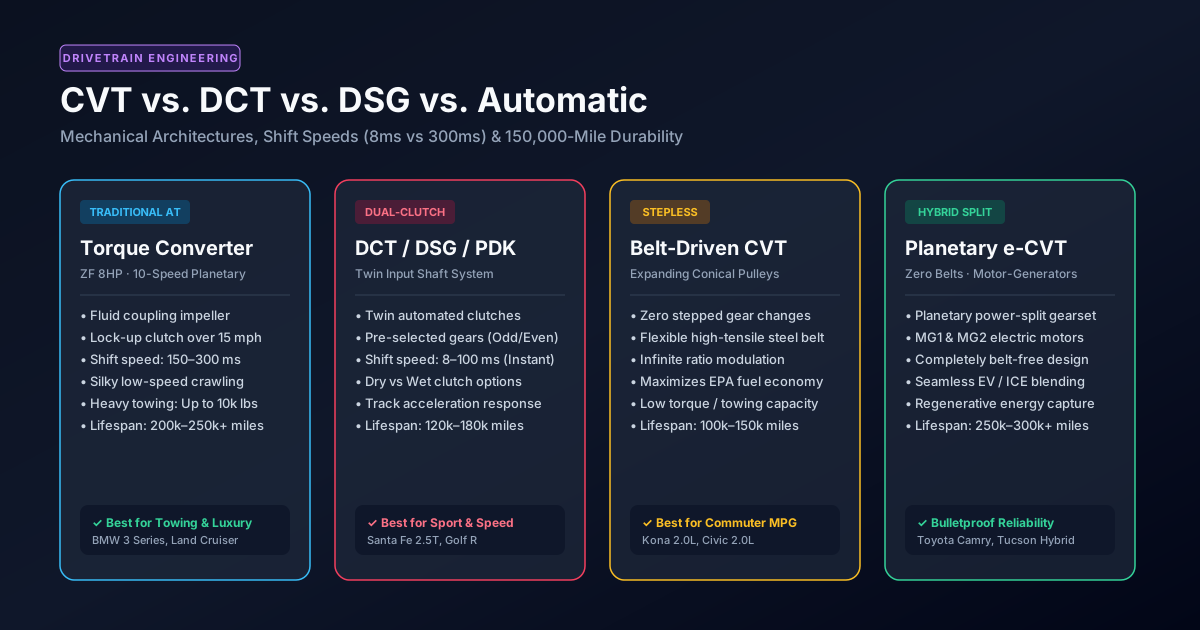
CVT vs. DCT vs. DSG vs. Automatic: Every Car Transmission Compared
Torque converter, dual-clutch, CVT or manual, how each gearbox works, how it feels to drive, and which one belongs in your next car.
September 5, 2026
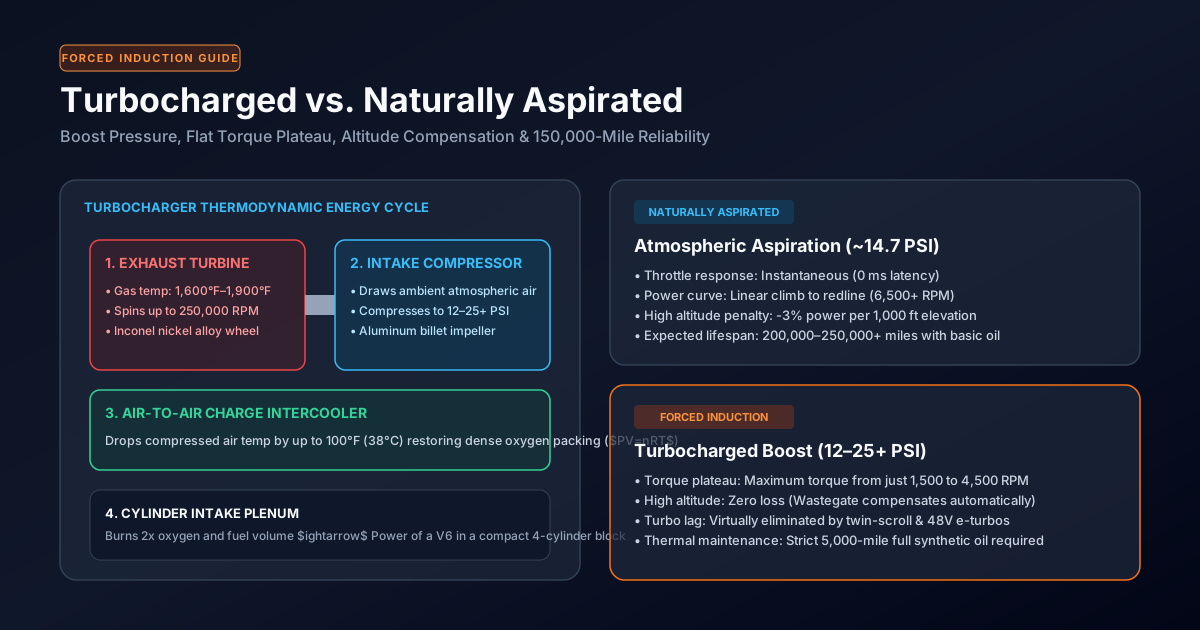
Turbocharged vs. Naturally Aspirated Engines: Boost, Lag, Reliability & Fuel Economy
Factory turbos now dominate new cars, but naturally aspirated engines still have real advantages. A balanced look at power, economy and reliability.
August 29, 2026
More Hyundai models