Three-Row Family SUV Battle: Kia Telluride vs. Hyundai Palisade vs. Toyota Highlander
Direct three-row SUV shootout: Kia Telluride vs Hyundai Palisade vs Toyota Highlander. Compare 3rd row legroom, V6 vs Hybrid MPG, towing, and warranty protection.
Car Data Index Editorial Desk
Automotive data desk · Sources: NHTSA · EPA · OEM records
Executive Summary: The Benchmark Three-Row Family Crossovers
For large families requiring everyday three-row passenger versatility, extensive road-trip luggage capacity, all-weather all-wheel-drive traction, and up to 5,000 lbs of boat or camper towing capability, the mid-size unibody crossover has completely displaced the traditional minivan. Within this hotly contested segment, three models dominate consumer demand: the **Kia Telluride, the Hyundai Palisade, and the Toyota Highlander**.
While the Korean platform twins, the Kia Telluride and Hyundai Palisade—disrupted the market by offering full adult-sized third-row packaging, bold styling, and near-luxury flagship cabin appointments, the venerable Toyota Highlander counters with generational manufacturing dependability and benchmark fuel economy through its advanced hybrid powertrain options.
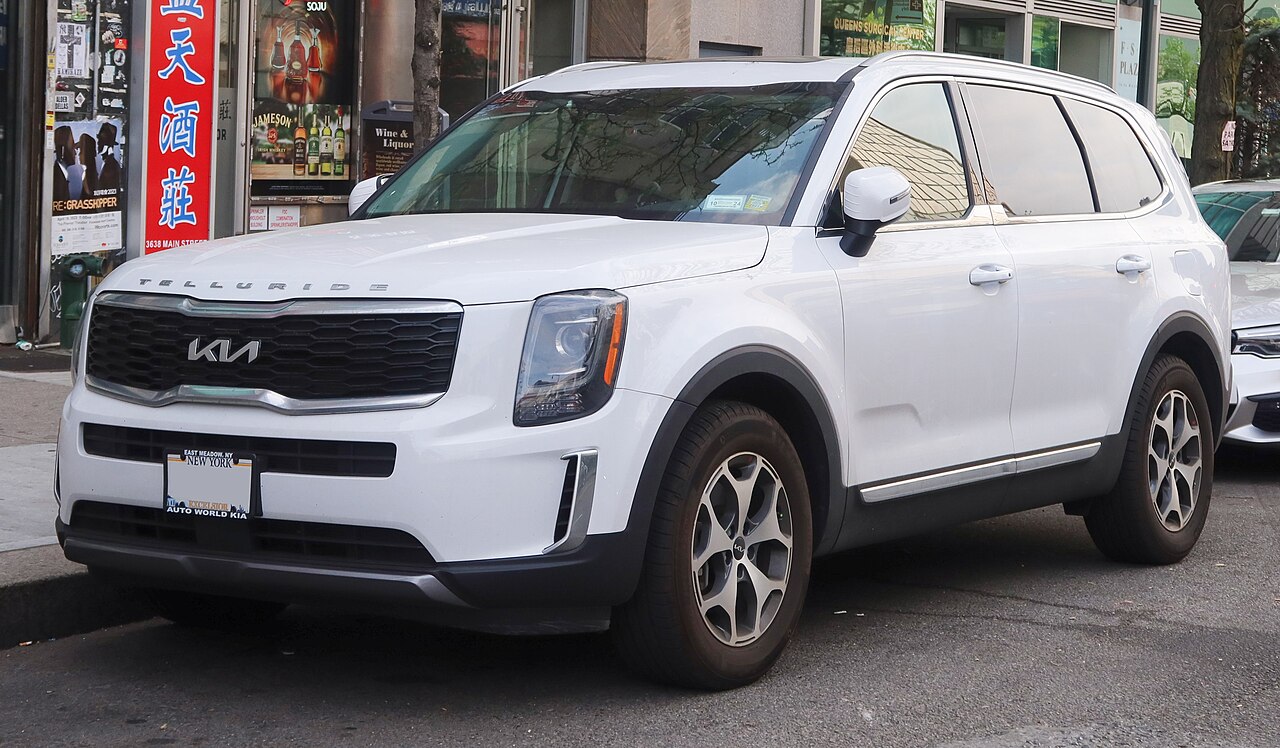
- The **Kia Telluride** emphasizes rugged, muscular styling, standard boxy exterior dimensions, off-road-oriented X-Line and X-Pro trims with 8.4 inches of ground clearance, and an expansive 21.0 cubic feet of cargo capacity behind the rearmost seats.
- The **Hyundai Palisade** leans into high-tech executive elegance, featuring distinctive vertical LED lighting, an opulent Calligraphy trim with quilted Nappa leather and micro-suede headliners, power-folding third-row seating, and acoustic laminated glass across all side windows.
- The **Toyota Highlander** focuses on mechanical longevity, compact exterior maneuverability built on the Toyota New Global Architecture (TNGA-K), and an available Hybrid Synergy Drive delivering an extraordinary 35 MPG combined, saving thousands of dollars in annual family fuel expenditures.
This comprehensive technical comparison audits platform packaging, powertrain thermodynamics, AWD mechanical torque transfer, interior noise levels (NVH), and verified 150,000-mile reliability.
Side-by-Side Three-Row Engineering Matrix
The engineering matrix below compares verified factory specifications across production variants of the Kia Telluride, Hyundai Palisade, and Toyota Highlander:
| Engineering Parameter | Kia Telluride SX V6 AWD | Hyundai Palisade Calligraphy AWD | Toyota Highlander Hybrid Limited |
|---|---|---|---|
| Platform Architecture | Hyundai-Kia N3 Global Architecture | Hyundai-Kia N3 Global Architecture | Toyota TNGA-K Global Platform |
| Powertrain Layout | Transverse Front-Engine, All-Wheel Drive | Transverse Front-Engine, All-Wheel Drive | Transverse Front-Engine, Electronic AWD |
| Engine Code | Hyundai-Kia Lambda II 3.8L GDI V6 | Hyundai-Kia Lambda II 3.8L GDI V6 | Toyota Dynamic Force A25A-FXS 2.5L I4 |
| Aspiration / Boost | Naturally Aspirated (Atmospheric) | Naturally Aspirated (Atmospheric) | Hybrid Synergy Drive (Dual Motor Gen) |
| Displacement (cc / cu in) | 3,778 cc (230.5 cu in) | 3,778 cc (230.5 cu in) | 2,487 cc (151.8 cu in) |
| Bore x Stroke (mm) | 96.0 mm x 87.0 mm (Oversquare) | 96.0 mm x 87.0 mm (Oversquare) | 87.5 mm x 103.4 mm (Long-Stroke) |
| Compression Ratio | 13.0:1 (Atkinson Cycle) | 13.0:1 (Atkinson Cycle) | 14.0:1 (Ultra-High Atkinson) |
| Horsepower @ RPM | 291 hp @ 6,000 RPM | 291 hp @ 6,000 RPM | 243 net system hp @ 6,000 RPM |
| Torque @ RPM | 262 lb-ft @ 5,200 RPM | 262 lb-ft @ 5,200 RPM | 175 lb-ft (engine) + Instant electric |
| Transmission Type | 8-Speed Torque Converter Automatic | 8-Speed Torque Converter Automatic | Electronically Controlled Planetary e-CVT |
| AWD System Type | Active On-Demand AWD w/ Center Lock | HTRAC Active On-Demand w/ Lock | Electronic On-Demand AWD (Rear e-Motor) |
| Towing Capacity | 5,000 lbs (5,500 lbs on X-Pro) | 5,000 lbs (Standard hitch prep) | 3,500 lbs (5,000 lbs on 2.4L Turbo Gas) |
| Wheelbase (in / mm) | 114.2 in (2,900 mm) | 114.2 in (2,900 mm) | 112.2 in (2,850 mm) |
| Overall Length (in / mm) | 196.9 in (5,001 mm) | 196.7 in (4,996 mm) | 194.9 in (4,950 mm) |
| Passenger Volume (cu ft) | 157.1 cu ft (Class-Leading) | 155.3 cu ft | 141.3 cu ft |
| 3rd Row Legroom (in / mm) | 31.4 in (798 mm) - Adult Sized | 31.4 in (798 mm) - Adult Sized | 27.7 in (704 mm) - Child Sized |
| Cargo Space (Row 3 / Max) | 21.0 cu ft / 87.0 cu ft | 18.0 cu ft / 86.4 cu ft | 16.0 cu ft / 84.3 cu ft |
| EPA Fuel Economy (AWD) | 18 City / 24 Hwy / 21 Comb MPG | 19 City / 24 Hwy / 21 Comb MPG | 35 City / 35 Hwy / 35 Comb MPG |
Chassis Dimensions & Passenger Packaging: The 50 mm Wheelbase Advantage
The critical differentiator among three-row crossovers lies in third-row passenger ergonomics and cargo functionality:
1. Hyundai-Kia N3 Platform: Real Adult Third-Row Ergonomics
Both the Kia Telluride and Hyundai Palisade ride on an extended 114.2-inch (2,900 mm) wheelbase.
- That extra 2.0 inches (50 mm) of wheelbase length over the Highlander directly translates into passenger legroom: the rearmost seats provide 31.4 inches of legroom combined with a high seat-bottom cushion. Adults standing 6 feet tall can sit comfortably on multi-hour road trips without their knees pressing into their chests.
- Behind the third row, the Telluride provides an enormous 21.0 cubic feet of cargo volume, accommodating four full-size roller suitcases under the liftgate without needing to fold any seats down. A deep sub-trunk storage bin beneath the luggage floor provides hidden space for emergency gear, strollers, or groceries.
2. Toyota TNGA-K Platform: Compact Maneuverability vs. Tight Rear Space
The Toyota Highlander prioritizes garage-friendly exterior dimensions, measuring two inches shorter overall with a 112.2-inch (2,850 mm) wheelbase.
- Consequently, third-row legroom drops to 27.7 inches—a substantial 3.7-inch deficit compared to the Korean crossovers. Furthermore, the floor pan is raised to clear the rear suspension subframe and hybrid battery pack, forcing passengers into a cramped "knees-up" posture suitable primarily for young children.
- Behind the third row, cargo capacity measures 16.0 cubic feet, requiring careful packing for family camping trips. However, the Highlander's tighter turning radius (37.4 ft vs. 38.8 ft) makes parallel parking and downtown parking garages significantly less stressful.
Powertrain Engineering: 3.8L Atkinson V6 vs. 2.4L Turbo vs. e-CVT Hybrid
Engine architectures define how these vehicles accelerate, tow heavy loads, and consume fuel:
1. Hyundai-Kia 3.8L Lambda II V6: Naturally Aspirated Refinement
Under the hood of the Telluride and Palisade sits the 3.8-liter Lambda II GDI V6 (Engine code: G6DN). To understand how cylinder displacement dictates torque curves, see our guide on Engine Displacement Explained.
- Atkinson Cycle Operation: The engine operates on a modified Atkinson thermodynamic cycle, utilizing variable valve timing (E-CVVT) to delay intake valve closure into the compression stroke. This reduces pumping losses by 12% and raises thermal efficiency while running safely on regular 87-octane unleaded gasoline.
- Linear Throttle Response: Producing 291 hp and 262 lb-ft of torque, the naturally aspirated V6 delivers seamless power delivery from idle to its 6,000 RPM redline. When merging onto fast highways with seven passengers onboard, there is zero turbo lag or transmission gear hunting.
2. Toyota Powertrains: 2.4L Turbo Gas & 2.5L Hybrid Synergy Drive
Toyota discontinued its historic 3.5-liter 2GR-FKS V6 in the Highlander, offering buyers two distinct four-cylinder philosophies:
- Standard 2.4L Turbo (T24A-FTS): Delivers 310 lb-ft of torque from just 1,700 RPM—surpassing the Korean V6 engines by 48 lb-ft down low. This turbocharged torque plateau enables rapid highway passing without requiring immediate multi-gear downshifts.
- Highlander Hybrid (A25A-FXS + Dual Motor Generators): The hybrid pairs a high-expansion 2.5-liter four-cylinder with two electric motor-generators through a planetary power-split transmission. Yielding 35 MPG in city driving and 35 MPG on highways, it cuts annual fuel costs by over $1,200 compared to the V6 Telluride and Palisade.
All-Wheel-Drive Traction & Winter Capabilities
All three vehicles offer sophisticated all-wheel-drive systems, but their mechanical configurations operate differently under severe snow and mud conditions:
1. Hyundai HTRAC & Kia Active On-Demand AWD
- Multi-Plate Clutch Coupling: An electrohydraulic multi-plate clutch within the rear axle differential continuously modulates front-to-rear torque distribution. Under dry highway conditions, the system directs 100% of torque to the front wheels to conserve fuel; during hard acceleration, it routes up to 50% rearward.
- AWD Lock Button: Unlike many modern crossovers that rely strictly on computer algorithms, the Telluride and Palisade feature a physical AWD Lock button on the center console. This locks the electrohydraulic clutch pack into a permanent 50:50 torque split at speeds below 25 mph, providing dependable traction when clawing through unplowed snowdrifts or sandy campsites.
- Terrain Modes: Dial-selected Snow, Mud, and Sand modes adjust throttle sensitivity, transmission shift points, and ABS brake pulse frequency to prevent wheel spin on slick surfaces.
2. Toyota Electronic On-Demand AWD (e-AWD)
- On the Highlander Hybrid, there is no mechanical driveshaft connecting the front engine to the rear wheels.
- Instead, a dedicated 54-hp rear electric motor is mounted directly to the rear axle. When front wheel slip is detected, the rear motor energizes in milliseconds to provide instant rear traction.
- While lightweight and hyper-efficient on snowy suburban asphalt, the e-AWD system lacks a low-speed mechanical differential lock, meaning prolonged heavy off-road climbing can induce thermal cutoffs in the rear motor inverter.
Interior Craftsmanship, Ergonomics & Noise Isolation (NVH)
The passenger environment showcases distinct design and acoustic engineering priorities:
- Hyundai Palisade Calligraphy: Represents the luxury benchmark of the group. Acoustic laminated glass on the windshield and all four side doors suppresses wind and tire noise, yielding an ultra-quiet 66.5 dB cabin noise level at 70 mph. The digital dashboard features dual 12.3-inch displays with customizable graphics, while the center console features a floating bridge with an electronic push-button shift-by-wire controller.
- Kia Telluride SX Prestige: Emphasizes rugged horizontal lines with integrated grab handles on the center console and matte wood-grain finishes. The traditional console-mounted shift lever provides intuitive physical control. Second-row captain's chairs feature heating, ventilation, and one-touch slide-and-fold buttons for effortless third-row access.
- Toyota Highlander Limited/Platinum: Focuses on bulletproof functional durability. A practical dashboard shelf holds family smartphones and snacks with pass-through cable routing to USB-C ports. While interior plastics are durable and hard-wearing, road and engine noise are noticeably more pronounced under hard acceleration compared to the whisper-quiet Palisade.
150,000-Mile Reliability & Cost-of-Ownership Audit
For multi-child families planning to keep their SUV beyond factory warranty terms, long-term durability is critical:
| Component / Maintenance Topic | Kia Telluride (3.8L V6) | Hyundai Palisade (3.8L V6) | Toyota Highlander (Hybrid) |
|---|---|---|---|
| Intake Valve Carbon Build-up | Direct Injection (GDI); valves accumulate minor carbon by 100k miles. | Direct Injection (GDI); valves accumulate minor carbon by 100k miles. | Dual D-4S (Port + Direct); intake valves remain permanently clean. |
| Transmission Durability | Robust in-house 8-speed torque converter; fluid flush at 60k miles. | Robust in-house 8-speed torque converter; fluid flush at 60k miles. | Planetary e-CVT has no belts or clutches; exceptional 250k-mile lifespan. |
| Rear Shock Absorbers | Self-leveling rear shocks on towing packages weep fluid around 80k miles. | Self-leveling rear shocks on towing packages weep fluid around 80k miles. | Traditional passive twin-tube dampers; inexpensive replacement. |
| Factory Warranty Coverage | 10-Year / 100,000-Mile Powertrain Warranty (Original Owner). | 10-Year / 100,000-Mile Powertrain Warranty (Original Owner). | 5-Year / 60,000-Mile Powertrain (10-Yr / 150,000-Mile Hybrid Battery). |
| 3-Year Resale Value | Exceptional (~69% value retention). | Strong (~65% value retention). | Benchmark (~70% value retention). |
CDI Comparative Verdict: Choosing Your Three-Row Family SUV
- **Buy the Kia Telluride** if you demand maximum third-row adult passenger space, class-leading cargo room behind the rearmost seats, rugged exterior presence, and superior towing capability (up to 5,500 lbs on X-Pro).
- **Buy the Hyundai Palisade** if you prioritize high-end executive luxury, whisper-quiet cabin acoustics, push-button power-folding seats, and cutting-edge digital driver assistance systems backed by a 10-year warranty.
- **Buy the Toyota Highlander** if your top priorities are cutting monthly fuel bills in half via 35 MPG hybrid efficiency, garage-friendly exterior dimensions, and legendary 250,000-mile mechanical durability.
Frequently asked questions
Which three-row SUV has the most adult legroom in the third row: Telluride, Palisade, or Highlander?
The Kia Telluride and Hyundai Palisade offer significantly more adult third-row space with 31.4 inches of legroom and an elevated seat cushion, enabled by their 114.2-inch wheelbase. The Toyota Highlander provides 27.7 inches of legroom, which is 3.7 inches tighter and best suited for children.
Why does the Toyota Highlander get better gas mileage than the Kia Telluride and Hyundai Palisade?
The Highlander Hybrid utilizes Toyota's Hybrid Synergy Drive combining a 2.5-liter Atkinson-cycle four-cylinder engine with dual electric motor-generators and an e-CVT, achieving 35 MPG combined. The Telluride and Palisade utilize a larger 3.8-liter V6 that delivers higher horsepower (291 hp vs 243 hp) but yields 21 MPG combined.
Can the Kia Telluride and Hyundai Palisade tow a boat or travel trailer?
Yes. Both the Kia Telluride and Hyundai Palisade are rated to tow up to 5,000 lbs (with the Telluride X-Pro rated up to 5,500 lbs) when equipped with factory towing packages, standard heavy-duty cooling, and an integrated tow mode.
What is the difference between Hyundai HTRAC and Kia AWD systems?
Both systems share the same electrohydraulic multi-plate clutch architecture developed with Magna. Both feature an AWD Lock button for a 50:50 torque split. The Palisade HTRAC tuning emphasizes refined highway stability and Snow mode, while the Telluride features specialized off-road tuning on X-Line and X-Pro trims with 8.4 inches of ground clearance.
Which three-row family SUV has the best warranty coverage?
The Hyundai Palisade and Kia Telluride provide industry-leading 10-year / 100,000-mile powertrain warranties and 5-year / 60,000-mile limited warranties for original owners. Toyota provides a standard 5-year / 60,000-mile powertrain warranty, though Highlander Hybrid components are backed by an 8-to-10-year factory warranty.
Cite this page: https://cardataindex.com/blog/three-row-family-suvs-telluride-vs-palisade-vs-highlander
Keep researching
Cross-check the numbers in this guide against live factory data in our specification index or decode a specific car with the free VIN decoder.