Compact Japanese Sedans Compared: Honda Civic vs. Toyota Corolla vs. Mazda3
Three-way Japanese compact sedan comparison: Honda Civic vs Toyota Corolla vs Mazda3. Compare interior craftsmanship, real-world fuel economy, and 200k-mile reliability.
Car Data Index Editorial Desk
Automotive data desk · Sources: NHTSA · EPA · OEM records
Executive Summary: The Benchmark Japanese Compact Trio
For over half a century, the global compact sedan segment has been defined by three automotive institutions from Japan: the **Honda Civic, the Toyota Corolla, and the Mazda3**.
While millions of crossover SUV buyers have migrated toward higher seating positions, compact sedans continue to deliver substantial engineering advantages: lower curb weights, superior aerodynamic drag coefficients ($C_d \approx 0.26–0.28$), communicative road handling, significantly lower purchase pricing, and real-world highway fuel economy exceeding 40 MPG.
However, each automaker approaches this segment with fundamentally divergent engineering architectures:
- The **Toyota Corolla (E210)** doubles down on benchmark thermal efficiency through its Toyota New Global Architecture (TNGA-C), offering both an indestructible 2.0-liter Dynamic Force engine and a hybrid powertrain delivering up to 50 MPG combined.
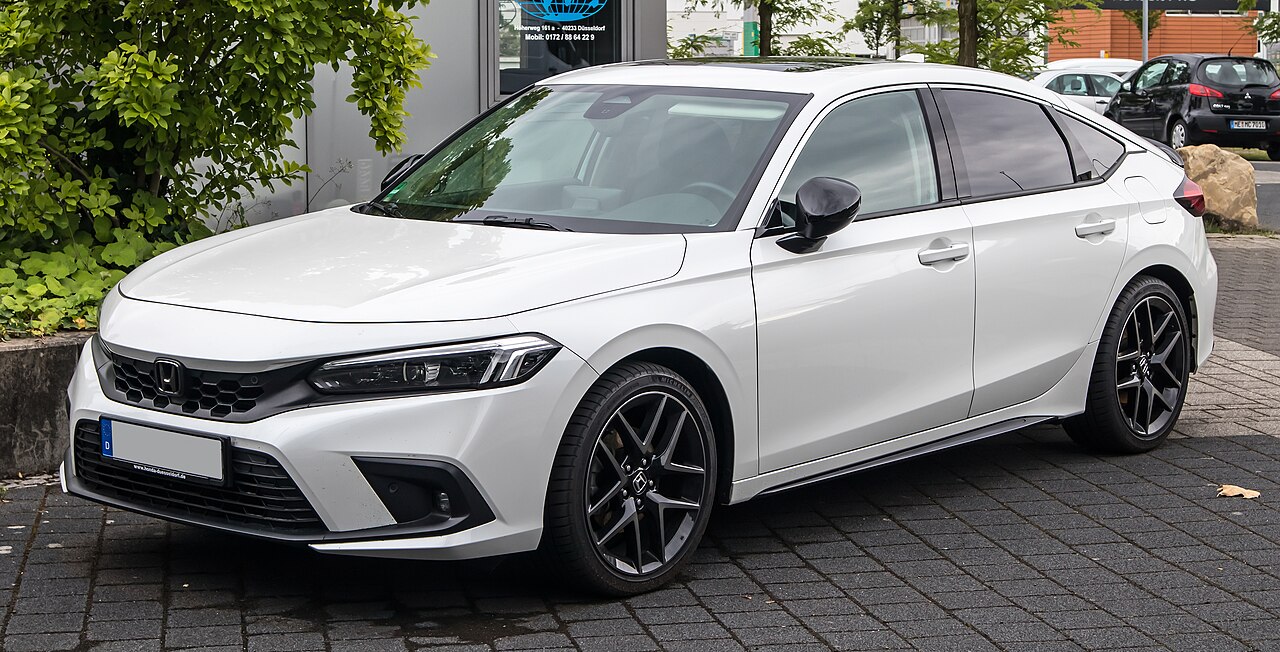
- The **Honda Civic (11th Gen FL/FE)** maximizes passenger packaging through its rigid Advanced Compatibility Engineering (ACE) structure, long 107.7-inch wheelbase, and responsive turbocharged powertrain with low-inertia boost dynamics.
- The **Mazda3 (4th Gen BP)** defies mass-market conventions by pursuing near-luxury refinement: rejecting continuously variable transmissions (CVTs) in favor of a responsive 6-speed torque-converter automatic, offering available i-Activ all-wheel drive, and utilizing sound-deadening insulation rivaling European executive cars.
This comprehensive technical comparison evaluates chassis architectures, transmission engineering, thermal efficiency, suspension design, real-world highway fuel economy, and 200,000-mile reliability.
Side-by-Side Japanese Compact Engineering Matrix
The matrix below compares verified engineering specifications across current production variants of the Honda Civic, Toyota Corolla, and Mazda3:
| Technical Parameter | Honda Civic EX/Touring (FE) | Toyota Corolla SE 2.0L (E210) | Mazda3 2.5 S (BP) |
|---|---|---|---|
| Platform Architecture | Honda Global Compact (ACE Body) | Toyota TNGA-C Global Architecture | Mazda Skyactiv-Vehicle Architecture |
| Engine Code | Honda L15BA / L15B7 1.5L Turbo | Toyota M20A-FKS Dynamic Force 2.0L | Mazda Skyactiv-G 2.5L (PY-VPS) |
| Aspiration / Boost | Single-Scroll Turbocharger (~16.5 psi) | Naturally Aspirated (Atmospheric) | Naturally Aspirated (Atmospheric) |
| Displacement (cc / cu in) | 1,498 cc (91.4 cu in) | 1,987 cc (121.3 cu in) | 2,488 cc (151.8 cu in) |
| Bore x Stroke (mm) | 73.0 mm x 89.5 mm (Undersquare) | 80.5 mm x 97.6 mm (Long-Stroke) | 89.0 mm x 100.0 mm (Long-Stroke) |
| Compression Ratio | 10.3:1 | 13.0:1 (Ultra-High Compression) | 13.0:1 (Ultra-High Compression) |
| Thermal Efficiency | ~38% Peak Efficiency | 40% Peak Thermal Efficiency | ~38% Peak Efficiency |
| Horsepower @ RPM | 180 hp @ 6,000 RPM | 169 hp @ 6,600 RPM | 191 hp @ 6,000 RPM |
| Torque @ RPM | 177 lb-ft @ 1,700–4,500 RPM | 151 lb-ft @ 4,400–4,800 RPM | 186 lb-ft @ 4,000 RPM |
| Fuel Delivery | Direct Fuel Injection (DI) | Dual D-4S (Direct + Port Injection) | Direct Fuel Injection (DI) |
| Transmission Type | Continuously Variable (LL-CVT) | Dynamic-Shift CVT (Physical 1st Gear) | Skyactiv-Drive 6-Speed Automatic |
| Front Suspension | MacPherson Strut with Aluminum Arms | MacPherson Strut with Stabilizer Bar | MacPherson Strut with Optimized Geometry |
| Rear Suspension | Independent Multi-Link | Independent Multi-Link with Trailing Arm | Torsion Beam with Internal Stiffener |
| Available Drivetrain | Front-Wheel Drive (FWD) | FWD (AWD available on Hybrid) | FWD or Predictive i-Activ AWD |
| Curb Weight (lbs / kg) | 3,000 lbs (1,361 kg) | 3,055 lbs (1,386 kg) | 3,100 lbs (1,406 kg) |
| EPA Fuel Economy (City/Hwy) | 31 City / 38 Hwy / 34 Comb | 31 City / 40 Hwy / 34 Comb | 28 City / 37 Hwy / 31 Comb |
| Interior Volume (Passenger) | 99.0 cu ft (Class-Leading) | 88.6 cu ft | 92.7 cu ft |
| Trunk Cargo Space | 14.8 cu ft | 13.1 cu ft | 13.2 cu ft |
Transmission Philosophy: Why Mazda Rejected the CVT
The single most significant mechanical differentiator among these three vehicles lies in how power is transferred to the drive wheels:
1. Honda: Stepped-Logic CVT (LL-CVT)
Honda equips the Civic with a high-efficiency belt-and-pulley Continuously Variable Transmission (CVT).
- To counter the unnatural "rubber-band" droning associated with early CVTs, Honda engineers programmed G-Design Shift Logic with artificial "stepped" gear steps during wide-open throttle acceleration.
- The transmission modulates fluid pressure electronically, holding the engine precisely at its 1,700–4,500 RPM peak torque plateau under moderate acceleration.
2. Toyota: Dynamic-Shift CVT with Physical Launch Gear
Recognizing that standard CVTs suffer from slow, sluggish mechanical efficiency from a dead stop, Toyota engineered an innovative hybrid gearbox:
- The Dynamic-Shift CVT incorporates an actual set of physical gear teeth (a mechanical 1st gear) dedicated solely to vehicle launch.
- From 0 to approximately 15–20 mph, the Corolla accelerates via genuine mechanical gear teeth, delivering snappy throttle response and eliminating belt slip under heavy load.
- Once up to speed, an electrohydraulic dog clutch seamlessly transitions power from the launch gear to the expanding belt pulleys, reducing belt angle forces and improving transmission efficiency by 6%.
3. Mazda: Skyactiv-Drive 6-Speed Torque Converter Automatic
Mazda famously refused to adopt CVTs across its passenger lineup, choosing instead to redesign the traditional multi-speed automatic from the ground up:
- The Skyactiv-Drive 6-speed features an oversized, multi-plate wet lockup clutch that remains mechanically locked 89% of the driving time.
- Unlike traditional automatics that slip fluid through the torque converter up to 30 mph, the Mazda locks its clutch almost immediately after roll-off, delivering direct, crisp throttle connection and sharp manual downshifts via steering wheel paddle shifters.
Engine Metallurgy & Thermal Efficiency: M20A vs. L15 vs. Skyactiv-G
Under the hood, each manufacturer achieves impressive power and low emissions through divergent mechanical strategies:
1. Toyota 2.0L M20A-FKS Dynamic Force: 40% Thermal Efficiency
Toyota's Dynamic Force engine is a masterclass in internal combustion thermodynamics. To learn how cylinder bore and stroke influence engine torque, read our guide on Engine Displacement Explained.
- Extreme Undersquare Stroke: With an 80.5 mm bore and a long 97.6 mm stroke, the elongated combustion chamber induces high tumble air velocity, causing the air-fuel mixture to swirl rapidly and burn completely in fewer milliseconds.
- D-4S Dual Fuel Injection: The engine utilizes both direct in-cylinder injectors (running at up to 200 bar) and traditional low-pressure port injectors. At low loads, port injection washes fuel detergents over the intake valves, completely preventing intake valve carbon accumulation—a notorious flaw in direct-injection engines.
- Laser-Clad Valve Seats: Instead of pressing in heavy iron valve seat inserts, Toyota laser-welds thin clad copper-alloy seats directly to the aluminum head. This allows wider intake valve openings and unrestricted heat dissipation into the cylinder head coolant jackets.
2. Honda 1.5L VTEC Turbo (L15): Downsized Forced Induction
Honda utilizes forced induction to deliver V6-like low-end torque from a featherweight 1.5-liter displacement:
- Low-Inertia Mono-Scroll Turbo: Featuring an electronic wastegate actuator and small-diameter turbine blades, the L15 generates boost pressure almost instantaneously, delivering 177 lb-ft of torque starting at just 1,700 RPM.
- Sodium-Filled Exhaust Valves: To survive the high thermal environment of prolonged 16.5 psi turbo boost, the exhaust valve stems are hollow and filled with metallic sodium, which liquefies at operating temperature and transfers heat rapidly away from the valve face to the cylinder guide.
3. Mazda 2.5L Skyactiv-G (PY-VPS): Big Displacement & 13.0:1 Compression
Mazda rejects small turbocharged engines for its standard sedan, relying instead on high atmospheric displacement:
- 13.0:1 Compression Ratio: Running an exceptionally high compression ratio on standard 87-octane pump gasoline requires precise knock mitigation. Mazda achieves this through an elaborate 4-2-1 exhaust manifold with tuned pipe lengths that prevent residual hot exhaust gas from back-flowing into adjacent cylinders during valve overlap.
- Cylinder Deactivation: Under steady highway cruising between 45 and 65 mph, hydraulic solenoids collapse the valve lifters on cylinders 1 and 4, turning the engine into a frugal two-cylinder without perceptible vibration.
Suspension Engineering: Multi-Link vs. Torsion Beam
Chassis composure over broken pavement reveals a fundamental design divergence:
- Honda Civic & Toyota Corolla (Independent Multi-Link Rear): Both the Civic and Corolla utilize independent multi-link rear suspension architectures mounted to rigid subframes. When one wheel hits a pothole or frost heave on a highway bend, the opposite wheel remains undisturbed, maintaining optimal tire contact patch geometry and preventing chassis skip.
- Mazda3 (Torsion Beam Rear Axle): When Mazda debuted the 4th-generation Mazda3, it replaced the multi-link setup with a rigid torsion beam rear axle. While a torsion beam is cheaper to manufacture and frees up trunk space, it causes minor lateral chassis shimmy over mid-corner pavement seams. However, Mazda mitigated this through custom ring-shaped internal stiffeners that make the car rotate eagerly into tight corners.
Interior Ergonomics & Noise, Vibration, Harshness (NVH)
The passenger environment demonstrates how distinct these vehicles feel on a 500-mile highway road trip:
- Honda Civic: Prioritizes volumetric passenger space with a class-leading 99.0 cubic feet of cabin volume. The thin A-pillars, door-mounted side mirrors, and low cowl line provide the best forward and peripheral visibility in the industry. The honeycomb metal mesh dashboard with tactile knurled dials exemplifies functional ergonomic brilliance.
- Toyota Corolla: Focuses on intuitive simplicity. The dashboard layout is straightforward with durable, wipe-clean plastics designed to withstand 20 years of commercial rideshare abuse. However, rear-seat legroom (34.8 in) is tight for taller adults compared to the Civic (37.4 in).
- Mazda3: Punches well into Audi and BMW territory for cabin luxury. Dual-wall floor structures, thicker acoustic floor mats, soft-touch leatherette dash stitching, and whisper-quiet window weatherstripping yield an interior sound level at 70 mph that measures just 67 dB—matching entry-level luxury sedans.
200,000-Mile Reliability & Cost-of-Ownership Audit
For budget-conscious buyers seeking longevity, verified mechanical reliability is paramount:
| Critical System | Honda Civic 1.5T | Toyota Corolla 2.0L | Mazda3 2.5L |
|---|---|---|---|
| Intake Valve Carbon Deposits | Direct-injection only; intake valves accumulate oil vapor carbon over 100k miles. | Dual D-4S (Port + Direct); intake valves remain permanently clean. | Direct-injection only; moderate carbon accumulation by 120k miles. |
| Transmission Longevity | Honda LL-CVT requires fluid changes strictly every 30k–40k miles to avoid belt slip. | Physical 1st gear reduces belt stress; fluid flush recommended at 60k miles. | Skyactiv 6-speed is exceptionally durable; fluid service at 60k–75k miles. |
| Oil Dilution Concerns | Early L15 engines in extreme winter short trips had minor fuel dilution; modern ECU fixes resolved it. | Naturally aspirated M20A has zero oil dilution issues across all climates. | Naturally aspirated Skyactiv-G has zero fuel dilution issues. |
| Rust Prevention & Bodywork | Excellent cathodic electro-dip primer; robust underbody plastic splash shields. | Outstanding galvanized zinc-coated steel; minimal rust reports nationwide. | Significant improvement over older Mazdas; modern E-coat process prevents panel rot. |
| Resale Value Retention | Benchmark resale value (holds ~68% value after 36 months). | Benchmark resale value (holds ~66% value after 36 months). | Slightly steeper depreciation curve (holds ~58% value after 36 months). |
CDI Verdict: Which Japanese Compact Sedan Is Right for You?
- **Buy the Honda Civic** if you want the most spacious family cabin, class-leading forward visibility, responsive low-end turbo acceleration, and the highest long-term resale value.
- **Buy the Toyota Corolla** if your absolute top priority is bulletproof 250,000-mile mechanical durability, low maintenance costs, and permanent immunity from intake valve carbon buildup via dual D-4S injection.
- **Buy the Mazda3** if you crave a genuine sports-sedan feel with a real 6-speed automatic transmission, available all-wheel drive for winter snow commuting, and an interior that feels like an entry-level European luxury car.
Frequently asked questions
Why does the Mazda3 feel faster and more responsive than the Civic and Corolla despite having similar horsepower?
The Mazda3 utilizes a traditional Skyactiv-Drive 6-speed torque-converter automatic transmission with a multi-plate clutch that remains locked 89% of the time, delivering direct mechanical throttle response. In contrast, the Honda Civic and Toyota Corolla utilize CVTs (Continuously Variable Transmissions) that modulate belt pulleys, which can feel somewhat detached during rapid acceleration.
Does the Toyota Corolla have carbon buildup on its intake valves?
No. The Toyota Corolla 2.0L Dynamic Force engine (M20A-FKS) utilizes Toyota's dual D-4S fuel injection system, which combines direct in-cylinder injectors with traditional port injectors. The port injectors spray fuel over the intake valves, permanently washing away oil blow-by and preventing the carbon accumulation that plagues direct-injection-only competitors.
Which Japanese compact sedan has the most rear legroom and cargo space?
The Honda Civic offers the largest cabin in its class with 99.0 cubic feet of passenger volume, 37.4 inches of rear legroom, and a class-leading 14.8 cubic feet of trunk capacity. The Toyota Corolla provides 13.1 cu ft of trunk space and 34.8 inches of legroom, while the Mazda3 offers 13.2 cu ft of trunk space and 35.1 inches of legroom.
Is the Mazda3 available with all-wheel drive (AWD)?
Yes. The Mazda3 offers predictive i-Activ all-wheel drive on both naturally aspirated and turbocharged models, making it one of the few compact sedans capable of handling severe winter snow conditions. The standard Honda Civic and non-hybrid Toyota Corolla are front-wheel-drive only.
How long do Honda Civic, Toyota Corolla, and Mazda3 engines last?
With routine 5,000-to-7,500-mile synthetic oil changes, all three Japanese sedans routinely exceed 200,000 to 250,000 miles without major powertrain overhauls. The Toyota Corolla 2.0L naturally aspirated engine is generally considered the most durable due to its mechanical simplicity and port injection cleaning.
Cite this page: https://cardataindex.com/blog/compact-japanese-sedans-civic-vs-corolla-vs-mazda3
Keep researching
Cross-check the numbers in this guide against live factory data in our specification index or decode a specific car with the free VIN decoder.