Best Compact Family SUVs Compared: Toyota RAV4 vs. Honda CR-V vs. Hyundai Tucson
Direct three-way compact SUV showdown: Toyota RAV4 vs Honda CR-V vs Hyundai Tucson. Compare hybrid MPG, cargo space, AWD systems, and crash safety ratings.
Car Data Index Editorial Desk
Automotive data desk · Sources: NHTSA · EPA · OEM records
Executive Summary: The Global Compact Crossover Benchmark
The compact crossover segment represents the competitive epicenter of the global automotive market, accounting for more than one out of every four passenger vehicles sold in North America. For suburban families, daily commuters, and multi-vehicle households, three historic nameplates consistently dominate the shopping shortlist: the Toyota RAV4, the Honda CR-V, and the Hyundai Tucson.
While all three nameplates deliver standard advanced driver-assistance suites (ADAS), versatile 5-passenger seating, and elevated command seating positions, their underlying engineering philosophies could not be more distinct:
- The Toyota RAV4 (XA50) relies on naturally aspirated mechanical simplicity, paired with Toyota's bulletproof planetary power-split hybrid architecture.
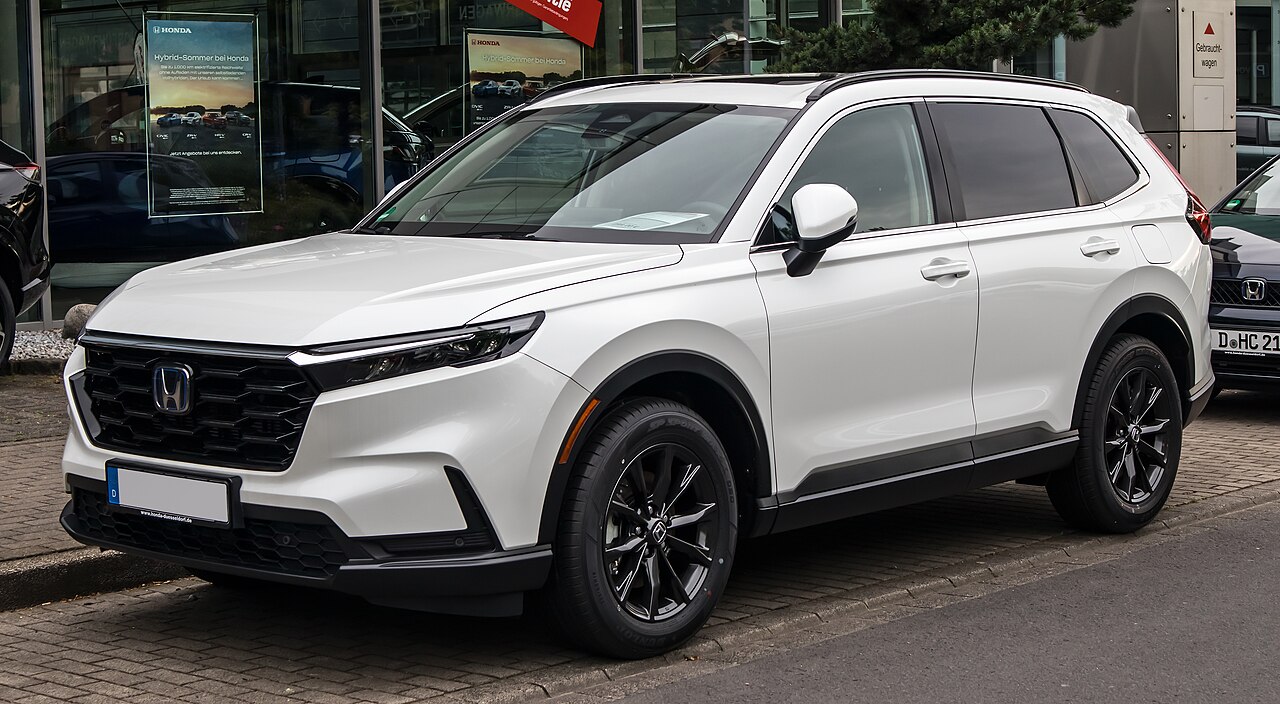
- The Honda CR-V (RS/6th Gen) emphasizes class-leading passenger packaging, acoustic isolation, and an innovative two-motor direct-drive clutch hybrid powertrain.
- The Hyundai Tucson (NX4) delivers avant-garde parametric design, standard turbocharged power, a conventional stepped 6-speed automatic hybrid, and an unmatched 10-year factory warranty.
This technical engineering audit directly compares the mechanical platforms, powertrain architectures, real-world EPA fuel economy, interior packaging dimensions, and 5-year ownership costs across all three crossover champions.
Side-by-Side Specification Matrix: Dimensions, Power & Towing
The comparative engineering matrix below analyzes verified factory specifications across current production generations of the Toyota RAV4, Honda CR-V, and Hyundai Tucson:
| Vehicle Model | Platform & Chassis | Dimensions L x W x H (mm) | Wheelbase (mm) | Cargo (Behind Row 2 / Max) | Base Powertrain (Combustion) | Hybrid Powertrain Output | EPA Combined (Gas / Hybrid) | Max Towing (lbs) |
|---|---|---|---|---|---|---|---|---|
| Toyota RAV4 (XA50) | TNGA-K Modular Architecture | 4,595 x 1,855 x 1,700 | 2,690 mm | 37.6 cu ft / 69.8 cu ft | 2.5L I4 (203 hp / 184 lb-ft) | 2.5L Dynamic Force Hybrid (219 hp) | 30 MPG / 40 MPG | 1,500–3,500 lbs |
| Honda CR-V (RS) | Honda Global Small Platform | 4,705 x 1,865 x 1,680 | 2,700 mm | 39.3 cu ft / 76.5 cu ft | 1.5L Turbo I4 (190 hp / 179 lb-ft) | 2.0L Two-Motor Hybrid (204 hp) | 30 MPG / 40 MPG | 1,500 lbs |
| Hyundai Tucson (NX4) | Hyundai-Kia N3 Architecture | 4,630 x 1,865 x 1,665 | 2,755 mm | 38.7 cu ft / 74.8 cu ft | 2.5L I4 (187 hp / 178 lb-ft) | 1.6L Turbo Hybrid (226 hp) / PHEV (261 hp) | 28 MPG / 38 MPG | 2,000 lbs |
1. Toyota RAV4 (XA50): Naturally Aspirated Simplicity & e-CVT Durability
Manufactured across Georgetown, Kentucky and Toyota's Tahara and Shokki plants in Japan, the fifth-generation Toyota RAV4 (chassis code XA50) is built on the rigid Toyota New Global Architecture (TNGA-K). By utilizing ring-shaped frame structures and extensive structural adhesive bonding, the XA50 chassis achieves a 57% increase in torsional rigidity over its predecessor.
Under the hood, the base combustion model employs the naturally aspirated 2.5-liter Dynamic Force (A25A-FKS) four-cylinder engine. Featuring Toyota's D-4S dual-injection system (combining high-pressure direct cylinder injection with low-pressure port injection), it achieves a remarkable 40% thermal combustion efficiency, delivering 203 horsepower at 6,600 RPM and 184 lb-ft of torque at 5,000 RPM mated to a Direct-Shift 8-speed automatic transmission.
The high-volume RAV4 Hybrid pairs the Atkinson-cycle version of this engine (A25A-FXS, 41% thermal efficiency) with dual electric motor-generators and a sealed lithium-ion traction battery, yielding 219 combined system horsepower. All hybrid variants feature standard Electronic On-Demand All-Wheel Drive (AWD-e), utilizing a dedicated 54-hp rear electric motor that engages instantly on slippery pavement without requiring a heavy, fuel-sapping mechanical driveshaft.
2. Honda CR-V (RS): Benchmark Interior Packaging & Direct-Drive Hybrid Dynamics
The sixth-generation Honda CR-V represents the benchmark for family ergonomic packaging. Stretching 4,705 mm in overall length with a 2,700 mm wheelbase, the CR-V delivers a class-leading 39.3 cubic feet of rear cargo space behind the second row, expanding to an cavernous 76.5 cubic feet with rear seatbacks folded flat.
Honda equips the CR-V with two distinct mechanical powertrains:
- 1.5-liter VTEC Turbo (L15B7): A direct-injected four-cylinder equipped with an ultra-responsive single-scroll turbocharger and electronic wastegate, generating 190 horsepower at 6,000 RPM and 179 lb-ft of torque across a broad 1,700 to 5,000 RPM plateau. It is paired with a continuously variable transmission (CVT) featuring stepped-ratio programming that mimics conventional gear changes under hard acceleration.
- 2.0-liter Two-Motor Hybrid System: Operating on the Atkinson combustion cycle, this powertrain combines a 2.0-liter direct-injected four-cylinder with two side-by-side electric motors. Rather than using a conventional gearbox, Honda utilizes an electronic lock-up clutch that connects the combustion engine directly to the front drive wheels solely at high-speed highway cruising speeds (where combustion engines operate at peak thermal efficiency). In city driving, the engine acts purely as an on-board electrical generator powering the traction motor. Combined system output stands at 204 horsepower and 247 lb-ft of instant electric torque.
3. Hyundai Tucson (NX4): Parametric Architecture, Turbocharged Output & 10-Year Warranty
Riding on the long-wheelbase variant of the Hyundai-Kia N3 Architecture, the fourth-generation Hyundai Tucson (chassis code NX4) showcases dramatic geometric styling, characterized by parametric jewel daytime running lights integrated seamlessly into the front grille.
Mechanically, the Tucson offers the widest variety of electrified powertrains in the segment:
- Smartstream G2.5 GDI: A naturally aspirated 2.5-liter four-cylinder delivering 187 hp and 178 lb-ft of torque paired with an 8-speed hydraulic automatic transmission.
- Smartstream 1.6L Turbo Hybrid (HEV): Pairs a 1.6-liter turbocharged T-GDI engine with a 44.2 kW electric motor and a 1.49 kWh lithium-ion battery, developing 226 horsepower and 258 lb-ft of torque. Unlike its Japanese rivals, Hyundai mates this hybrid system to a conventional 6-speed torque-converter automatic transmission, providing drivers with the familiar stepped gear shifts of a traditional automobile.
- Smartstream 1.6L Turbo Plug-in Hybrid (PHEV): Upgrades to a 66.9 kW electric motor and a 13.8 kWh battery pack, generating 261 horsepower, 258 lb-ft of torque, and an EPA-certified 33 miles of pure electric driving range.
All Tucson all-wheel-drive variants utilize Hyundai's mechanical HTRAC AWD system, which features an electronic variable-torque-split clutch pack capable of actively shunting power between front and rear axles based on selected drive modes (Comfort, Smart, Sport, Snow).
Hybrid Transmission Engineering: Planetary e-CVT vs Direct-Drive vs Stepped Automatic
The mechanical divergence between these three crossovers is most pronounced in their transmission architectures. To understand how gearboxes handle torque transfer under continuous load, review our comprehensive guide on Transmission Types Compared.
- Toyota's Planetary e-CVT: Uses an epicyclic planetary gearset where the combustion engine connects to the planet carrier, motor-generator 1 (MG1) to the sun gear, and motor-generator 2 (MG2) to the ring gear. There are zero drive belts, zero pulleys, and zero friction clutches. Gear ratios are modulated purely through electromagnetic resistance. Because gear teeth are in permanent mesh, this transaxle routinely exceeds 300,000 miles with basic fluid flushes.
- Honda's Two-Motor Direct-Drive: Completely eliminates a transmission in city driving. The vehicle operates as a serial hybrid where electric motor 2 drives the wheels and motor 1 generates electricity. At steady highway cruising (typically between 55 and 75 mph), a hydraulic wet clutch locks the combustion engine directly to the final drive differential at a tall, fuel-efficient 0.805 ratio.
- Hyundai's Integrated 6-Speed Automatic: Positions a disc-shaped permanent magnet traction motor directly between the combustion engine's flywheel and a conventional 6-speed planetary gearbox. While this introduces hydraulic valve bodies, solenoids, and clutch friction plates, it delivers the most natural passing acceleration for drivers who dislike the sustained high-RPM drone of CVT architectures.
Interior Packaging, Cargo Capacity & Real-World Family Usability
When evaluating utility for suburban family duties, such as hauling bulky strollers, sports gear, and flat-pack furniture, physical packaging dictates day-to-day satisfaction:
- Honda CR-V: Leads the segment in outright spatial efficiency. The rear door apertures open to a near-90-degree angle, making child safety seat installation effortless. The load floor behind the second row sits at a low 27.8-inch lift-over height, and the cargo opening measures a generous 44.2 inches across.
- Hyundai Tucson: Capitalizes on its lengthy 2,755 mm wheelbase to provide the most spacious second-row passenger legroom in the segment at 41.3 inches (surpassing the CR-V's 41.0 inches and the RAV4's 37.8 inches). Rear passengers also benefit from reclining seatbacks with eight distinct detent positions.
- Toyota RAV4: While slightly more compact in rear legroom (37.8 inches), the RAV4 offers a reversible cargo floor panel (carpeted on one side, rugged hard plastic on the other) ideal for muddy pets, camping equipment, or snowy winter gear.
Total Cost of Ownership: 5-Year Maintenance, Depreciation & Factory Warranty Audit
A complete vehicle valuation requires looking beyond the window sticker to audit maintenance schedules, historical depreciation, and manufacturer warranty backing:
- Brake Wear: All three hybrid variants utilize regenerative braking, where kinetic deceleration is captured by the electric motors to recharge the traction battery. As a result, mechanical brake pads and cast-iron rotors routinely last 80,000 to 100,000 miles before requiring replacement, cutting routine brake maintenance costs by more than 50%.
- Warranty Protection:
- Hyundai Tucson: Dominates the competition with a 10-Year / 100,000-Mile Powertrain Limited Warranty and a 5-Year / 60,000-Mile basic warranty. However, buyers should note that when sold to a private second owner, the powertrain coverage drops to 5 years / 60,000 miles unless certified through an authorized Hyundai CPO dealer.
- Toyota RAV4: Backs hybrid powertrain components with an 8-Year / 100,000-Mile Hybrid System Warranty and a 10-Year / 150,000-Mile Hybrid Battery Warranty. Crucially, this coverage is 100% transferable to subsequent owners with zero paperwork or administrative fees.
- Honda CR-V: Provides an 8-Year / 100,000-Mile High-Voltage Battery Warranty, which also transfers seamlessly to subsequent retail owners.
Before purchasing any pre-owned compact crossover, always verify open safety recalls, factory engine codes, and original manufacturing assembly plant data using our free 17-Digit VIN Number Decoder.
Purchasing Verdict: Which Compact Crossover Fits Your Family?
- Choose the Toyota RAV4: If your highest priorities are time-tested mechanical durability, an ultra-reliable planetary e-CVT hybrid system, standard electronic all-wheel drive, and the highest historical five-year resale value retention in the crossover segment.
- Choose the Honda CR-V: If you require maximum rear cargo space, best-in-class second-row child seat ease-of-installation, whisper-quiet highway acoustic isolation, and sports-car-like steering precision.
- Choose the Hyundai Tucson: If you want cutting-edge digital infotainment tech, the most generous rear passenger legroom in the compact class, the responsive shifting feel of a traditional 6-speed automatic hybrid, and the peace of mind provided by a 10-year factory warranty.
Frequently asked questions
Which compact SUV has the most cargo space: RAV4, CR-V, or Tucson?
The Honda CR-V delivers the largest rear cargo volume at 39.3 cubic feet with seats upright, expanding to 76.5 cubic feet when the rear seats are folded. The Hyundai Tucson is a close second at 38.7 / 74.8 cu ft, while the Toyota RAV4 offers 37.6 / 69.8 cu ft.
Which hybrid system is the most reliable long term?
The Toyota RAV4 Hybrid's e-CVT planetary power-split system has the longest proven reliability record, with no drive belts or friction clutches to wear out. The Honda CR-V's two-motor direct-drive clutch system and Hyundai's 6-speed stepped automatic hybrid are also exceptionally reliable.
How do all-wheel-drive systems differ between RAV4, CR-V, and Tucson?
The RAV4 Hybrid uses an Electronic On-Demand AWD system with a standalone 54-hp rear electric motor. The Tucson Hybrid uses a traditional mechanical propshaft with an electro-hydraulic center clutch (HTRAC), while the CR-V uses Honda's Real Time AWD with an intelligent multi-plate clutch pack.
Are maintenance costs higher on hybrid models than gasoline models?
No. In fact, hybrid models typically cost less to maintain over 100,000 miles because regenerative braking absorbs deceleration energy, allowing factory brake pads and rotors to last up to 80,000 to 100,000 miles.
What is the towing capacity of the RAV4, CR-V, and Tucson?
Standard trims of all three models tow between 1,500 and 1,750 lbs. However, specialized rugged trims like the RAV4 Adventure/TRD tow up to 3,500 lbs, and the Hyundai Tucson tows up to 2,000 lbs.
Cite this page: https://cardataindex.com/blog/best-compact-family-suvs-compared-rav4-cr-v-tucson
Keep researching
Cross-check the numbers in this guide against live factory data in our specification index or decode a specific car with the free VIN decoder.