Tesla Model 3 & Model Y Front Upper Control Arm Failure: Squeak, Ball Joint Seal & TSB Guide
Definitive Tesla Model 3 & Model Y front suspension guide: upper control arm (FUCA) ball joint creak, water intrusion, TSB SB-20-31-006, and upgraded polyurethane fixes.
Car Data Index Editorial
Automotive data desk · Sources: NHTSA · EPA · OEM records
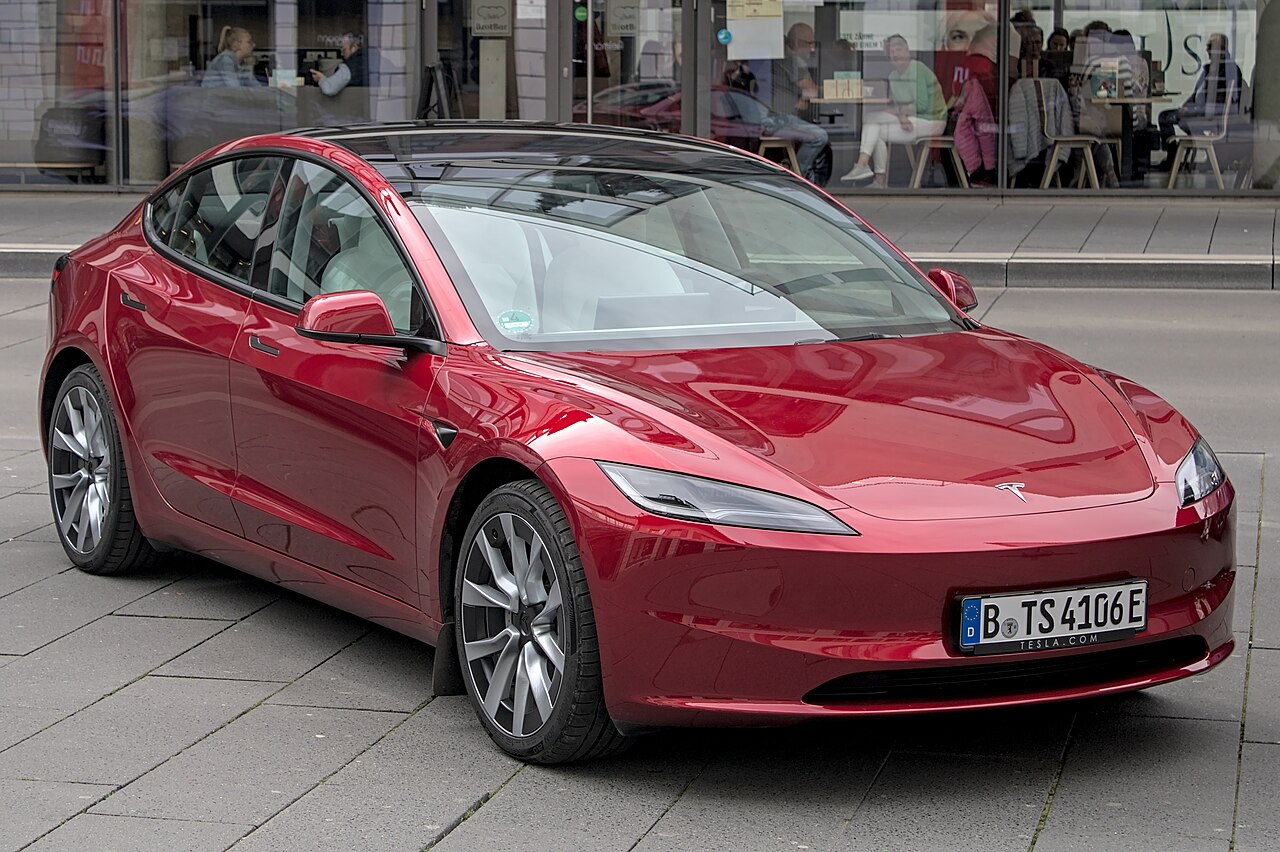
Celebrated as modern benchmarks of automotive software, electric range, and silent electric propulsion, the **Tesla Model 3 and Tesla Model Y** have dominated global EV sales charts. Engineered around a rigid skateboard battery chassis and lightweight double-wishbone virtual-steer front suspension, both vehicles deliver sports-sedan handling and instantaneous torque.
However, beneath this futuristic veneer lies the most notorious and pervasive mechanical defect in the Tesla ownership experience: the Front Upper Control Arm (FUCA) Ball Joint Creak.
Affecting hundreds of thousands of Model 3 (2017–2021) and Model Y (2020–2021) crossovers across North America and Europe, this defect causes the front suspension to emit an embarrassing, agonizingly loud creaking and groaning noise, often compared by owners to a rusted box spring mattress or a 17th-century wooden pirate ship, audible whenever the steering wheel is turned or the car rolls over minor pavement imperfections.
This comprehensive technical guide deconstructs the composite materials and fluid dynamics behind the ball joint seal failure, examines Tesla Service Bulletin SB-20-31-006, exposes the risks of temporary DIY grease injection hacks, and evaluates permanent factory and aftermarket forged aluminum hardware upgrades.
1. Mechanical Anatomy: Stamped Steel & The Water-Trapping Recess
To understand why a state-of-the-art electric car develops a suspension squeak worthy of an antique carriage, one must examine the construction of the factory front upper control arm:
Unlike traditional performance sedans that utilize solid forged aluminum or cast iron suspension wishbones, Tesla engineered a hybrid composite design for the early Model 3 and Model Y:
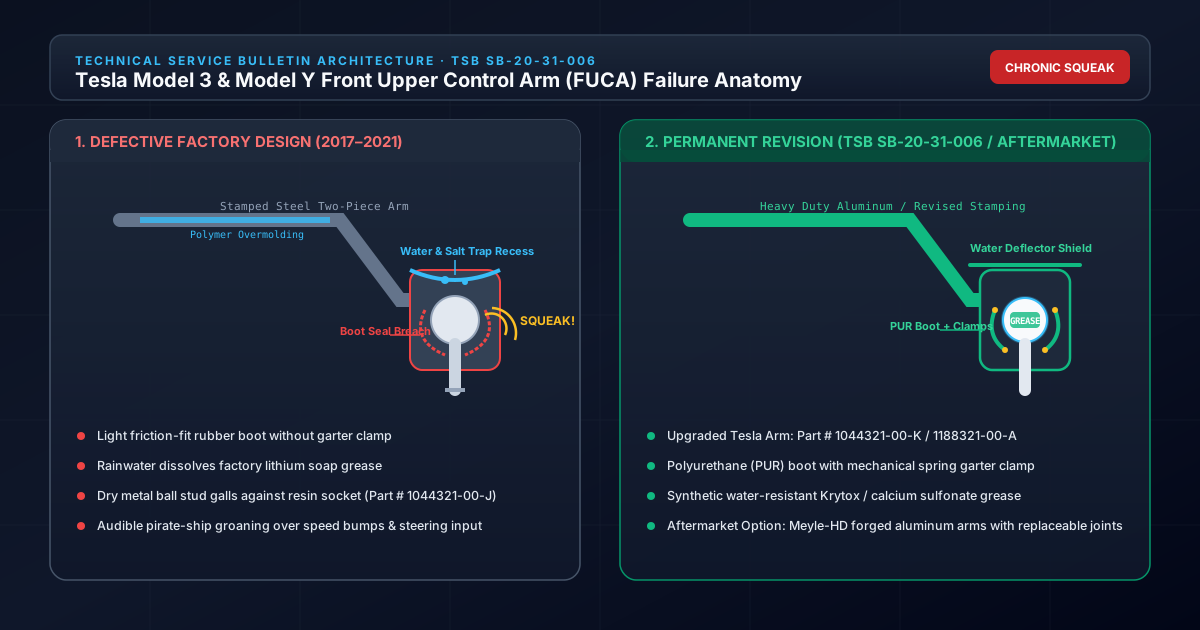
Factory Control Arm Architecture (Part # 1044321-00-J & 1044326-00-J):
* Body Structure: Two thin stamped steel halves bonded together, encapsulated in an injection-molded structural plastic (polymer) overmolding to reduce weight and production tooling costs.
* Integrated Ball Joint: The outer ball joint housing is permanently swaged directly into the stamped steel arm. The ball joint is non-serviceable; worn joints require replacing the entire control arm assembly.
* The Internal Contact Interface: A polished carbon-steel ball stud pivots within a low-friction synthetic polyoxymethylene (POM) resin bearing cup, lubricated from the factory with a modest charge of white lithium soap grease.
* The Flawed Boot Sealing Lip: An elastomeric rubber dust boot covers the joint. Crucially, the upper sealing lip was designed as a simple slip-on friction fit against the ball joint housing neck, lacking any mechanical garter spring, retaining ring, or vulcanized chemical bond.
2. The Water Ingress Pathology: Why the Grease Washes Out
The root cause of the failure is not premature mechanical load wear, but environmental water contamination:
Failure Progression: From Rain Puddle to Audible Squeak
* Phase 1: Water Accumulation. The geometric orientation of the wishbone creates an upward-facing depression above the ball joint. Rainwater, car wash soap, and winter road slush pool continuously in this shallow metal pocket.
* Phase 2: Capillary Seal Infiltration. As the steering wheel turns from lock to lock, the rubber boot twists and flexes. Without a mechanical garter clamp, the unbonded boot lip pulls away from the metal neck, allowing dirty water to seep past via capillary action.
* Phase 3: Grease Emulsification & Washout. The trapped water mixes with the factory lithium grease. Over several thousand miles of vibration, the grease emulsifies into a milky, watery fluid and drains out through the lower boot opening.
* Phase 4: Metal-on-Plastic Galling. With zero lubricating film remaining, the mirror-polished steel ball stud rubs directly against the composite resin bearing cup.
* Phase 5: The Severe Acoustic Creak. High friction generates severe stick-slip oscillations. Every minute rotation of the steering knuckle or 5 mm bump stroke causes the dry ball stud to shudder violently, radiating a high-frequency, metallic-plastic creak through the aluminum front shock tower directly into the passenger cabin.
3. Tesla Service Bulletins: SB-20-31-006 & SB-21-31-002
In response to thousands of customer warranty claims and widespread social media demonstrations, Tesla Engineering released multiple Technical Service Bulletins:
1. The Early Diagnostic Bulletin (TSB SB-20-31-006)
Released in late 2020 for Model 3 and Model Y vehicles, this bulletin directed service technicians to:
- 1.Replicate the squeaking noise by jouncing the front corner or turning the steering wheel while listening with a mechanic's stethoscope on the upper ball joint.
- 2.Verify that the creak originates from the ball joint and not the lower lateral link or stabilizer bar end-links.
- 3.Replace both left and right front upper control arms under warranty if the vehicle was within the 4-year / 50,000-mile Basic Vehicle Limited Warranty.
2. The Production Redesign (TSB SB-21-31-002 & Revision K/A Arms)
Tesla phased in an updated control arm assembly (Part # 1044321-00-K, 1044326-00-K, and later 1188321-00-A):
- Polyurethane (PUR) Boot: Replaced the original rubber with durable, tear-resistant polyurethane.
- Ultrasonic Sealing Ring: Added a mechanical spring retention ring around the upper boot neck to physically prevent water ingress.
- High-Tack Calcium Sulfonate Grease: Replaced the easily washed-out lithium grease with heavy water-resistant synthetic grease designed for severe marine duty.
4. The Temporary Needle-Grease Hack vs. Reality
On internet forums and YouTube, the most widespread DIY fix involves using a hypodermic grease gun needle to puncture the rubber boot and inject wheel bearing grease:
| Aspect | Needle Grease Injection Hack | Complete Component Replacement |
|---|---|---|
| Upfront Cost | $15 – $25 (Grease tube + needle gun) | $280 – $320 (Aftermarket) / $850 (Tesla) |
| Labor Time | 20 minutes (Wheel removal required) | 90 minutes (3 bolts per side) |
| Symptom Relief | Immediate silence within 5 miles | Permanent silence |
| Long-Term Durability | Temporary (3 to 6 months) | Permanent (80,000+ miles) |
| Mechanical Risk | Puncturing the boot creates a permanent hole that admits road grit and moisture; accelerates ball stud scoring. | Restores factory mechanical geometry and safety integrity. |
Engineering Verdict: While injecting grease is an effective diagnostic tool to confirm that the upper ball joint is indeed the source of the noise, relying on it as a permanent repair is counterproductive. Once road grit enters the punctured boot, the abrasive paste grinds away the bearing cup, eventually requiring full control arm replacement.
5. Inspection & DIY Diagnostic Procedure
Owners experiencing front-end groaning can verify the diagnosis with a straightforward three-step test:
- 1.The Bounce Test: Place the vehicle in Park on level ground. Stand next to the front driver-side fender and push down rhythmically on the fender above the wheel with two hands. If you hear a loud, creaky bed-spring sound from the wheel arch, the upper ball joint has failed.
- 2.The Stethoscope / Touch Test: Have an assistant turn the steering wheel slowly back and forth while you reach behind the front tire (do not place hands near moving steering links). Place your fingertips lightly onto the plastic top of the upper control arm ball joint. You will physically feel the dry "chatter" and stick-slip vibration synchronized with each creak.
- 3.Visual Inspection: Look at the base of the ball joint boot. If you see brownish-orange rust staining, crusty dried soap residue, or a dislodged boot lip, moisture ingress has occurred.
6. Real-World Repair Cost Breakdown & Upgrade Options
| Repair Path | Hardware / Parts Cost | Labor Cost | Total Estimated Cost | Longevity & Warranty |
|---|---|---|---|---|
| Tesla Factory Warranty (TSB SB-20-31-006) | $0 (Covered under 4yr/50k mi) | $0 (Tesla Service) | $0 (100% Free) | Genuine Revision K/A arms with 1-year parts warranty. |
| Tesla Service Out-of-Warranty | $320 – $420 (Pair of OEM arms) | $450 – $650 (Labor + Alignment) | $770 – $1,070 | Dealership service; includes digital 4-wheel alignment. |
| Independent EV Specialist | $280 – $360 (Aftermarket OEM-spec) | $250 – $380 (1.5 hrs labor) | $530 – $740 | Professional install at local independent electric vehicle garage. |
| DIY Upgrade: Meyle-HD Forged Arms | $260 – $320 (Pair of Meyle-HD) | $0 (Self-Install) | $260 – $320 | Best Long-Term Fix: Solid forged aluminum with replaceable, grease-sealed joints. |
| DIY Performance: Billet Adjustable Arms | $550 – $800 (MPP / Unplugged) | $0 (Self-Install) | $550 – $800 | CNC billet aluminum with spherical bearings; allows camber adjustment. |
7. Affected Tesla Models & Platform Specifications
Cross-reference your vehicle's factory specifications, manufacturing year, and chassis platform:
- **Tesla Model 3** (Standard Range Plus, Long Range AWD & Performance: 2017–2021): Front Virtual-Steer Double Wishbone architecture
- **Tesla Model Y** (Long Range AWD & Performance: 2020–2021): Shares front subframe and upper control arm assembly with Model 3
- **Tesla Model S**: Air suspension platform utilizing dedicated forged aluminum front wishbones
Frequently asked questions
Why does my Tesla Model 3 or Model Y creak loudly when turning or going over bumps?
The loud squeaking or creaking, often described as sounding like a rusted bed frame or an old pirate ship, is caused by dry friction inside the front upper control arm ball joint. Water and road salt penetrate the factory rubber boot seal, washing away the internal lubricating grease. As you steer or compress the suspension, the unlubricated steel ball stud rubs directly against the resin bearing cup.
Is it dangerous to drive with a squeaking Tesla upper control arm?
In the initial stages, the squeak is primarily an acoustic annoyance without immediate danger of catastrophic separation. However, if driven for thousands of miles without grease, the steel ball stud and resin socket will develop severe mechanical play (axial lash), degrading wheel alignment, causing uneven tire feathering, and eventually creating an MOT/safety inspection failure.
What does Tesla Technical Service Bulletin TSB SB-20-31-006 cover?
TSB SB-20-31-006 (and subsequent bulletin SB-21-31-002) outlines the inspection and replacement procedure for affected Front Upper Control Arms on 2017–2021 Model 3 and Model Y vehicles. If the vehicle is under the 4-year/50,000-mile Basic Vehicle Limited Warranty, Tesla service replaces both upper control arms with redesigned revised units (Part # 1044321-00-K) free of charge.
Can I fix the squeak by injecting grease with a needle or spraying WD-40?
Injecting heavy-duty synthetic chassis grease using a hypodermic needle through the rubber boot is a popular temporary DIY band-aid that silences the squeak for 3 to 6 months. However, puncturing the boot creates a permanent entry hole for road salt, accelerating long-term ball stud corrosion. Penetrating sprays like standard WD-40 should never be used, as petroleum solvents dissolve remaining grease and degrade the rubber boot.
How much does it cost to replace Tesla upper control arms out of warranty?
Out-of-warranty replacement at a Tesla Service Center typically costs between $750 and $1,100 for both front upper control arms and a 4-wheel alignment. Independent EV repair shops generally charge $500 to $700. DIY owners can purchase upgraded aftermarket forged aluminum control arms (such as Meyle-HD) for $260 to $320 for the pair and install them in approximately 2 hours.
Cite this page: https://cardataindex.com/blog/tesla-model-3-model-y-front-upper-control-arm-squeak-repair-guide
Keep researching
Cross-check the numbers in this guide against live factory data in our specification index or decode a specific car with the free VIN decoder.